


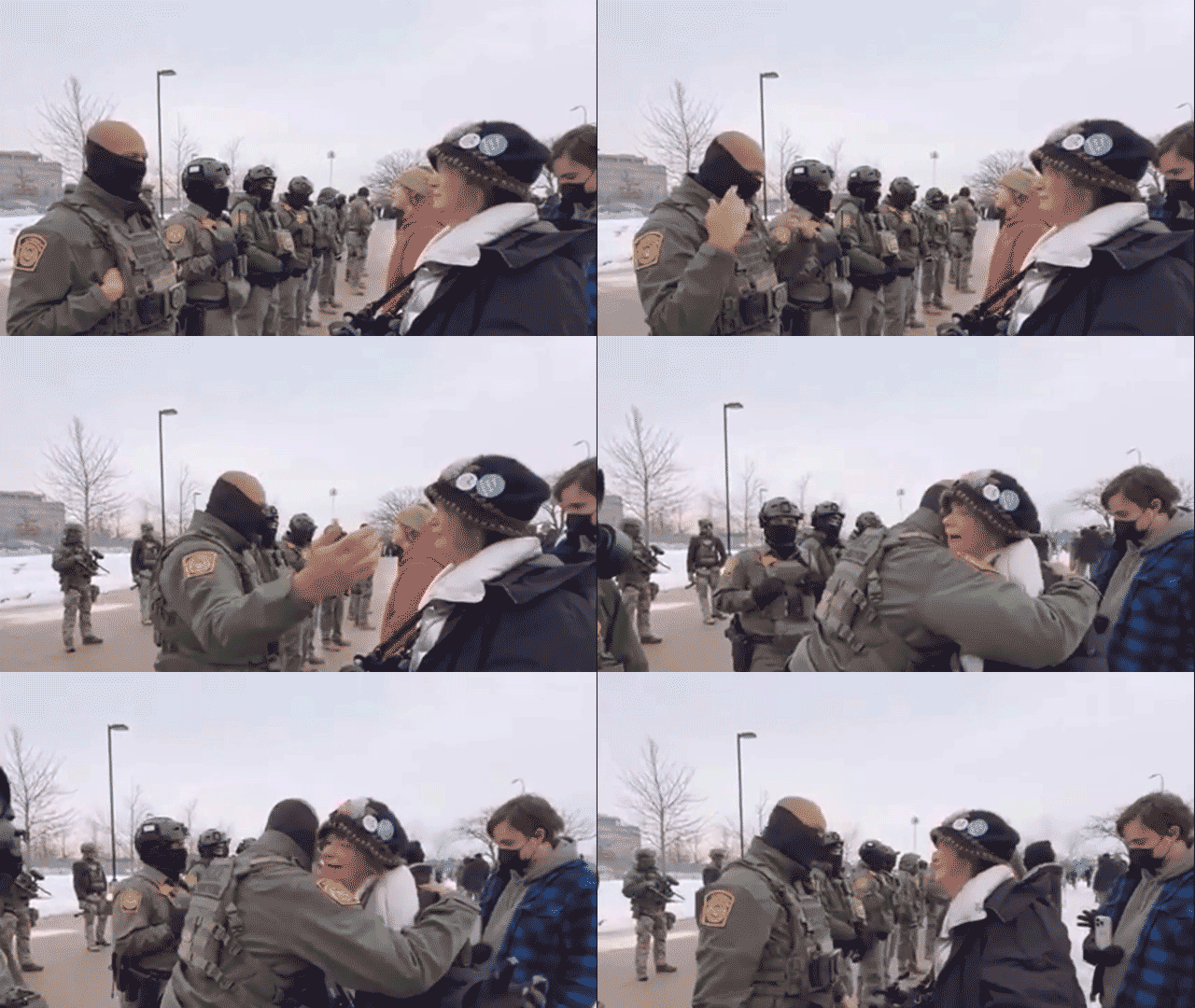
In Minnesota, a Border Patrol agent stepped out of a security line to hug a woman who had been shouting into a bullhorn at him. One day earlier, a different federal agent working an immigration operation in the state had fired a shot that left a mother of three dead.
Where The Hug Happened And Why
According to video and reporting published by Fox News, the embrace took place during a protest near a Border Patrol formation in Minnesota. Demonstrators had gathered as federal immigration authorities continued operations that followed the fatal shooting of 37-year-old Renee Nicole Good, a mother of three, during an Immigration and Customs Enforcement operation in the state.
Fox News reported that an ICE agent shot and killed Good the previous day after she allegedly attempted to drive into him during an immigration operation. The Department of Homeland Security, which oversees both ICE and Border Patrol, told the outlet that the shooting was an act of “self-defense,” while several Democratic officials publicly described the killing as “murder.”
Those two characterizations self defense and murder frame the legal uncertainty that still surrounds the death. At the same time, the Border Patrol video has circulated as a rare image of an on-duty federal agent and an opponent of immigration enforcement searching for common ground in the middle of a tense scene.
Two Federal Stories In One Week
The Fox News account describes Good as a 37-year-old mother of three who was shot and killed by an ICE agent during an attempt to take her into custody. According to that reporting, DHS officials said Good had allegedly tried to drive her vehicle into the agent, who then fired, killing her.
The same report states that DHS officials characterized the agent’s actions as “self-defense.” It also notes that some Democratic politicians labeled the shooting a “murder” and urged accountability for the agent involved. That language points to a divide between federal officials, who initially defended the shooting, and critics who argue that prosecutors should examine whether the use of deadly force was criminal.
Good’s shooting has sharply divided the nation, as conservatives argue Good accelerated into ICE agents while liberals such as Frey say shooting her was excessive force.https://t.co/byWaPCF4K5 pic.twitter.com/PrdKifVqHs
— Tony De Jonker (@TonyDeJonker) January 10, 2026
Fox News reported that the shooting was recorded on video and that it sparked protests in Minnesota and in other parts of the United States. At the time of that reporting, no criminal charges had been filed against the ICE agent. The article did not describe the status of any internal or external investigation into the shooting.
ICE and Border Patrol are separate agencies within DHS. ICE focuses largely on interior immigration enforcement and deportation, while the Border Patrol is part of U.S. Customs and Border Protection and concentrates on security between ports of entry. The Minnesota video captures personnel from one agency, Border Patrol, protecting an operation tied politically and practically to the work of another, ICE.
What The Minnesota Protest Video Shows
In the Fox News video, a white woman who opposes immigration enforcement stands near a line of Border Patrol agents. She holds a bullhorn and a gas mask, and she directs criticism and questions toward the agents in front of her.
One agent begins talking with her about military service. According to the transcript published by Fox News, he tells her, “You signed [up] to become a soldier, right,” and then adds, “The purpose of the soldier is to go to war. This mission is different [with Border Patrol]. I understand, because I was in the Air Force, and I was an airman.”
She replies with a joke about the Air Force, saying, “Not the Air Force. They’re fly boys,” and tells him that if he had been a Marine she would have brought him crayons. The tone, at least in the excerpt Fox News broadcast, briefly shifts from confrontation toward banter.
As the exchange continues, the agent tells her, “I love you,” and then, “I want to hug you.” She initially responds that he cannot do that, glancing toward the other agents, but then adds that she would allow it. “You can hug me. I would embrace it if you would hug me,” she says.
The agent steps out of the line and hugs her. According to Fox News, she smiles, and he tells her, “We have a heart, you know what I mean.”
The conversation does not stay light. At one point, the woman raises the topic of race and profiling, referring to what the agent should do if he sees “a Brown-skinned person.” The agent holds out his bare hands to indicate he is not white. She scans the line of agents and asks, “What are you, the force of immigrants?” She then says she wants every agent who has immigrant family members to write to their relatives, tell them that they love them, and apologize for the work they are doing.
As the discussion ends, the woman urges the agent to distance himself from ICE. “You don’t have to do this,” she says, according to Fox News. “And if you do want to stay in Border Patrol, for God’s sake, quit protecting ICE.”
Rules That Govern Force For Federal Agents
Both ICE and the Border Patrol operate under the Department of Homeland Security, but they have distinct missions and internal policies. Publicly available guidelines from U.S. Customs and Border Protection, which includes the Border Patrol, state that officers and agents may use deadly force only when they reasonably believe that such force is necessary to protect human life or prevent serious injury. Those policies also warn that agents must be able to justify each use of force after the fact in reports and reviews.
CBP summarizes its use of force framework on its website, including descriptions of investigative reviews that follow shootings and other serious incidents involving its personnel. Those materials outline a combination of administrative inquiries, potential referrals to the Department of Homeland Security Office of Inspector General, and coordination with local prosecutors when agents use force that results in death or serious injury. The agency’s overview can be found at cbp.gov.
ICE maintains its own use of force policies, and, like CBP, is subject to oversight by the DHS Office of Inspector General and by internal professional responsibility offices. The inspector general’s office, described at oig.dhs.gov, has authority to investigate allegations of criminal misconduct and other serious violations within DHS agencies.
The Fox News report on Good’s death does not specify which investigative bodies, if any, had opened formal inquiries into the shooting. It notes only that no charges had been filed against the ICE agent at the time of publication and that the fatal incident had been recorded on video.
What Is Known, And What Is Not
From the information currently available in public reporting, several facts are clear. An ICE agent shot and killed Renee Nicole Good during an immigration enforcement operation in Minnesota. DHS officials told Fox News that the shooting was “self-defense.” Some Democratic officials publicly called the incident a “murder” and demanded accountability. Video of the shooting exists, and its aftermath helped spur protests around the country. A day after the killing, during ongoing operations in Minnesota, a Border Patrol agent and an anti-enforcement protester shared a hug that was captured on a different video.
Other key points remain unclear. The Fox News account does not describe whether local law enforcement agencies, state authorities, the Department of Justice, or DHS oversight offices had launched independent reviews of the ICE shooting. It also does not include any detailed narrative from Good’s family members, from other witnesses, or from the agent who fired the shot beyond the brief description provided by DHS officials.
Without public access to investigative files, unedited video, autopsy results, and formal use-of-force determinations, the legal status of the shooting remains unsettled in the public record. The terms “self-defense” and “murder” carry precise meanings in criminal law, but in this case they are being used by different actors to describe the same event before a court has weighed the evidence.
The Minnesota protest video shows that, even in a charged environment, individual agents and protesters sometimes try to acknowledge one another as people. It also sits alongside a separate use of lethal force, carried out by another federal agent during the same broader enforcement effort, that is still being contested in public debate. Until more detailed findings are made public, the questions of whether Good’s death will be treated as a crime, a justified use of force, or something that remains in between will continue to hang over both the protests and the agencies involved.