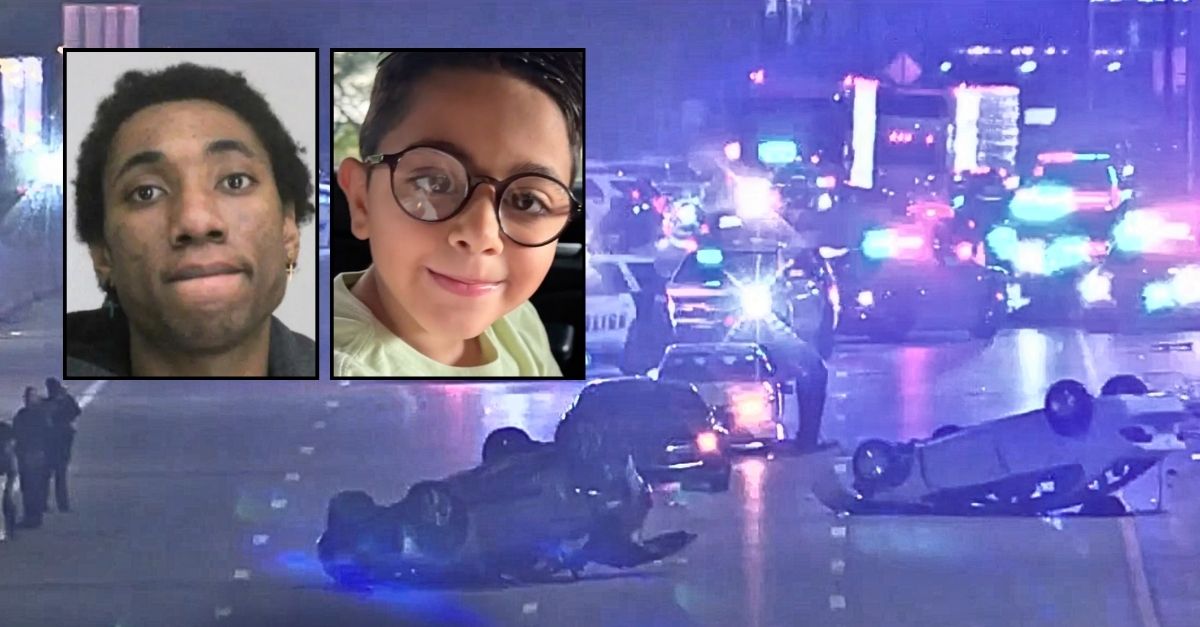
The boy remembered telling his mother he was simply sad about losing his leg. The police report used different language for the driver who hit them.
According to Dallas police, 7-year-old Saeed Abbasova was riding in his family’s car on Central Expressway in Dallas when a speeding vehicle, allegedly driven by an intoxicated 23-year-old, struck them and sent their car flipping. Saeed was thrown from the vehicle and gravely injured, and prosecutors now say the crash was the result of criminal conduct rather than an unavoidable collision.
The New Year’s Drive That Ended in a Flip
The collision took place in the early hours after New Year’s Eve, as Saeed’s family drove along Central Expressway in Dallas, Texas. His mother, Ruksara Abbasova, later told local station KDFW that the family had been celebrating the holiday before starting their drive home.
In a report summarized by Law & Crime, Dallas police say witnesses observed a driver later identified as Michael McRae weaving through lanes and speeding for several miles before the crash. Officers allege that McRae was intoxicated when he struck the Abbasova family’s vehicle, causing it to overturn.
The impact flipped the family car. In the chaos that followed, Abbasova told KDFW she saw parts of her family but not her son. “I saw my husband, I saw my daughter, I didn’t see my son,” she said. “Someone hit us, and after that the car start to flip.”
Police say the force of the crash ejected Saeed from the vehicle and threw him an estimated 60 feet. According to the Law & Crime account, responding officers and medical crews found the child with catastrophic injuries to one of his legs.
A Child’s Leg Amputated After the Crash
Abbasova told KDFW that when she finally found her son on the ground near the crash scene, she saw extensive bleeding and initially could not understand the source. “When I saw him on the ground, I thought that I would lose him,” she said. She described seeing “a lot of blood” and wondering, “Where does the blood come from? From head? From back? From his internal organs?”
Only when she saw his entire body, she told reporters, did she realize he was missing part of his leg. Police and local reporting say that Saeed’s leg had been badly mangled in the crash and that doctors decided they had no choice but to perform an emergency amputation once he arrived at the hospital.
While recovering, Saeed spoke briefly with KDFW about what had happened to him. “I am so sad,” he said. “I lost my leg.” He also expressed gratitude for being alive after the severe crash. “The main thing is that I’m alive,” he told the station. “I’m with you, mom. With my family. I know that I will be good. I will be better.”
According to the Law & Crime report, Saeed turned 8 years old only a few days after the incident. Publicly available reporting has not detailed the full extent of his medical treatment or the expected length of his rehabilitation, but emergency amputation following a traumatic crash typically requires long-term follow-up care and prosthetic support.
The Charges Against the Alleged Driver
Dallas police identified the other driver as 23-year-old Michael McRae. According to the charging information cited by Law & Crime and KDFW, McRae faces several counts, including intoxication assault causing serious bodily injury, failure to maintain financial responsibility, and resisting arrest.
Under Texas law, intoxication assault applies when a person operates a motor vehicle in a public place while intoxicated and, by reason of that intoxication, causes serious bodily injury to another person. The statute, found in Texas Penal Code Section 49.07, classifies intoxication assault as a felony offense.
Prosecutors allege that McRae’s intoxication and driving conduct on Central Expressway met that definition and resulted in Saeed’s life-altering injuries. Police also accuse him of failing to maintain financial responsibility, which typically refers to required auto insurance coverage under Texas law, and of resisting arrest when officers attempted to take him into custody after the crash.
According to KDFW’s reporting, McRae was booked into jail and later released on bond while he awaits his next court date. Court records and local stories describe him as currently out on bond, subject to whatever conditions the court imposed. He has not entered a public plea in the materials cited, and no conviction has been reported.
McRae is presumed innocent unless and until he is proven guilty in a court of law. The precise evidence of intoxication, such as any blood alcohol concentration testing or field sobriety observations, has not been fully detailed in the public reporting available.
How This Fits Into Texas Drunk Driving Trends
Although the Abbasova family’s crash is one case, it fits into a broader pattern of alcohol-impaired driving incidents in Texas and across the United States.
The National Highway Traffic Safety Administration reports that in 2022, 13,524 people were killed in crashes involving an alcohol-impaired driver nationwide, which averages to one death every 39 minutes. That figure is published on the agency’s drunk driving data page.
Texas routinely records some of the highest numbers of drunk driving fatalities in the country in federal traffic data. State law imposes criminal penalties for driving while intoxicated and enhances potential punishment when serious bodily injury results, as in alleged intoxication assault cases. The Dallas case involving Saeed falls into that enhanced category, given the severity of his injuries described by doctors and his family.
Criminal cases that involve children with permanent injuries often proceed on parallel tracks. One track is the criminal prosecution that focuses on punishment and public safety. Another track, sometimes pursued through separate civil litigation, can address medical costs, long-term care, and other damages. Public reporting so far has not indicated whether Saeed’s family has filed or plans to file any civil claims related to the crash.
What Remains Unknown as the Case Continues
Several key details about the crash and the investigation have not yet been publicly disclosed. Police summaries in Law & Crime and KDFW’s coverage describe witnesses who saw a speeding and weaving vehicle, but they do not specify McRae’s alleged speed or the exact traffic conditions at the time of impact.
Authorities have also not publicly detailed any toxicology results or the precise level of intoxication they attribute to McRae. Those measurements, if presented, are likely to become central evidence in any future court hearings or trial concerning the intoxication assault charge.
The conditions of McRae’s bond have not been fully reported either, beyond the fact that he has been released while awaiting his next appearance. In similar felony cases, judges can order restrictions such as ignition interlock devices, alcohol testing, or travel limits. It is not clear from current public sources whether any such conditions apply here.
For the Abbasova family, the legal process unfolds alongside ongoing medical realities. In her interview with KDFW, Ruksara Abbasova described her experience as a parent watching her child suffer injuries she could not prevent or heal. “It’s tragedy for me. Tragedy,” she said. “Because do you know how to see your child in this condition? You want to take his pain to you, you want to take his injuries to you. But you can’t.”
The criminal charges against McRae remain pending, and any trial or plea discussions have not yet been reported. Saeed’s statement from his hospital bed, that “the main thing is that I’m alive,” sits alongside the fact that the man accused of causing his injuries is out on bond while the courts decide what legal consequences, if any, will follow.