

How a Late Night Shift Turned Into an Armed Robbery Case
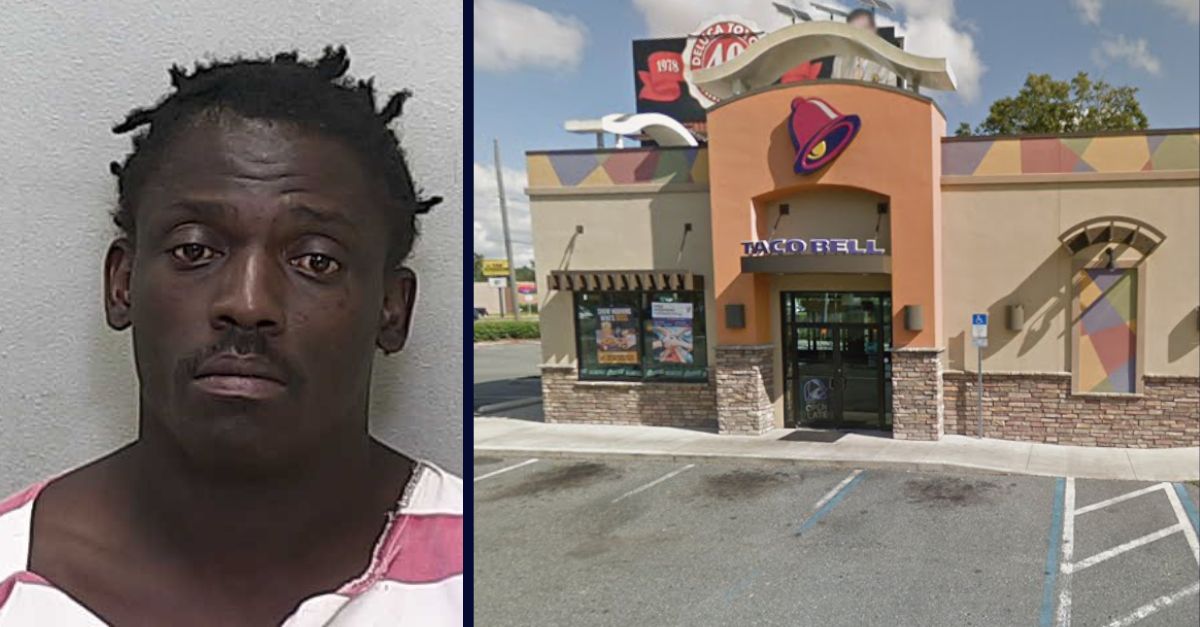
According to court records reported by Law & Crime, 40-year-old Kewarren Anderson was prosecuted in Marion County, Florida, for an incident that began just after midnight at a Taco Bell in Ocala.
Law & Crime wrote that, in a probable cause arrest affidavit, police said officers were called to the fast food restaurant on Southwest College Road around 12:30 a.m. on a July night in 2025. Employees told officers that a man had entered the store through the drive-thru window while holding a large rock and demanding money.
Witnesses said the man had wrapped his shirt around his head, then climbed through the window from the outside. Staff reported that he held the rock, demanded cash, and chased them out of the building and into the parking lot. No one was reported injured in the affidavit as summarized by Law & Crime.
After employees fled, the man left the area on foot. There is no indication in the available reporting that customers were involved or that any other weapons were used.
From Dumpster Search To Arrest
Officers brought a K-9 unit to search the area near the Taco Bell. The dog led police to a dumpster behind a nearby business, where they found a man who matched the description provided by employees.
Workers from the restaurant later identified that man as the person who had come through the drive-thru window with the rock, according to the same Law & Crime report. The article states that some employees knew him as “Tony the Tiger.”
Investigators identified him as Kewarren Anderson. Law & Crime reports that Anderson admitted he was at Taco Bell during the incident and that he had the rock with him. The outlet also reports that, according to the affidavit, Anderson told officers he was homeless and needed money.
Police said Anderson failed to take any cash from the restaurant. Nonetheless, he was arrested and booked on a charge of armed robbery. He remained in custody from the time of his arrest until his sentencing in early 2026, according to Law & Crime.
Why a Rock Counts as a Weapon Under Florida Law
Florida treats robbery as a serious felony offense. Under section 812.13 of the Florida Statutes, robbery is defined as the taking of money or other property from another person, with the intent to deprive that person of the property, when the taking involves “the use of force, violence, assault, or putting in fear.”
The statute increases penalties when a weapon is involved. Armed robbery applies when the person committing the robbery carries a weapon or a deadly weapon during the crime. Although the statute does not list specific objects such as rocks, Florida courts have allowed everyday items to be treated as weapons if they are used or threatened in a way that can cause serious harm.
That framework helps explain why prosecutors charged Anderson with armed robbery even though there was no firearm and no money was actually taken. In the version of events described in the probable cause affidavit, he entered through a drive-thru window holding a large rock, demanded cash, and chased workers while carrying that object. Those facts fit into a category where the law focuses on force and fear, not just on whether property changed hands.
Law & Crime quoted its own summary of the case in stark terms: “A man is headed to prison after he robbed a Florida Taco Bell with a rock and chased employees around the parking lot demanding cash.” The rock, in this case, is what moved the charge from simple robbery to armed robbery under Florida law.
The Plea, the Sentence, and Time Already Served
According to Law & Crime, Anderson eventually chose not to contest the main charge. In a court hearing described in the outlet’s report, he entered a no-contest plea to armed robbery. A no-contest plea means he did not admit guilt but accepted that the court could find him guilty based on the evidence.
The judge adjudicated Anderson guilty of armed robbery and sentenced him to four years in state prison. The article notes that he received credit for nearly 200 days he had already spent in the county jail while his case moved through the court system.
The same Law & Crime report states that, during his time at the jail, Anderson was involved in a separate incident that led to another criminal case. According to that account, while fighting with another inmate, he kicked and slapped a corrections officer. That conduct resulted in a battery charge by a person in a detention facility.
Anderson also entered a no-contest plea in the jailhouse battery case, the article reports. The judge imposed a sentence for that offense to run concurrently with the four-year term for armed robbery, rather than after it. In practical terms, that means the additional conviction did not increase the total time he will spend in state prison, based on the available reporting.
Homelessness, Late Night Work, and Public Risk
One detail from the probable cause affidavit, relayed in the Law & Crime coverage, stands out. Anderson reportedly told officers that he was homeless and needed money. The affidavit itself is not reproduced in the public reporting, so it is not clear whether it includes additional information about his background, employment history, or access to services.
The restaurant where the incident occurred is part of the Taco Bell chain, which operates thousands of fast food locations nationwide. Quick service restaurants that stay open late are widely recognized as workplaces where robberies and threats of violence can occur. In this case, employees encountered a person climbing through a service window while holding an object they reasonably believed to be a potential weapon.
Law & Crime’s reporting indicates that no workers were physically injured and that no money was actually taken. Those facts did not prevent the case from resulting in an armed robbery conviction, because the legal focus is on the combination of force, fear, and a weapon, rather than on financial loss alone.
From Anderson’s perspective, the law treated a single incident, carried out with a rock and with no financial gain, as severe enough to send him to state prison. Public records referenced by Law & Crime show no indication in the article that the court ordered any mental health evaluation or substance use assessment as part of the sentence. However, such evaluations sometimes occur in felony cases in Florida.
What Remains Unanswered
The public reporting on this case leaves several points unclear. The probable cause affidavit, summarized but not published in full, would provide more precise details about the interaction between Anderson and the employees, including the length of the encounter and any verbal threats that may have been made.
It is also not clear from the available sources what resources, if any, were offered to Anderson to address the homelessness he reportedly described to officers. Nor is there detail on how the affected workers have recovered from being chased out of their workplace by a person holding a rock and demanding cash.
What is clear, from Law & Crime’s account and from the structure of Florida’s robbery statute, is that a few minutes at a drive thru window, a rock, and a late night search behind a nearby business were enough to meet the legal definition of armed robbery, send a homeless man to prison, and leave open questions about what might have prevented the incident in the first place.