


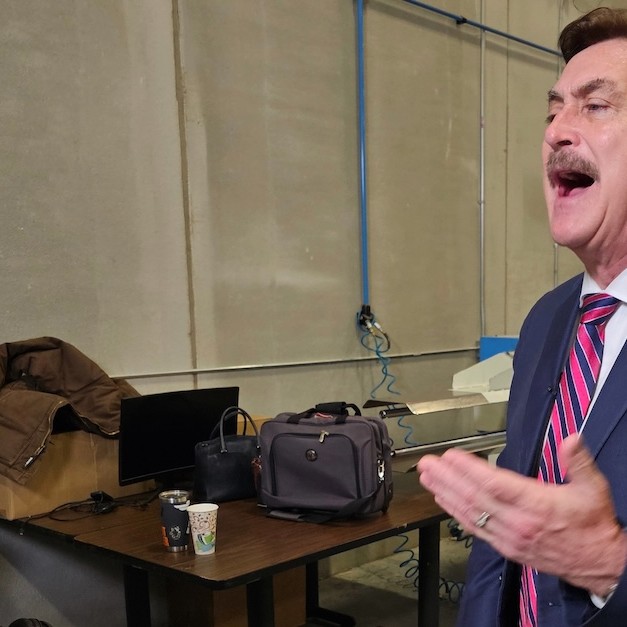
In a new filing in federal court, voting technology company Smartmatic told a judge that Minnesota gubernatorial candidate and MyPillow chief executive Mike Lindell used his 2025 campaign to buy large quantities of his own books from MyPillow while a $56,369 sanctions order remains unpaid, raising a dispute over whether this reflects hardship or defiance.
TLDR
Smartmatic told a federal judge that Mike Lindell’s 2025 Minnesota gubernatorial campaign spent more than $187,000 on bulk purchases of his own books from MyPillow while a $56,369 sanctions order remains unpaid, and is asking for contempt penalties to compel payment.
Smartmatic Points to Campaign Spending
In a short supplemental filing submitted in early February 2026, Smartmatic alerted U.S. District Judge Carl Nichols to Minnesota campaign finance records for Lindell’s 2025 run for governor. According to the filing, those state records show that the campaign raised $356,513.40 and spent $272,578.03, with a large share of the outlays going to Lindell’s own company.
Smartmatic told the court that $187,037.87 of the spending went to MyPillow Inc., described on disclosure reports as payments for “Lindell Books” and “Mike Lindell Books.” The company argued that those descriptions, tied to Lindell’s control of MyPillow, demonstrate that he chose to channel campaign contributions into bulk purchases that benefited his business rather than pay the federal sanctions he already owed.
The filing summarized the pattern this way, stating that “the majority of the funds raised by the Campaign in 2025 were used to make bulk purchases of books from MyPillow Inc., of which Mr. Lindell is the Founder, CEO, and Majority Shareholder.” Smartmatic framed this as evidence that Lindell could access significant cash flow while maintaining in court that he faced genuine financial distress.
According to the Minnesota Reformer, which reviewed the same campaign records, the purchases included Lindell’s memoir, titled “What Are the Odds? From Crack Addict to CEO,” a book he has said he distributed widely, claiming to have given away more than 20,000 copies. Smartmatic cited those reported giveaways to underscore that the campaign expenditures were not incidental, but part of a deliberate strategy to acquire and distribute Lindell-branded books.
💩Mike Lindell bought his own books in ‘bulk’ from MyPillow rather than paying Smartmatic sanctions: Court filing. Having already asked a judge to force MyPillow CEO Mike Lindell to pay more than $56,000 in sanctions for “frivolous” 2020 election claims, Smartmatic states that… pic.twitter.com/fejbIriazN
— Sumner (@renmusb1) February 10, 2026
The campaign filings, compiled under state law and then highlighted by Smartmatic for Judge Nichols, do not themselves characterize the payments as improper. They list dates, amounts, and descriptions, leaving it to the federal court to decide what weight, if any, to give the pattern in evaluating Lindell’s obligation to pay sanctions.
Sanctions From Election Litigation
The sanctions at issue stem from litigation following the 2020 presidential election. Dominion Voting Systems sued Lindell and MyPillow for defamation over repeated claims that Dominion’s technology helped steal the election. In that case, Smartmatic became involved as a third-party defendant after Lindell countersued, alleging RICO violations and other wrongdoing by Dominion and Smartmatic.
Judge Nichols, who presides over the Dominion case in Washington, D.C., previously found parts of Lindell’s counterclaims to be legally unsupported. In January 2025, he ordered Lindell to pay $56,369 in sanctions for what the court described as frivolous allegations advanced in that countersuit. The sanctions were intended to compensate opposing parties for the costs of responding to those claims and to deter similar conduct.
In a motion filed in March 2025, Smartmatic told the court that Lindell still had not paid the sanctions and had not, in its view, “meaningfully engaged in any discussions or negotiations regarding the terms of payment.” That motion asked Nichols to hold Lindell in civil contempt, asserting that a simple order to pay had not been enough to secure compliance.
Nearly a year later, Smartmatic now argues that the new campaign finance data confirms its earlier warnings. The company told the court that it has “all the evidence it needs” to show a violation of the sanctions order and to justify “further contempt sanctions,” pointing to the simultaneous nonpayment of the court-ordered sum and the significant spending on book purchases.
Hardship Claim Versus Spending Record
In response to past enforcement efforts, Lindell has publicly and in court filings described himself as facing severe financial pressure from multiple defamation cases and from what he portrays as a broader campaign against him and his company. Smartmatic told Nichols that Lindell’s most recent filing again leaned on an asserted inability to pay, characterizing the sanctions as unaffordable given his current circumstances.
Smartmatic, however, urged the court to read the campaign expenditures as contradicting that claim. The new filing stated that “Mr. Lindell’s instant response demonstrates precisely what Smartmatic foresaw: a claim of inability to pay born of disregard for this Court’s orders, rather than genuine financial hardship. Mr. Lindell will not pay unless and until the Court compels him to do so through contempt.”
Elsewhere in the same submission, Smartmatic told Nichols that “This is not an inability to pay. It is a calculated refusal to pay. Only the threat of contempt will move him to comply.” The company asked the judge to “coerce” compliance by holding Lindell in contempt and imposing a daily monetary penalty until the sanctions are paid in full.
The spending path described in the filing matters because of Lindell’s role at MyPillow. As Smartmatic emphasized, Lindell is the founder, chief executive, and majority shareholder of the company, receiving the campaign’s book payments. Smartmatic argued that bulk purchases of his own books from a company he largely owns amount to paying himself, at least indirectly, and that this is relevant to evaluating whether he truly lacks funds for the sanctions.
The campaign reports, however, do not address Lindell’s broader personal finances, liabilities, or access to credit, and the federal docket materials available through the filing do not include any sworn financial statement from Lindell in this sanctions dispute. The picture presented to Judge Nichols is, therefore, partial, centered on one stream of campaign-related spending that Smartmatic says undercuts the hardship narrative.
Potential Contempt and Public Accountability
If Judge Nichols agrees with Smartmatic, the next stage would be civil contempt, a tool federal courts use to try to enforce their orders. Civil contempt can include fines that escalate over time, structured to pressure a party to comply rather than to punish past behavior. In some cases, courts also require detailed financial disclosures so that claims of inability to pay can be tested against documentary records.
Smartmatic is asking for exactly that kind of pressure, requesting a “daily penalty” until the $56,369 sanctions amount is paid. The company is not, in this filing, seeking new findings on the underlying defamation allegations or on Lindell’s political activities. Instead, it is focused on the narrow question of whether a party who has been ordered to pay sanctions may decline to do so while continuing to direct substantial sums elsewhere.
The current filings do not include a response from Lindell to Smartmatic’s latest allegations about his campaign spending, and the article on which this summary relies does not report any comment from him or his legal team about the supplemental submission. As of the filing described, the question before Judge Nichols is how to interpret the campaign-finance numbers in light of earlier claims that Lindell cannot pay.
The dispute highlights how civil litigation over false election claims can spill into other arenas, including state campaign finance records and ongoing political campaigns. Whether the judge ultimately treats the book purchases as evidence of bad-faith noncompliance, or as spending that does not resolve questions about Lindell’s overall financial position, will determine whether further contempt sanctions are issued and how enforceable such monetary penalties prove to be in high-profile political litigation.
References