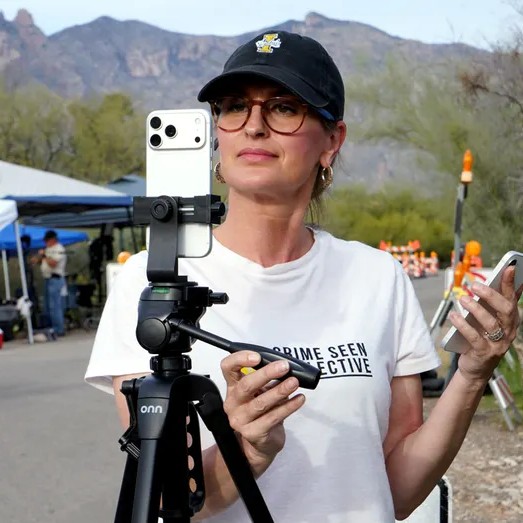
Four weeks after 84-year-old Nancy Guthrie disappeared from her Tucson home, investigators are working through forensic leads while, just beyond the crime scene tape, livestreamers narrate every police car and food delivery. That collision between an active investigation and an always-on audience now sits at the center of a growing dispute.
TLDR
As authorities investigate the disappearance of Nancy Guthrie in Tucson, online true-crime streamers have set up outside her home, drawing donations, ordering food to the scene, and broadcasting around the clock, even as law enforcement and local officials warn that speculation could harm the case.
Guthrie, the mother of NBC “Today” co-host Savannah Guthrie, was reported missing from her Tucson residence in January 2026. According to Fox News, investigators with the Pima County Sheriff’s Department and the FBI are treating the case as a suspected kidnapping, but have announced no arrests, even as the curb outside her home has turned into a live studio for competing true-crime channels.
Crime Scene Streaming Comes to Tucson
According to Fox News, the scene outside Guthrie’s home now includes traditional camera crews, handheld phones on stabilizers, and, at times, drivers arriving with bags of fast food ordered by viewers. One recent incident involved a delivery worker with fast food and drinks being stopped at the driveway by a Pima County deputy, after which she asked journalists to stop filming her. The food, Fox News reported, was destined for Alina Smith, co-founder of Crime Seen Collective, who had been streaming from the street all day after driving from Dallas.
Smith is one of several independent streamers who have traveled to Tucson to cover what they describe as an unfolding major crime story. Another streamer, Mel Smith, who operates a channel from just north of New York City, has also been broadcasting near the home and showing viewers a growing roadside memorial for Guthrie. Local YouTuber Damian Enderle, who usually covers Tucson crime and homelessness, told Fox News he started filming at the site because, as he called it, the “biggest” story had suddenly arrived in his own city.
Officials Push Back on Speculation
As the livestream audience has grown, so have unproven theories. Fox News reports that some online commentators and streamers have suggested, without evidence, that Guthrie’s relatives might be implicated. On February 16th, 2026, Pima County Sheriff Chris Nanos issued a written statement rejecting those claims and emphasizing that investigators view the family as victims. “The family has been nothing but cooperative and gracious and are victims in this case,” Nanos wrote, urging media and streamers alike to avoid unfounded accusations.
The Sheriff’s Department also asked media and streamers to stop sending food deliveries to the crime scene address after a pizza driver walked up to the home, according to Fox News. State Representative Alma Hernandez, who lives in Tucson, used her X account to criticize what she described as “random wannabe journalists and YouTubers” spreading speculation and following law enforcement vehicles, warning that such activity could put the “serious case” in jeopardy. She called on visitors to leave so investigators could work without a constant online chase.
Ethical Fault Lines for a Growing Industry
The Guthrie investigation has become a test of how far real-time crime coverage can push into an active case before crossing ethical lines. Robert Quigley, an associate professor of practice at the University of Texas at Austin and a former newspaper journalist, told Fox News that the central question for both streamers and traditional reporters is whether they apply basic standards. “Are you following ethics, are you being sensitive, are you being transparent, all those types of things that make for good journalism?” he said, noting that breaking-news environments attract both careful reporting and what he described as more salacious approaches.
Other Fox News reporting on the case describes federal investigators preparing for multiple possible outcomes while awaiting DNA and genetic genealogy results. That work is unfolding largely out of sight, while the public-facing narrative is shaped by clips of patrol cars, neighborhood shots, and live commentary from people who are not bound by newsroom policies. Supporters of crime-scene streaming argue that it puts pressure on authorities and provides unfiltered views, while critics question whether the constant presence and occasional misstatements may influence witnesses, neighbors, or even potential jurors in any future prosecution.
For now, Guthrie remains missing, and investigators have not announced any suspects or charges. Law enforcement officials are asking for patience and restraint, even as some streamers say they plan to keep broadcasting from the sidewalk until their followers decide the story is finished. The question that lingers is how police, courts, and communities will adapt when every major crime scene can become a permanent stage.