In the surveillance video now circulating among Atlanta officials, the first person to stop a fast-moving man at an airport checkpoint is not wearing a uniform.
What the New Video Shows
The footage comes from Hartsfield-Jackson Atlanta International Airport, one of the busiest passenger hubs in the world. It documents an incident at a Transportation Security Administration, or TSA, checkpoint on the morning of October 30, according to reporting by Fox 5 Atlanta and Fox News.
Police identified the man in the video as 40-year-old Fabian Leon. According to those outlets, law enforcement later charged him with simple battery and avoiding security measures. Court records related to the case were not immediately available in online public databases, so the ultimate outcome of those charges remains unclear.
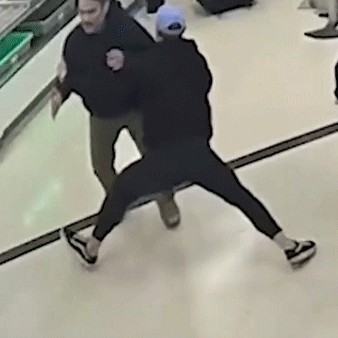
The video, released through an open public records request, shows a man running through the terminal toward a TSA checkpoint. As he approaches the initial screening area, he appears to shove a TSA officer, knocking the officer to the floor and stumbling over him. Other personnel move toward the man as he continues forward.
According to the accounts from Fox 5 Atlanta and Fox News, a TSA officer can be heard or seen signaling a breach. In response, a nearby traveler, later identified as Mark Thomas, turns, steps into the man’s path, grabs him, and lifts him before taking him down to the floor. The takedown happens within seconds of the initial contact at the checkpoint.
The video that has been released does not contain audio of every exchange between those involved. It also does not include any extended view of what occurred before the man reached the checkpoint. That makes police reports and witness statements key to understanding what led up to the breach and what followed it.
Police Account and Criminal Charges
According to Fox 5 Atlanta’s summary of police records, Leon was taken into custody after the scuffle and later charged with simple battery and avoiding security measures. Those are state-level offenses. As of the latest reporting, there is no public indication that federal charges were filed, which would typically fall under statutes that criminalize interfering with airport security screening.
Police told reporters that Leon said he had consumed alcohol and taken drugs shortly before the incident. That detail comes from officers’ descriptions of their interviews with him, not from any independent toxicology report made public. No test results have been released through the same records request that produced the video, at least in the portions described by local media.
Authorities also said three officers were assaulted during the wider effort to restrain Leon at the checkpoint. The publicly described video clips primarily show the initial shove of the TSA officer and the bystander’s takedown. Any alleged assaults on additional officers would be documented in other camera angles or written reports that have not yet been widely distributed.
In the aftermath of the takedown, officers can be seen in the footage securing Leon in a chair at the scene, according to both Fox outlets. From there, he was taken into custody. No serious injuries to passengers were reported in connection with the incident.
The Bystander Who Stepped In
Mark Thomas, the traveler who intervened, has spoken publicly about his decision to physically stop Leon. In an interview with Fox 5 Atlanta, he described watching the man knock over the first officer and keep moving toward the checkpoint.
Thomas said, using his own words, that he reacted almost automatically: ‘I saw him knock over the first dude and then a TSA agent tried to grab him, and once he was going to get past me, I was just like, okay, I’ll just take over if I can.’
He also described Leon’s demeanor once he was on the ground and restrained. According to Thomas, Leon seemed oddly composed and disconnected from what had just happened. Thomas recalled: ‘He was very soft-spoken. He just kept saying, “Oh, I’m okay, I’m okay, let me up, let me up, I’m okay”. It’s like, kind of clear, that he was sort of detached from the entire situation.’ Those details have not been contradicted by police, but they are based on Thomas’s observation rather than medical records.
Thomas told Fox 5 Atlanta that he would step in again if he felt he needed to. At the same time, he questioned why it came down to a bystander to physically stop someone who had already pushed through one layer of security personnel. In his words, ‘I think more police presence should have probably been there, it shouldn’t have taken me to take him down. I don’t know how many checkpoints or people he got passed before that.’
Airport and police officials have not publicly addressed Thomas’s specific criticism about staffing levels at that checkpoint at that time. No agency has released a detailed timeline of which officers were assigned to that area that morning, who responded, and how long it took them to reach the scene once the breach was called.
How Checkpoint Security Usually Works
Security at large U.S. airports is typically split between TSA officers, who handle screening, and local or airport police, who respond to crimes and physical threats. Hartsfield-Jackson is no exception. The airport’s own public materials emphasize that TSA handles screening while the Atlanta Police Department’s Airport Unit and other partners provide law enforcement support.
According to Airports Council International, Hartsfield-Jackson has ranked among the world’s busiest airports by passenger volume in recent years, with tens of millions of travelers passing through annually. Higher traffic generally means more screening lanes and more officers, but it also increases the number of unpredictable encounters that frontline staff must manage.
TSA publicly states that interfering with screening operations or assaulting officers can trigger criminal charges and civil penalties. The agency’s enforcement pages describe potential fines for actions such as attempting to bypass screening or physically interfering with security procedures. Those materials do not detail how often, in practice, local agencies choose state charges like simple battery instead of pursuing federal cases.
What the Atlanta video concretely shows is a sequence in which a TSA officer is knocked down, a second officer reacts and calls a breach, and a traveler, not a uniformed law enforcement officer, executes the most forceful stop. There is no indication in the publicly described footage that Thomas coordinated with officers before acting. His involvement appears to be voluntary and unplanned.
There is also no evidence that authorities have disciplined any TSA staff or police officers over the handling of this incident. If internal reviews took place, their findings have not yet surfaced through the open records process that made the video public.
Unanswered Questions About Preparedness
Several basic facts about the breach are now well documented. The video confirms that a man identified by police as Leon moved rapidly toward a TSA checkpoint, knocked down an officer, and was tackled and restrained by a bystander within seconds. Police records, as summarized by local outlets, show that he faced state charges and told officers he had consumed alcohol and drugs beforehand.
Other important elements are still missing from public view. Officials have not provided a complete accounting of the number of officers in the immediate area when the breach occurred, what their specific assignments were, or how long it took for additional law enforcement to arrive after the initial ‘breach’ alert.
There is no public explanation of whether TSA or airport police adjusted staffing, training, or procedures at that checkpoint after reviewing the incident. Also unknown is whether prosecutors pursued the most serious available charges or whether any mental health evaluations or substance screenings were conducted as part of Leon’s case.
For now, the clearest narrative comes from a combination of silent video and a traveler who decided to step between a fast-moving man and an active security lane. Until Atlanta’s airport and law enforcement agencies release more of their own findings, one of the world’s busiest checkpoints will have a security story in which the critical intervention belongs to a passenger rather than the people assigned to protect him.