

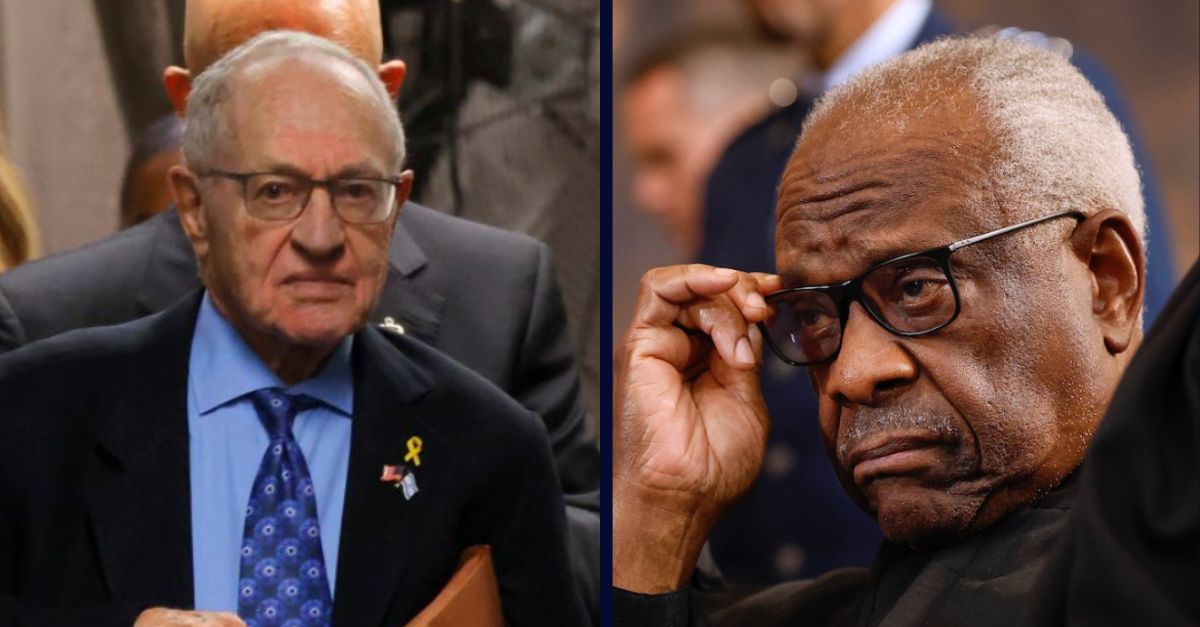
A federal appeals judge said CNN had “simply lied” about Alan Dershowitz, yet still voted to end his defamation case. Now Dershowitz is asking the U.S. Supreme Court to weaken or overturn the landmark rule that made that result almost inevitable.
From Impeachment Argument To Defamation Claim
Alan Dershowitz, a longtime criminal defense lawyer and Harvard Law School professor emeritus, represented President Donald Trump during his first impeachment trial in the U.S. Senate. During that trial, Senator Ted Cruz asked whether it mattered if there was a quid pro quo involving military aid to Ukraine and a request for an investigation of Joe Biden.
Dershowitz answered that a quid pro quo would be unlawful only if the “quo” was itself illegal. He went on to describe three possible motives a president might have for seeking a benefit. Public interest, political self-interest, and financial self-interest. On public interest, he said that every public official believes their election is in the public interest and that if a president acts to help get reelected for what he believes is the public interest, that “cannot be the kind of quid pro quo that results in impeachment.”
According to Dershowitz, CNN edited and framed that exchange in a way that told viewers he believed a president could do anything, even illegal acts, so long as he believed his reelection was in the public interest. His complaint alleged that the network presented a “one-sided and false narrative” that he had argued the president was effectively immune from impeachment if he sincerely believed reelection served the public good, regardless of illegality. Law&Crime summarized those allegations in its report on the lawsuit and subsequent appeal here.
Dershowitz sued CNN in federal court in Florida, claiming defamation. In 2021, the trial judge allowed the case to move forward past a motion to dismiss, finding that CNN had arguably presented an official proceeding in a misleading way. But at the summary judgment stage, after discovery, the judge ruled for CNN and dismissed the case.
An Appeals Court That Criticized CNN, Then Ruled For It
Dershowitz appealed to the U.S. Court of Appeals for the Eleventh Circuit. A three-judge panel affirmed the dismissal. Yet one member of that panel, Judge Barbara Lagoa, used unusually sharp language about CNN while agreeing that existing Supreme Court precedent required the result.
In a concurring opinion quoted by Law&Crime, Lagoa wrote that in some instances CNN “blurred the line between fact and commentary, and in others, they simply lied about what Dershowitz had said.” She concluded that “the only thing standing between Dershowitz and justice is Sullivan,” referring to New York Times Co. v. Sullivan, the 1964 Supreme Court case that reshaped American defamation law.
New York Times v. Sullivan held that public officials suing for defamation about their official conduct must prove that a statement was made with “actual malice.” That is, with knowledge that it was false or with reckless disregard for whether it was false or not. The Court later extended that standard to many public figures, not just officials. The opinion is widely credited with giving the press broad protection to report on government and powerful people, sometimes incorrectly, without facing crushing liability for good-faith mistakes. The Supreme Court’s description of that standard can be read in the original opinion, which is available through Cornell Law School’s Legal Information Institute here.
Under that framework, the Eleventh Circuit concluded that even if CNN’s editing and commentary were unfair or misleading, Dershowitz had not produced enough evidence to show actual malice as the Supreme Court currently defines it. That result, combined with Lagoa’s criticism of CNN’s conduct, set the stage for the next step.
The Supreme Court Petition: A Direct Challenge To Sullivan
After the loss in the Eleventh Circuit, Dershowitz retained Jay Sekulow and the American Center for Law and Justice to take the case to the U.S. Supreme Court. Sekulow, like Dershowitz, served on Trump’s impeachment defense team. According to the Law&Crime report, Dershowitz sought and received an extension from Justice Clarence Thomas to file a petition for a writ of certiorari, then filed the petition on Dec. 29.
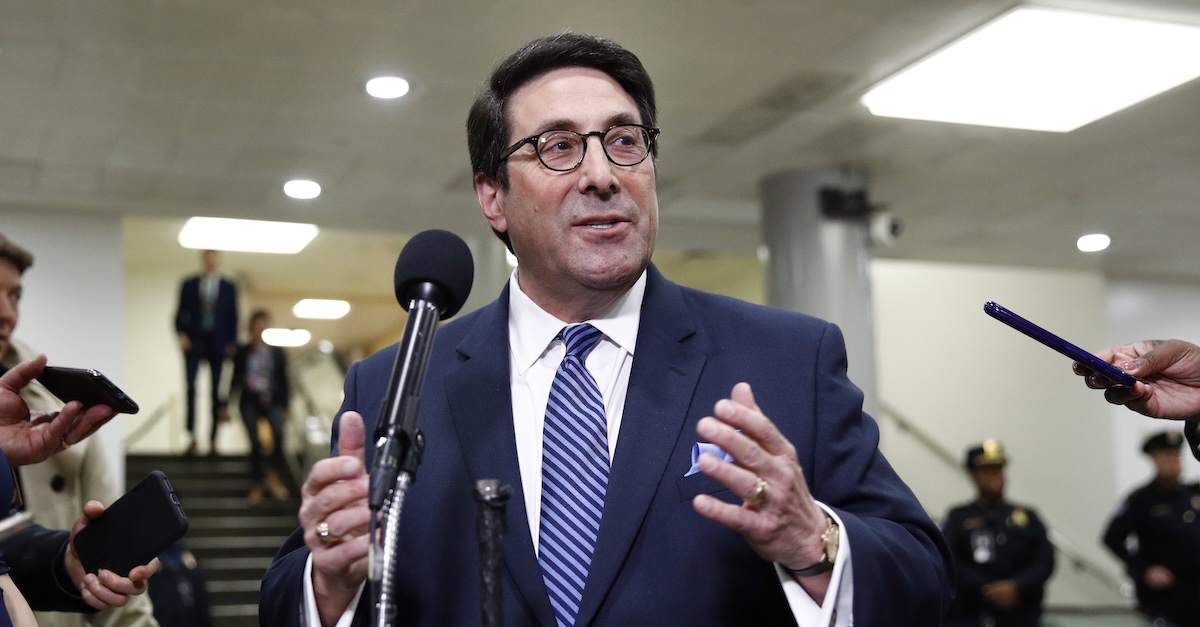
The petition asks the Court to use his dispute with CNN to reconsider, narrow, or even discard the New York Times v. Sullivan framework. Among the written questions presented are whether the “actual malice” standard as articulated in Sullivan and later cases “should be discarded altogether or at least as to private citizens who are public figures” and whether the Court should modify Sullivan’s clear and convincing evidence burden.
NEWS: Alan Dershowitz is asking the Supreme Court to overrule New York Times v. Sullivan and reinstate his $300 million defamation suit against CNN. pic.twitter.com/JIeJgAtXjk
— Jimmy Hoover (@JimmyHooverDC) January 5, 2026
The filing also asks the Court to address what Dershowitz contends is a split among federal appellate courts on a more specific point. Whether a “defendant’s systematic omission of qualifying and limiting language from a plaintiff’s recorded statement” can itself be proof of actual malice sufficient to get a case in front of a jury. The petition cites decisions from the Second, Third, Fifth and Ninth Circuits that have allowed plaintiffs to use such omissions to survive summary judgment, contrasted with the Eleventh Circuit’s treatment in his case.
In public comments to Law&Crime, Dershowitz framed the petition as an effort to rebalance speech protections, not to start what critics warn could become “libel warfare” against the press. He said, “We present a series of options short of overruling Sullivan: limiting it to government officials, as it originally was; changing the malice burden to preponderance; leaving malice to [a] jury.” In his view, “These changes should create a fairer balance.”
How The ‘Actual Malice’ Standard Became A Flashpoint
Sullivan has been settled law for six decades, but it has not been free from criticism inside the Supreme Court. In 2019, Justice Clarence Thomas used a concurrence in the denial of review in McKee v. Cosby to argue that the Court should reconsider Sullivan and its progeny. Thomas wrote that the Court should “not continue to reflexively apply this policy-driven approach to the Constitution” without reexamining its historical basis.
In 2021, Justice Neil Gorsuch raised related concerns when the Court declined to hear Berisha v. Lawson. In a dissent from that denial, Gorsuch questioned whether Sullivan’s heavy burden on public figure plaintiffs still made sense in a digital media environment where false information can spread quickly and widely. Justice Thomas joined that dissent.
Dershowitz’s petition directly appeals to these currents. It argues that Sullivan has “devolved into near absolute immunity for media defendants, even when they profoundly misrepresent verifiable public statements,” according to language quoted in the Law&Crime report. The petition describes current doctrine as a “license to lie.” It also contends that traditional common law protections for the press, such as privileges for fair reporting and the defense of truth, can safeguard robust journalism without the heightened Sullivan standard. As the petition puts it, “Under the common law, the media already can perform aggressive reporting without liability for good faith mistakes.”
What Could Change If The Court Takes The Case
At this stage, the Supreme Court has not agreed to hear the dispute. It will first decide whether to grant review, which requires the votes of at least four justices. The Court has repeatedly declined invitations to revisit Sullivan, including in the McKee and Berisha cases. However, the explicit criticism from sitting justices and the Eleventh Circuit’s unusual concurrence have made this petition a closer test of how far the Court is willing to go.
If the Court were to narrow Sullivan only for certain types of public figures or adjust the burden of proof, public officials and prominent individuals could find it easier to bring cases like Dershowitz’s to juries. A full overruling of Sullivan would go further. It could allow states to return to a more traditional negligence-based standard for many defamation suits by powerful plaintiffs. That change would sharply increase legal risk for news organizations, commentators and even individual social media users who criticize public figures.
Supporters of Sullivan warn that weakening it could chill investigative reporting on law enforcement, public corruption and corporate misconduct. They point to the original context of Sullivan itself. A civil rights era case in which an elected official in Alabama used libel law to attack media coverage critical of police and local authorities. The Supreme Court’s summary on Oyez notes that the justices imposed the actual malice rule in part to protect “uninhibited, robust, and wide open” debate on public issues, even when that debate includes “vehement, caustic, and sometimes unpleasantly sharp attacks” on government and public officials, as described in the Court’s opinion here.
Dershowitz and his lawyers respond that their proposals would still leave room for mistaken reporting and pointed commentary, but would remove what they describe as constitutional protection for deliberate or reckless misrepresentation. Their petition argues that to the extent media outlets have relied on Sullivan as a “license to lie,” they have relied on “a constitutional error and injustice.”
What Remains Unresolved
The Court has not yet commented on Dershowitz’s filing beyond the earlier extension granted by Justice Thomas. There is no public timetable for when the justices will decide whether to take the case, although such petitions are typically resolved within several months of filing.
If the Court turns the petition away, Sullivan will remain intact, and Dershowitz’s case against CNN will be over. If it grants review, the dispute that began with an edited clip from a Senate impeachment trial could become the vehicle for the most significant reworking of American defamation law in a generation. For now, the same precedent that one federal judge called the “only thing” blocking Dershowitz’s claim is also the precedent the Supreme Court must be willing to question before any of his broader arguments can be heard.