


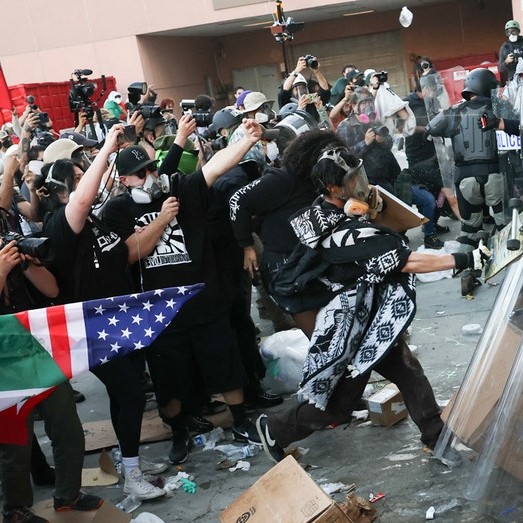
Police videos showed officers firing chemical agents into a crowd outside a federal detention center in downtown Los Angeles. Protesters described a thick haze and confusion. Between those two accounts sits a night that ended with arrests and unresolved questions about how a large immigration protest was policed.
According to reporting from Fox News that relied on Los Angeles officials and the Los Angeles Police Department, thousands of people gathered at City Hall on a Friday in late January 2026 before marching to a nearby federal detention facility near Union Station in support of a national “ICE Out Everywhere” protest wave. The demonstrations were described as a response to the shooting deaths of Alex Pretti and Renee Good during encounters with federal agents in Minneapolis.
Because these events took place after the close of Truthfully’s current archival record in late 2024, this account cannot draw on contemporaneous court filings or independent video review. The facts below rely on public statements from city leaders, the Los Angeles Police Department, and national reporting, including coverage by Fox News and the Associated Press, supplemented with existing public information about protest policing.
What Prompted the Los Angeles Protest
The Los Angeles march was one of many actions organized under the “ICE Out Everywhere” banner. Organizers oppose federal immigration enforcement practices and the detention of immigrants in local facilities. The demonstration in Los Angeles zeroed in on the federal detention center that holds people in federal custody, including those in immigration proceedings.
Fox News reported that the unrest followed a series of shooting deaths in Minneapolis that involved federal agents and two people identified as Alex Pretti and Renee Good. Details of those shootings, including the precise circumstances and any ongoing investigations, were not outlined in the Los Angeles coverage and could not be independently verified here.
Los Angeles Mayor Karen Bass, a Democrat, linked the protest to what she described as the Trump administration’s immigration crackdown. She told reporters that public demonstrations remain an important tool but warned residents against property damage or physical confrontation, saying, “I think the protests are extremely important, but it is equally important for these protests to be peaceful, for vandalism not to take place. That does not impact the administration in any kind of way that is going to bring about any type of change.”
How the Night Unfolded Downtown
By afternoon, thousands of people were gathered outside Los Angeles City Hall. Many then walked east through downtown toward the federal detention center adjacent to Union Station, according to the Fox News report and LAPD statements. Somewhere along that route, the tone of the event shifted in the eyes of the police.
LAPD officials described a subset of the crowd as “violent agitators.” The department said individuals pushed a large construction dumpster and used it to block the loading dock entrance to the detention facility. Video clips posted to the department’s official account on X, formerly Twitter, showed officers in protective gear forming skirmish lines while objects appeared to be thrown from the crowd.
In one widely cited post, LAPD captioned a video with the message, “We had hoped that demonstrations today would be peaceful, however, as you can see in this video, the violent agitators invited LAPD due to their actions.” That framing underscores a core dispute that often surfaces in protest coverage, where authorities characterize certain protesters as instigators while organizers contend they are responding to the way police approach the crowd.
Dispersal Orders, Tactical Alert, and Crowd Control
As tensions rose near the detention center, the LAPD declared an unlawful assembly in the area and began issuing dispersal orders. The department reported that a formal order went out at around 5:45 p.m. local time, covering Alameda Street between Union Station and First Street. Anyone who remained risked arrest for failure to disperse, a misdemeanor offense that has been used frequently in protest contexts in Los Angeles.
Shortly afterward, police placed the city on “tactical alert,” an internal status that allows commanders to reassign officers and expand resources in response to unfolding incidents. Officials said the alert was triggered by what they described as violent agitators along Alameda Street between Temple and Aliso streets.
LAPD stated that some protesters complied with orders to leave. Others, according to the department, continued to throw bottles and rocks at officers and at federal personnel guarding the detention facility. Police said one individual was arrested after allegedly using a slingshot to fire hard metal objects at officers. There was no immediate public accounting of injuries, if any, among either protesters or law enforcement officers.
On X, LAPD wrote, “Protestors are actively fighting with Officers after multiple dispersal orders were issued. Metropolitan Division is now on scene. Less-than-lethal has been authorized due to the violence against officers.” “Less than lethal” is the term law enforcement agencies generally use for munitions such as foam rounds and other projectiles, as well as chemical agents like pepper balls and tear gas, all of which can still cause significant injury.
The department later confirmed that it had used pepper balls and tear gas to move the crowd away from the detention center. How quickly dispersal orders were given relative to that use of force, and whether all parts of the crowd could hear and obey those orders, are questions that frequently arise in after-action reviews of protest responses, but no such review has yet been made public in this case.
Protesters, Elected Officials, and Competing Narratives
Bass said in a news conference that five people had been arrested for failure to disperse. At the time of that appearance, the LAPD did not confirm the total number of arrests or list the specific charges. It also remained unclear whether any federal arrests occurred separate from city actions.
While the mayor urged nonviolence and described vandalism as ineffective, she also criticized how federal authorities are using their power. Referring to the national political climate, she said, “violent protests are exactly what I believe this administration wants to see happen” and warned residents, “Don’t be surprised if the military reenters our city.” Her comments invoked earlier deployments of federal agents and, in some cities, National Guard troops in response to protests in recent years.
Representative Maxine Waters, a Democrat who represents parts of Los Angeles, appeared at the detention center protest earlier in the day. Standing in front of officers in riot gear, she led a chant of “ICE out of L.A.” and later told reporters, “What I see here at the detention center are people exercising their constitutional rights. And of course, they’re now trying to tear gas everybody. It’s in the air, but people are not moving.” Her account emphasizes crowd determination and the immediate impact of chemical agents, in contrast to the LAPD’s focus on projectiles thrown at officers.
Those dueling descriptions illustrate a familiar divide in protest coverage. Law enforcement highlights threats and injuries to officers and damage to property. Protest participants and their allies center constitutional rights and the harms of crowd control tactics. Without comprehensive public data about injuries, arrest processing, and body camera footage, it is difficult for outside observers to fully reconcile the two narratives.
The Don Lemon Case and the FACE Act
In her remarks, Bass also tied the Los Angeles protest to a separate high-profile case. She pointed to the recent arrest in Los Angeles of former CNN host Don Lemon, who was charged, she said, with conspiracy to deprive rights and violation of the federal Freedom of Access to Clinic Entrances Act, or FACE Act, for his role in an anti-ICE protest that disrupted a church service in Minnesota.
“Here you have a world-renowned reporter, Don Lemon. No one questions that he is a reporter, and for him to be arrested for doing his job and for them to attempt to restrict his ability to do his job was just an egregious misuse of our justice system,” Bass said, before reflecting on what she called the erosion of American democracy.
The FACE Act is a federal law that, among other things, makes it a crime to use force, threat of force, or physical obstruction to injure, intimidate, or interfere with people seeking or providing reproductive health services or exercising religious freedom. Bass’s description of Lemon’s case suggests federal prosecutors are applying that statute in the context of immigration related demonstrations, not only abortion clinic blockades, although Truthfully has not independently reviewed any indictment or court filings in that case.
What Remains Unclear
Several key facts about the Los Angeles protest remain unsettled in the public record. LAPD has not yet provided a final tally of arrests, a breakdown of charges, or detailed timelines that match dispersal orders to specific uses of pepper balls and tear gas. There has been no comprehensive accounting of injuries to protesters, bystanders, or officers, if any occurred.
It is also not yet known whether any civilian oversight body or external agency will conduct a formal review of the department’s tactics at the detention center. In previous large-scale protests in Los Angeles, including those in 2020 after the murder of George Floyd, later reviews faulted the city and LAPD for inconsistent dispersal orders, poor communication, and the use of projectiles in dense crowds. Whether changes implemented since then shaped how this protest was handled is an open question.
For now, what is documented is limited. Police posts frame a confrontation with “violent agitators” and justify less lethal weapons as a response to attacks on officers. Elected officials at the scene describe residents asserting constitutional rights while choking on gas near a federal jail. Until fuller records are released, the gap between those narratives will continue to define how this night in Los Angeles is understood.