


The drowning of 12-year-old Dylan Harrison during a scuba training session at a private lake in north Texas has now moved into civil court, where her parents allege not only individual failures, but a safety culture that tolerated what they describe as an “annual student kill count.” At this early stage, the lawsuit raises detailed accusations about negligence and attitudes toward risk, while leaving key factual questions about what happened underwater, and how the program was run, still unresolved.
Harrison’s parents have filed a wrongful death lawsuit against the scuba training facility, The Scuba Ranch in Terrell, Texas, along with the organizations and individuals they say were responsible for keeping their daughter safe. According to reporting by Law & Crime, the complaint alleges that negligence by the school, its instructors, and affiliated entities caused the 12-year-old’s death during a training exercise at the lake. The defendants’ responses, which will be filed in court, are expected to contest those allegations and offer a different account of the events.
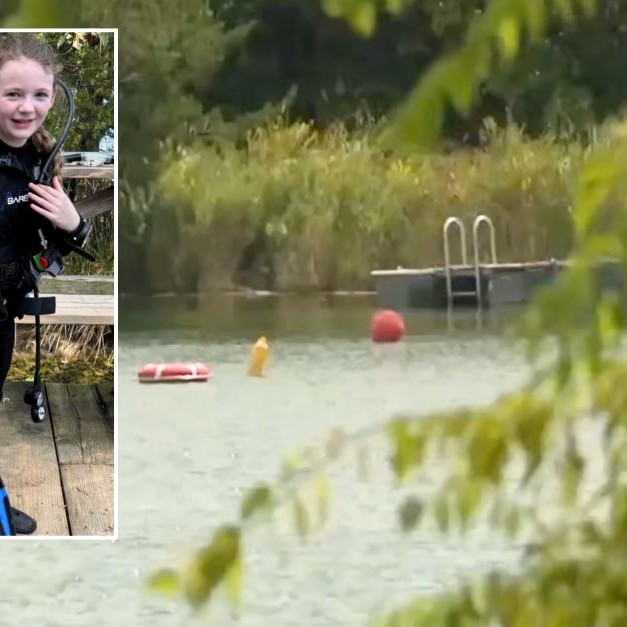
Image: Background: The Scuba Ranch training lake in Terrell, Texas. Inset: Dylan Harrison, as shown in the lawsuit.
Allegations in the Wrongful Death Complaint
The lawsuit, as described by Law & Crime, centers on a basic claim: that adults and institutions who invited a child into an environment with known risks did not do enough to protect her. The parents accuse the scuba school and related defendants of negligence and wrongful death, arguing that their conduct before, during, and after the dive fell below what is reasonably expected of professionals running a youth training program.
According to Law & Crime’s account of the complaint, Harrison was participating in a training exercise at The Scuba Ranch when she drowned. The suit alleges that those overseeing the session failed to implement or enforce adequate safety procedures, and that they did not respond effectively when the 12-year-old was in distress. The filing seeks monetary damages, but it also functions as a public allegation that the systems meant to keep beginners safe did not work.
The most striking accusation focuses on the program’s alleged attitude toward fatalities. The lawsuit, as quoted by Law & Crime, claims that staff were comfortable with what it describes as an “annual student kill count.”
The complaint portrays this phrase as evidence that the scuba school accepted student deaths as a routine cost of doing business, rather than as intolerable failures that demanded urgent change.
A wrongful-death lawsuit has been filed over the fatal scuba training dive of 12-year-old Dylan Harrison in Texas.
The claim alleges preventable failures, instructor negligence, and systemic safety issues within dive training. The case builds on earlier eyewitness accounts and… pic.twitter.com/Wlg9QkpOuU
— The Scuba News (@TheScubaNews) February 3, 2026
All of these claims remain allegations. At this point, the public record reflects only the plaintiffs’ description of what happened and of how the training program operated. The full dive logs, internal communications, and instructor accounts have not yet been presented in open court, and no judge or jury has evaluated the facts.
What Safety Duties a Scuba School Owes Children
Scuba diving carries inherent risks, including drowning, equipment failure, and medical emergencies. When children are involved, those risks are typically managed through layers of precautions that go beyond what is expected for experienced adults.
In recreational diving programs, industry standards generally emphasize several recurring ideas: careful screening of participants’ health and swimming ability, conservative depth and time limits for beginners, close supervision with clear lines of sight, and thorough emergency planning that includes rescue procedures and coordination with local medical services. Formal certification agencies, while not named in the Law & Crime reporting, usually publish detailed training standards that instructors are expected to follow.
Under Texas civil law, operators of a training program for minors are expected to exercise reasonable care. In practical terms, that means anticipating foreseeable dangers, taking steps to reduce those dangers, and responding promptly and competently when something goes wrong. For a scuba school, that duty can include, among other things, maintaining equipment, ensuring that student-to-instructor ratios are appropriate, monitoring students during underwater exercises, and having emergency oxygen and communication tools available.
When a tragedy occurs, the key legal question is rarely whether diving is risky in the abstract. Courts instead look at whether the defendants took reasonable precautions in light of known risks. The Harrison lawsuit, as summarized in public reporting, argues that they did not, and that this failure directly led to the 12-year-old’s death.
At the same time, important specifics are not yet clear from the available accounts. The public does not yet have a detailed, minute-by-minute reconstruction of Harrison’s final dive, nor a full picture of the staffing, training, and equipment in use that day. Those gaps are likely to be central to the litigation.
Culture Claims and Questions About Prior Incidents
The allegation of an “annual student kill count” pushes the case beyond individual decisions on a single day and toward a broader critique of organizational culture. In civil suits involving dangerous activities, culture claims often carry significant weight, because they can suggest that a failure was not an isolated lapse, but part of a pattern of attitudes and practices.
By highlighting that phrase, Harrison’s parents are asking a court to consider not only whether instructors acted reasonably in the moment, but also whether the entities running the program tolerated or normalized catastrophic outcomes. If a finder of fact concludes that leaders saw deaths as an acceptable recurring cost, that could affect both liability and the size of any damages awarded.
For now, however, those cultural claims are one sided. The defendants have not publicly presented their own view of the program’s safety record, how seriously they took prior incidents, or whether they dispute that the “annual student kill count” phrase was ever used. It is also not yet clear from public reporting how many student deaths, if any, occurred at the facility in past years, or whether state or local authorities ever investigated.
That lack of publicly available historical context matters. A claim that a facility maintained an “annual” count implies repeated tragedies, but the underlying numbers, dates, and circumstances have not been documented in detail in the initial reporting. Whether the phrase was an offhand remark, a mischaracterized comment, or a reflection of an actual pattern will likely be tested through sworn testimony and document production if the case proceeds.
How Civil Litigation Could Fill the Gaps
The Harrison case is still at a preliminary stage, centered on the parents’ complaint. If the lawsuit moves forward, the civil process in Texas will give both sides tools to gather and test evidence through discovery. That can include internal emails, training manuals, incident reports, safety audits, and prior claims or complaints, along with depositions of instructors, managers, and possibly other students or witnesses.
For the plaintiffs, discovery offers a chance to substantiate the picture painted in the complaint, including the “annual student kill count” allegation and any broader claims about lax safety standards. For the defendants, it offers an opportunity to challenge that narrative by pointing to written procedures, past safety records, or expert testimony about what constitutes reasonable care in youth diving programs.
Many civil negligence cases end in confidential settlements, which can limit what the public ultimately learns. Others proceed to summary judgment or trial, where judges or juries must weigh conflicting accounts. In either scenario, the legal process tends to produce a more detailed factual record than is available in initial news coverage, even if that record remains partially sealed or technical.
At this point, several questions remain unanswered in the Harrison case. How did the training dive unfold underwater, step by step? What policies and checklists were in place for supervising children in deep water? How, if at all, had the facility responded to any past serious incidents? The lawsuit ensures that those questions will now be asked under oath, but it will be up to the courts, and potentially a jury, to decide which answers to accept.
Sources
- Law & Crime: Scuba School That Let 12-Year-Old Girl Drown Was Fine With Annual Student Kill Count, Lawsuit Says
- Divers Alert Network: Annual Diving Report