

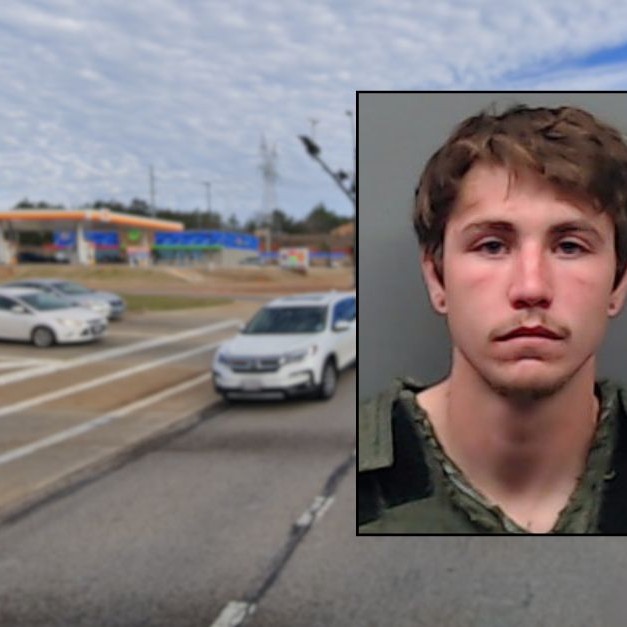
A 23-year-old truck driver is jailed on a first-degree murder charge in Tyler, Texas, after police say he shot a 29-year-old Marine during a roadside confrontation that unfolded at a red light while the victim’s wife and three children watched from inside their Tesla. Detectives have already rejected his claim of self-defense, but key details about how the encounter escalated remain in dispute.
TLDR
Prosecutors in Tyler, Texas, have charged 23-year-old Dayton Alexander Morgan with first-degree murder in the shooting death of 29-year-old Marine Trevor Julian during a road rage encounter at a red light that investigators say was not justified as self-defense.
According to Law & Crime’s reporting, citing local television and newspaper accounts, the confrontation on February 13th, 2026, began when Morgan’s truck stopped closer to a white Tesla at a red light than he considered safe or appropriate. Inside the Tesla, police say, were Julian in the front passenger seat, his wife driving, and their three children in the back seat.
By the time officers with the Tyler Police Department arrived at the intersection of Grande Boulevard and Paluxy Drive around 5 p.m., Julian had been shot once and was mortally wounded. Investigators quickly focused on Morgan, who remained at the scene and, according to police, identified himself as the only person who had fired a weapon.
Key Players and Initial Charge
Authorities have identified the defendant as Dayton Alexander Morgan, a 23-year-old truck driver. He is charged with one count of first-degree murder in the killing of 29-year-old Marine Trevor Julian, according to Law & Crime, which reviewed charging information and local news reports.
Jail records reviewed by the outlet show that Morgan is being held at the Smith County jail. Public reporting has not detailed his bond status or whether he has retained an attorney, and no public court filings were immediately available that would outline a fuller narrative from prosecutors.
Julian, described in local coverage as a Marine, was riding in the Tesla’s passenger seat. His wife was behind the wheel, and their three children were in the back seat, according to Nacogdoches-based CBS affiliate KYTX as cited by Law & Crime. That means four family members are potential eyewitnesses to at least part of the encounter.
The Confrontation at the Red Light
Much of what is publicly known about the moments before the gunshot comes from Morgan’s own account to police, as summarized in local media. According to the Longview News-Journal, which was referenced by Law & Crime, Morgan told investigators that both his truck and the Tesla were approaching the intersection when the traffic signal turned red.
He allegedly said the Tesla stopped abruptly, forcing him to stop his truck closer to the rear of the Tesla than he preferred. That positioning at the light, Morgan reportedly told police, is what triggered the confrontation.
Morgan claimed that Julian then got out of the Tesla and began walking toward his truck. While remaining seated, Morgan opened his driver’s side door. From there, according to the police account reported by multiple outlets, the men began shouting at each other in the roadway.
Julian allegedly yelled at Morgan to back his truck up. Morgan, according to the reported statement, answered with a profanity-laced question: “What the expletive is your problem?” The shouting continued, with Julian again telling Morgan to move his truck and Morgan telling Julian to move on, police said.
At this point, Morgan told investigators, Julian came closer to the driver’s side door of the truck. Morgan said he then reached into the center console, took out a handgun, racked the slide, and pointed the firearm toward the driver’s side door, according to the account summarized in Law & Crime’s reporting.
Morgan said the door of the truck was halfway open when he fired a single round through the window, striking Julian. When questioned by police after the shooting, Morgan reportedly acknowledged that Julian had not made verbal threats and that he did not see a gun in Julian’s possession.
Investigators Reject Self-Defense Claim
Despite Morgan’s account, detectives with the Tyler Police Department concluded that the facts did not support a legal claim of self-defense. According to Law & Crime’s summary of the investigation, police stated that “detectives determined that Morgan’s claim of self-defense was not supported by the evidence.” They have not, to date, publicly detailed the specific evidence that led to that conclusion.
Texas law allows the use of deadly force in self-defense under limited circumstances, generally requiring that a person reasonably believe such force is immediately necessary to protect against another’s use or attempted use of deadly force, or to prevent certain serious violent crimes. Whether Morgan’s actions could meet that threshold is now a question for the courts, not investigators.
The available reporting does not specify whether detectives reviewed surveillance footage from nearby businesses, dash camera recordings, or video from the Tesla, which is equipped with multiple external cameras in standard configurations. It also does not describe what officers were told by other motorists, pedestrians, or Julian’s family members beyond Morgan’s own statement.
What is clear from police statements is that investigators did not accept Morgan’s characterization of the encounter as one where he reasonably feared for his life or grave bodily harm. Their decision to recommend a first-degree murder charge rather than a lesser offense signals that authorities believe the evidence shows an intentional killing without legal justification.
A Family as Direct Witnesses
One unusual aspect of this case, even in a state where road rage shootings have been a recurring concern, is that the alleged victim’s immediate family appears to have witnessed much of what happened. KYTX, as cited by Law & Crime, reported that Julian’s wife was driving the Tesla and their three children were seated behind them when the confrontation began.
Investigators have not publicly described the children’s ages or what, if anything, they were able to tell detectives. Nor has there been public reporting on whether Julian’s wife has given a detailed statement that contradicts Morgan’s account of the events at the light.
The presence of multiple family eyewitnesses could be central at trial, particularly in a case where the defendant’s narrative and any forensic evidence can be compared with recollections from people who were feet away from the shooting. Texas juries in homicide cases routinely hear not only from law enforcement and experts, but also from surviving family members about what they saw.
For now, however, their accounts have not been detailed in public records or news coverage, leaving Morgan’s account of the argument and the moment he fired as the most fully documented version of events available.
From Street Encounter to Court Case
The February 13th, 2026, shooting turned a minor traffic dispute into a high-stakes criminal case that could carry a lengthy prison sentence if it results in a conviction. Under Texas law, first-degree murder convictions can be punished by decades in prison, though specific sentencing ranges depend on the statute charged and any enhancements.
As of the latest reporting, Morgan remained in custody at the Smith County jail. There has been no public indication that he has entered a plea or appeared in court beyond initial arrest and booking procedures. Defendants in Texas murder cases typically have a right to a bond hearing, but judges can impose high bond amounts or, in some situations, deny bond.
Because detectives have rejected Morgan’s self-defense claim, prosecutors are likely to emphasize any evidence showing that Julian was unarmed, that Morgan had the option to disengage or remain in his truck without firing, and that the argument did not rise to a level justifying deadly force under Texas law.
If the case proceeds to trial, defense lawyers could argue that Morgan reasonably perceived Julian as a threat, even if Julian did not have a weapon, or that the rapid escalation of events created a split-second decision under stress. They may also scrutinize whether investigators thoroughly canvassed for video, physical evidence, and independent eyewitnesses that could either support or weaken Morgan’s account.
Unanswered Questions and What Comes Next
Several significant questions remain unanswered in the public record. It is not yet clear whether any cameras captured the confrontation, whether 911 callers saw the argument before the shot was fired, or whether Julian made any movements that Morgan interpreted as threatening beyond walking toward the truck.
There is also no public information about whether Morgan had a license to carry the handgun, how long he had been driving in the area that day, or whether either man had consumed alcohol or other substances. Those are the kinds of details that often appear later, in affidavits, pretrial motions, or trial testimony, rather than in initial arrest reports.
What is clear is that a brief traffic dispute at a Tyler intersection ended with a Marine fatally shot, a 23-year-old facing a first-degree murder charge, and a family who, according to authorities, witnessed the killing from a few feet away. As the case moves from the street into the courtroom, judges and jurors will be asked to decide whether Morgan’s split-second decision to fire was criminal or legally justified self-defense.
Until those proceedings unfold, the only official conclusion is the one already reached by investigators: that the evidence they have collected does not support Morgan’s self-defense claim on the side of the road.