


The left turn should have taken only a few seconds. Instead, firefighters later wrote three words in an official report that now sit at the center of a Florida criminal case: “They burned alive.”
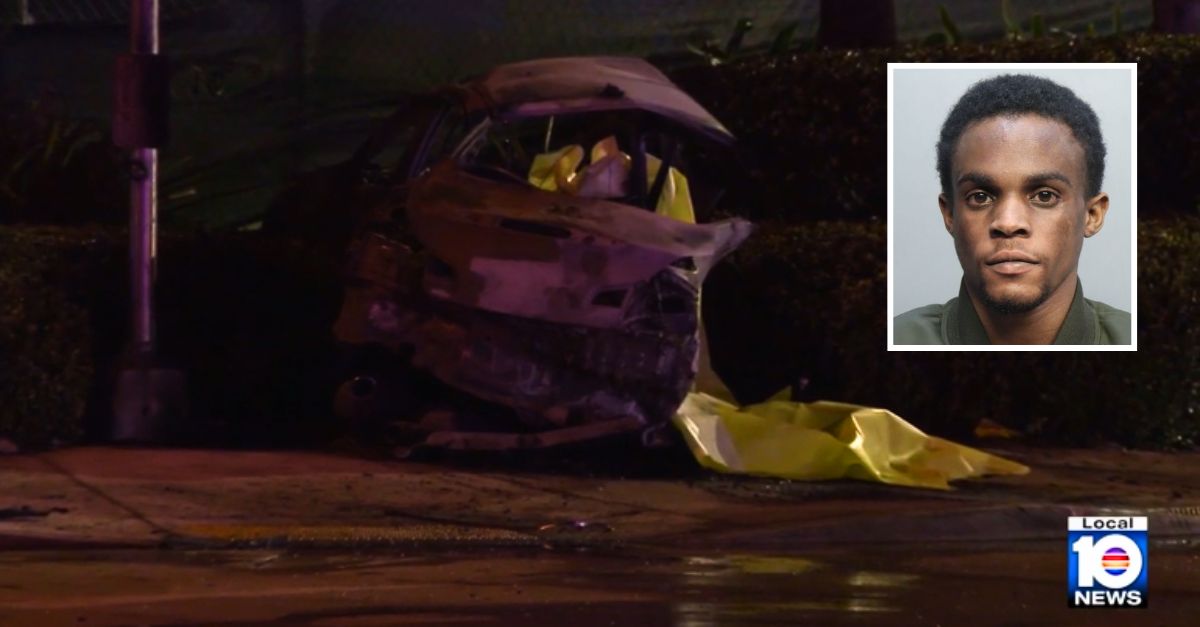
Those words describe the final moments of 43-year-old Cynthia Orsa Telliz and her daughters, 15-year-old Sophia Saidi and 12-year-old Maria Saidi, after a Dodge Charger, driven at highway speeds on a city causeway, collided with their Infiniti in North Bay Village near Miami. The driver, 27-year-old Julius Bernstein, has now been sentenced to 45 years in state prison for vehicular homicide and leaving the scene of a crash involving death, according to court proceedings reported by Law & Crime.
The Causeway Crash
The collision happened in June 2022 on the John F. Kennedy Causeway, a stretch of road that connects mainland Miami to barrier island communities and carries a posted speed limit of 30 miles per hour.
A probable cause affidavit, described by Law & Crime, states that Bernstein was traveling at 109 miles per hour in his Dodge Charger as he approached the area where Telliz was attempting a left turn in her Infiniti G35. Data cited in that affidavit indicates he had only slowed to about 97 miles per hour when his car hit hers.
The impact set the Infiniti on fire. First responders arrived quickly and were able to pull Telliz out of the burning vehicle, according to that same affidavit. Her daughters, still inside, could not be reached in time.
“They burned alive,” investigators wrote in the probable cause affidavit, a blunt description that has since been repeated in courtroom coverage.
All three were pronounced dead. Public reporting has not indicated that any other vehicles were involved in the crash.
Leaving the Scene and Arrest in Another State
According to the affidavit summarized by Law & Crime, Bernstein did not remain at the scene after the collision. Instead of calling 911 or trying to help, he left the area while injured, reportedly leaving a visible blood trail behind him.
Florida law requires drivers involved in crashes that cause death or serious injury to stop, remain at the scene, and provide information and assistance. Prosecutors charged Bernstein not only with vehicular homicide but also with leaving the scene of a crash involving death, a felony that treats flight from a fatal wreck as a separate serious offense.
After investigators identified Bernstein as the suspected driver, authorities obtained an arrest warrant. He was taken into custody in North Carolina in 2023, according to Law & Crime. Details of how long he had been in that state and how he was ultimately located there have not been fully described in public reporting.
There has also been no reporting that prosecutors alleged Bernstein was impaired by alcohol or drugs at the time of the crash. The case, as it has been presented publicly, has focused on speed, decision-making, and the failure to remain at the scene.
From Trial to 45-Year Sentence
In September, a Miami-Dade County jury convicted Bernstein of vehicular homicide and leaving the scene of a crash causing death. The charges reflect two distinct findings by jurors. First, that his driving on the causeway met Florida’s legal definition of vehicular homicide. Second, that his decision to leave the scene after the collision constituted a separate crime.
At a sentencing hearing described by Law & Crime, the judge imposed a total of 45 years in prison. Public reporting has not broken down how that term was allocated between the individual counts, nor has it detailed the precise sentencing guidelines calculations that were presented in court.
In Florida, judges in serious traffic homicide cases typically hear from both sides about factors such as a defendant’s prior record, risk to the public, and any mitigating circumstances before deciding on a sentence within the legally permitted range. It is not clear from current public accounts what arguments Bernstein’s defense team made in mitigation or whether prosecutors sought a longer term than the 45 years that was ultimately imposed.
So far, there has been no widely reported indication of whether Bernstein plans to appeal his conviction or sentence. Appeals in similar cases can focus on issues such as how crash reconstruction evidence was presented, the admissibility of expert testimony, or how jurors were instructed on legal standards like recklessness.
The Family’s Words in Court
During the sentencing hearing, members of Telliz’s family addressed the court. Their statements are not legal evidence, but they do give a public record of the impact of the crash on those left behind.
Telliz’s husband, and the father of Sophia and Maria, spoke about losing his wife and both daughters in a single event. According to coverage of the hearing, he described their deaths as a permanent break that he could not forgive, and he framed his remarks directly to the defendant in the courtroom. Local ABC affiliate WPLG reported that he described his family members’ lives as having been taken from him.
Telliz’s brother, Omar Orstelliz, also addressed the court. WPLG reported that he said, “Being left alone in their final moments is something we live with every day.”
His words point to the particular circumstances of this crash. The official record states that first responders could not get to the girls in time, and that the driver who hit them left the scene without rendering aid. For the family, the gap between those facts is part of the harm.
What We Know, and What We Do Not
Public records and reporting establish some core facts about this case. A mother and two daughters died when their car erupted in flames after being struck by a Dodge Charger traveling more than three times the posted speed limit on a Miami-area causeway. The driver of that Charger left the scene, was later arrested in another state, and has now been convicted and sentenced to 45 years in prison for vehicular homicide and leaving the scene of a crash involving death.
They also show that first responders were able to reach only one of the occupants in time, that investigators described the girls in stark terms as having burned alive, and that the family has spoken publicly in court about living with the knowledge of how those final moments unfolded.
Other details remain unclear from available reporting. It is not publicly known whether Bernstein had any prior serious traffic offenses, what specific plea discussions, if any, took place before trial, or whether an appeal is already in progress. The precise forensic evidence that convinced jurors, beyond speed calculations and physical crash damage, has also not been fully described outside the courtroom.
What is clear from the court record and media coverage is that a few seconds on a causeway, and decisions made before and after impact, have now resulted in three deaths, a 45-year prison sentence, and a set of questions for the families involved that a criminal verdict cannot entirely resolve.