

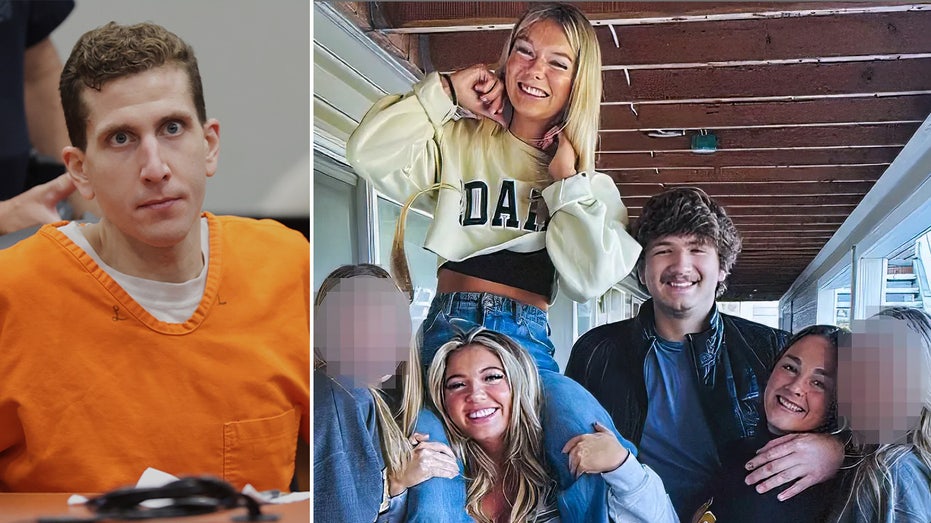
By the time the public saw the new diagrams and injury counts, the person convicted in the killings was already serving four life terms. Yet the most intimate details of what happened inside the Moscow, Idaho, rental house had stayed sealed until now.
What the New Records Reveal
Unsealed court filings, described in reporting by Fox News Digital, provide a granular forensic account of the November 2022 killings of four University of Idaho students in an off-campus home on King Road.
The filing summarizes anticipated testimony from a bloodstain pattern analyst. According to that document, the expert reviewed autopsy materials, crime scene photographs, and laboratory results to reconstruct how the victims were injured and whether they moved after the attacks began.
The disclosure, as reported by Fox, lists approximate numbers of sharp force injuries for each victim:
Kaylee Goncalves: about 38 sharp force wounds.
Madison Mogen: 28 sharp force wounds.
Xana Kernodle: 67 sharp force wounds.
Ethan Chapin: 17 sharp force wounds.
The document does not reproduce the full autopsy reports. Instead, it highlights selected findings that prosecutors and defense attorneys expected to be central at trial, including the locations of the bodies and the presence or absence of blood on the victims’ feet.
Inside the House on King Road
Public records and contemporaneous reporting establish the basic outlines of the crime. In mid-November 2022, four students were found dead in a three-story rental home near the University of Idaho campus. They were identified as roommates Kaylee Goncalves and Madison Mogen, both 21, and Xana Kernodle and Ethan Chapin, both 20. Chapin was staying overnight as a guest of Kernodle. A summary of the case history appears on the Wikipedia entry for the 2022 University of Idaho killings, which compiles information from court documents and multiple news outlets.
The newly unsealed disclosure gives a more detailed picture of what investigators believe happened in the moments before and after the fatal wounds were inflicted.
According to the expert summary described by Fox News Digital, all four students were found in their respective bedrooms. There was no physical evidence in the rooms to suggest that any of them had left and then returned after the attacks began.
Goncalves and Mogen were discovered together, lying in bed under a comforter in Mogen’s third-floor bedroom. Investigators reported no blood on the bottoms of their feet. The bloodstain analyst’s view suggested that both women remained in or near the bed from the time they were first attacked until they died.
Chapin was found on the bed in Kernodle’s second-floor bedroom, partially covered with bedding. The disclosure states that there was no blood on the bottoms of his socks. That detail again led the analyst to conclude that Chapin likely did not move around the room after he was injured.
Kernodle’s body was found on the floor of her bedroom. Unlike the other three, she had blood on the bottoms of her bare feet. According to the summary, the analyst interpreted that pattern as evidence that Kernodle stepped in blood and moved around inside her room during at least part of the attack.
The expert’s conclusions are not unusual in modern homicide cases. Bloodstain pattern analysis is regularly used to infer whether a person stood, walked, or remained in place after being wounded. It is a field that has also drawn scrutiny from defense attorneys and some researchers, who argue that its techniques can be misapplied if analysts overstate what blood patterns can definitively prove.
Fitting Forensic Detail Into a Larger Case
The new disclosure does not exist in isolation. It sits on top of a record that already included an extensive probable cause affidavit and a notice of intent to seek the death penalty.
In December 2022, police arrested Bryan Kohberger, then a Washington State University doctoral student, in connection with the killings. According to the publicly released probable cause affidavit, investigators tied Kohberger to the King Road house through a series of data points, including cellphone records that placed his device near the residence, video images of a white Hyundai Elantra, and DNA on a knife sheath recovered at the scene. Those elements are summarized in detail on the Wikipedia case entry, which cites filings from the Latah County court and outlets such as the Associated Press and CNN.
In mid-2023, prosecutors filed a formal notice that they intended to seek the death penalty. The state argued in that filing that the murders were, in the language of Idaho capital sentencing law, “especially heinous, atrocious or cruel, manifesting exceptional depravity,” a phrase that appears in the state’s statutory aggravating factors and was quoted in coverage by multiple national outlets.
The bloodstain pattern disclosure appears to have been prepared for a contested, capital trial. It sets out how the expert would testify regarding where each victim was located, the sequence of the attacks, and any signs of defensive movements or struggle inside each bedroom. Those details would have helped jurors interpret other evidence, such as photographs, sketches, and autopsy summaries, had the case gone to a full death penalty trial.
From Capital Case to Life Sentence
Instead, the case ended in a plea agreement. According to Fox News Digital, Bryan Kohberger pleaded guilty in July 2025 to four counts of first-degree murder. The state reportedly agreed to take the death penalty off the table, and Kohberger received four consecutive life sentences without the possibility of parole. He is incarcerated at the Idaho Maximum Security Institution.
Plea agreements in capital cases often reflect a combination of factors. For prosecutors, they remove the uncertainty, time, and expense of a death penalty trial and possible appeals. For defendants, they eliminate the risk of execution in exchange for a guaranteed life term.
What is less visible from outside the courtroom is precisely how newly surfaced forensic disclosures influence that decision-making. The bloodstain pattern analysis in this case supports a narrative of a targeted, close-contact attack in confined spaces, with three of the four victims likely dying in or very near their beds. Kernodle’s apparent movement within her room suggests she may have remained conscious for at least some portion of the attack.
Those kinds of details can affect plea discussions on both sides. For the state, they reinforce arguments about the severity and cruelty of the crime. For a defense team, they shape assessments of how a jury might respond to graphic testimony about the victims’ final moments.
Families, Secrecy, and a Slow Unsealing
The families of the four students have been vocal throughout the case about their desire for transparency and a complete public record. Reporting in 2024 and 2025 described their frustration with sealing orders and with the limited information released about autopsies and the crime scene. Fox News Digital has previously reported on the families’ anger after crime scene photographs were accidentally released during a separate proceeding.
At the same time, Idaho courts have had to balance those calls for openness against the defendant’s right to a fair trial and, later, the need to protect sensitive images and medical details from unnecessary circulation. For much of the pretrial period, judges restricted public access to parts of the record, including detailed autopsy results and some expert disclosures.
The newly surfaced bloodstain pattern summary reflects that tension. It reveals more about what investigators believe happened inside the house without disclosing every medical detail documented by coroners. It also helps explain some of the early public statements by investigators, who repeatedly said they believed the students were likely attacked while sleeping and that the killings were targeted rather than random.
What Remains Unanswered
The core narrative of the case is now fixed in one crucial way. Kohberger has pleaded guilty and received his sentence. There will be no capital trial where jurors publicly weigh the expert testimony described in the unsealed filing.
Yet significant pieces remain outside public view. The complete autopsy reports are still not part of the regular court file. The full set of crime scene photographs, diagrams, and lab reports also remains restricted.
The unsealed bloodstain pattern analysis offers a narrower kind of clarity. It indicates that three of the students appear not to have moved from where they were first attacked. It suggests that one of them did. It sets those conclusions out in the clinical language of forensic science, not in the emotional terms used by grieving families or in the legal language of capital sentencing law.
With the criminal case resolved and a convicted defendant serving life without parole, it is not yet clear how much more of the forensic record will ever be released. The new disclosures answer specific questions about where the victims were and how much they moved. They also underscore how much of what investigators saw inside the house is still known only to a small set of people who were never in the room when it happened.