



By the time officers forced their way into the Jeffersonville, Indiana, home, a photograph of the woman on the floor had already been texted from her phone to another man, along with two words that would later be repeated in court: “Your fault.”
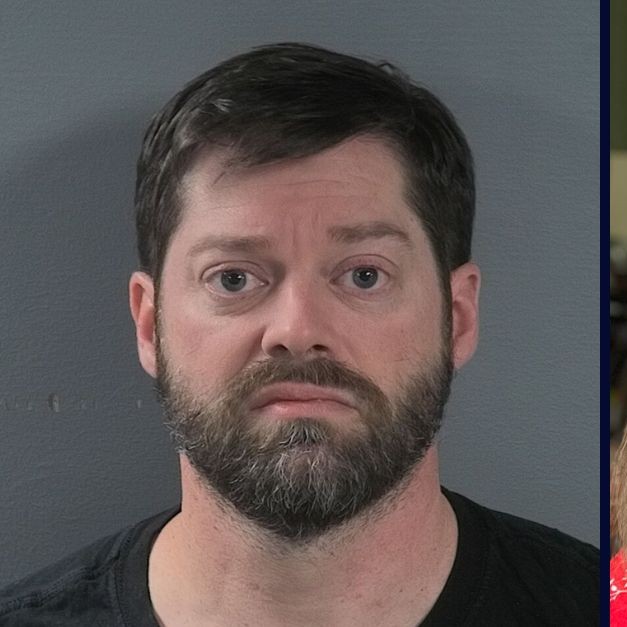
Prosecutors say that the image showed 36-year-old Deborah Meyer, who had been stabbed dozens of times. According to Indiana court records and a detailed account in Law&Crime, a Clark County jury has now found her husband, 35-year-old Taylor James Meyer, guilty of murder after a six-day trial.
A Late Night Call and a Disturbing Photo
According to prior reporting from Law&Crime, Jeffersonville police were dispatched to the Meyers’ address on Westwood Drive late on Valentine’s Day after a man called for help. The caller told an emergency dispatcher that he had received a call from Deborah Meyer’s phone and could hear her yelling for help in the background.
When officers arrived, they knocked repeatedly, but no one answered. The caller drove to the house and met them there. While he was outside speaking with the police, a new message appeared on his phone. It came from Deborah Meyer’s number. The attached photograph, he told authorities, appeared to show her lying on the floor inside the home.
At that point, officers breached the door. According to a probable cause affidavit described by Law&Crime, they encountered an aggressive Taylor Meyer and used “control techniques” to detain him. Inside, they found Deborah Meyer dead and three young children, all under the age of 5, still in the home.
A medical examiner later concluded that Deborah Meyer had been stabbed about 40 times. Investigators wrote in the affidavit that the wounds were concentrated around her chest.
What Meyer Told Detectives Happened
The most detailed account of what occurred inside the house comes from Meyer himself, as summarized by detectives in the probable cause affidavit and quoted by Law&Crime. In a hospital interview after his arrest, he allegedly admitted to killing his wife and described a marriage he said had been unraveling for months.
Meyer told investigators he had seen a photo of his wife holding hands with another man in January. He referred to the man as her “co-worker” and said he believed the two were in a relationship. From that point, he claimed, he felt humiliated and angry.
According to the affidavit, Meyer said he tried to repair things by planning an elaborate Valentine’s Day evening at home. He told police it had a “Bringing Paris to you” theme and that he had their children draw Eiffel Tower pictures to use as decorations.
“It was the hardest I’ve ever tried,” he allegedly told detectives. He said his wife did not respond the way he hoped and later left the house. He believed she was meeting the man he thought was her boyfriend and told police he was upset about being left at home with the children again.
“For the last two months I’ve been staying home with the kids every Saturday night while she goes and f***s whoever and lies to my face about it,” Meyer said, according to the affidavit quoted by Law&Crime. That language comes from his recorded statement as summarized by investigators.
Meyer said Deborah Meyer left the home for about 20 minutes. When she returned and went into the bathroom, he tried to look at her messages through the smartwatch she used. When she came back out, he demanded her phone. She refused.
From there, his account describes a rapid escalation. In the affidavit, a detective wrote that Meyer said his wife punched him in the face when he tried to take her phone. “He stated that during the argument she punched him in the face and he grabbed her and took the cellular phone and told her, ‘I’m stronger than you,'” the officer wrote.
According to that same affidavit, Meyer told the detective that the interaction became “all wrestling and hitting, and I started choking her. She hit me with a water bottle, and I hit her with a wine bottle, and then I went and got the knife.”
Meyer claimed that during the struggle, his wife asked him, “What are you going to do, kill me? You’re going to hurt me and leave our kids with no parents?”
A Phone Call, a Knife, and a Text
At some point, according to the affidavit, Meyer got hold of his wife’s phone while she was on the ground. He said he went through her messages, then used the phone to call the man he believed was her boyfriend. With Deborah Meyer screaming in the background, he told the man on the line, “It’s your f***ing fault. You want to ruin my marriage and tear my family apart,” the detective wrote.
After that call, Meyer said he went back to choking his wife. He told investigators he hit her in the head several times with a wine bottle until she was unconscious. Unsure whether she was dead, he stated that he walked into the kitchen, took a large kitchen knife, and repeatedly stabbed her in the chest.
Police and prosecutors say he then used Deborah Meyer’s phone to send a photograph of her body to the same man, with a caption that read, “Your fault.” Law&Crime reports that the man received that image while standing outside the home with officers.
The medical examiner’s finding of approximately 40 stab wounds is consistent with the description in the probable cause affidavit and was introduced at trial, according to court records cited by Law&Crime.
From Homicide Scene to Murder Conviction
Publicly available records on Indiana’s MyCase portal list a state case against Taylor James Meyer in Clark County and show a jury verdict of guilty on one count of murder. The case summary, accessible through the state’s online system, confirms that jurors returned their decision after a multi-day trial. The docket also reflects that Meyer remains in custody at the Clark County Jail while he awaits sentencing.
Law&Crime reports that jurors deliberated only a few hours after closing arguments before convicting Meyer of murdering his wife on Valentine’s Day. The outlet notes that the trial lasted six days, but available reporting does not detail what arguments Meyer’s defense team presented in response to his recorded statements and the forensic evidence.
Under Indiana law, a murder conviction can carry a wide range of penalties, from several decades in prison to a sentence that effectively lasts for the rest of a person’s life. Exactly where within that range Meyer will fall is expected to be decided at a sentencing hearing currently scheduled in Clark County court, according to Law&Crime’s review of the case.
What the Public Record Still Does Not Show
Many of the most vivid details in this case come from a single source: Meyer’s own description to detectives, as captured in the probable cause affidavit and relayed by Law&Crime. That statement was given after his arrest and after officers had already found his wife dead in the home.
The public record that is easily accessible does not include a full trial transcript. It does not show what, if any, parts of Meyer’s account his attorneys contested in court. It is not clear from current reporting whether the defense challenged his statements as unreliable, sought to introduce expert testimony, or argued for a lesser offense based on his mental state or other factors.
The available documents and reporting also do not describe the couple’s history before the night of the killing. There is no public information in these sources about prior calls to police, any previous allegations of domestic violence, or whether family members or friends had raised concerns about the relationship before the homicide.
What is clear from both the affidavit and the jury’s verdict is that three very young children were inside the house when their mother was killed, and their father was arrested. The court docket does not reveal where those children are now or what long-term arrangements are being made for their care, privacy, and safety.
As sentencing approaches, the core facts reflected in the official record remain stark. A woman is dead from dozens of stab wounds on a night that was supposed to be a celebration. Her husband admits to inflicting them, but has not yet heard the length of the prison term he will serve. How the court will weigh his detailed confession, the impact on the couple’s children, and the circumstances he described around the marriage will be decided in a courtroom that, for now, is documented mainly through a short docket entry and a few sentences in a probable cause affidavit.