


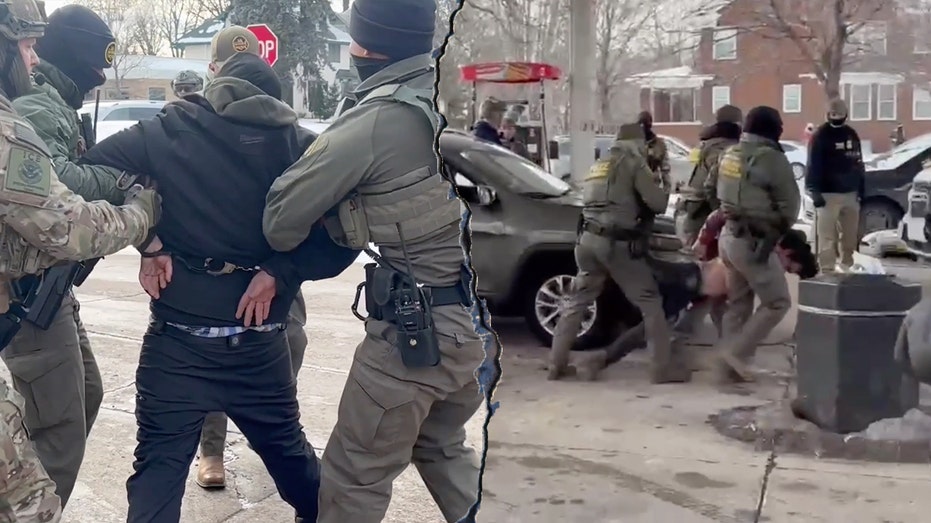
At a St. Paul gas station, car horns blared as federal agents pulled two men to the pavement and carried them away by their arms and legs. On camera, a senior Border Patrol official shouted orders. On paper, there is still no clear public record of why it happened.
What The Videos Show And What They Do Not
The incident entered public view through short clips posted to X, formerly Twitter, and through reporting by Fox News Digital. The outlet published video that appears to show U.S. Border Patrol Chief Gregory Bovino directing agents and bystanders in a gas station parking lot in St. Paul, Minnesota, as two men are detained on the ground and handcuffed.[1]
In one clip, multiple federal agents encircle a parked vehicle as people with phones record at close range. The crowd is noisy but the images, as described in the Fox report, show no clear weapons or obvious threat from those standing nearby.
Over the sound of car horns, Bovino can be heard telling people to move back.
“Back up, guys, back up,” he says in the video. “We’re going to back you on up for our safety and your safety… Stay there.”[1]
Moments later, agents pull a man in a brown jacket from the vehicle, push him to the ground, and put him in handcuffs. Fox reports that three agents then carry him away by his arms and one leg as others continue to direct the crowd to step back.
A second clip, according to the same report, shows a Border Patrol agent again ordering bystanders to retreat. When a man appears not to comply, several agents tackle him and restrain him on the pavement before carrying him away in a similar manner.
The videos make at least three facts clear.
Item 1: Federal agents, identified by Fox News as Border Patrol personnel, physically detained two men at the St. Paul gas station and carried them away in handcuffs.
Item 2: A senior official, identified as Chief Bovino, directly managed both the crowd and the arresting agents during the incident.
Item 3: Bystanders were close enough to record detailed video, and some did not immediately comply with verbal orders to move back.
Beyond those points, most key details remain off camera. The clips do not show what prompted the initial stop, whether the men were suspected of a crime, whether they were targets of a federal operation, or whether they ultimately faced any charges.
Officials Decline Comment, Records Not Yet Public
Fox News Digital reported that spokespersons for the Department of Homeland Security (DHS) and for U.S. Customs and Border Protection (CBP) did not immediately respond to requests for comment about the detentions.[1] As of that reporting, there was no public statement explaining the legal basis for the arrests, the identity of the men, or whether they were released or charged.
CBP, the parent agency for the Border Patrol, typically publishes high-level policies and press releases about significant enforcement operations on its website.[2] There is no indication in the Fox article that CBP treated the gas station detentions as an operation that warranted a public announcement. Without charging documents, court records, or an agency account, the men at the center of the video remain unnamed and their status unknown.
That lack of documentation limits what anyone outside law enforcement can say with confidence. Viewers can analyze the clips frame by frame. They cannot see the paperwork that would normally justify a federal arrest or explain whether local prosecutors were ever involved.
Set Against A Deadly ICE Shooting
The gas station confrontation did not happen in isolation. Fox News linked it directly to tensions in the Twin Cities following the fatal shooting of 37-year-old Renee Nicole Good during an Immigration and Customs Enforcement (ICE) operation in Minneapolis.[1]
According to that reporting, Good was shot and killed by an ICE agent during a federal immigration enforcement action. Federal officials told Fox that Good had attempted to drive her vehicle toward agents during the encounter, and that the agent fired in response to what was described as a potentially deadly threat. Family members and some local leaders disputed that account, questioning whether Good posed the kind of imminent danger that would justify lethal force.
In the days that followed, people took to the streets in Minneapolis and St. Paul to protest the shooting and the broader presence of immigration enforcement in their neighborhoods. Fox described many of those on the streets as “agitators” and emphasized confrontations with federal officers. Other outlets and advocates have historically used different language in similar situations and have characterized participants as protesters or community members.
💢 At least 29 people were arrested after protesting against ICE agents, authorities say
Protests in response to the shooting death of Renee Nicole Macklin Good, 37, by an Immigration and Customs Enforcement agent in Minneapolis https://t.co/cQsx6gwDpy pic.twitter.com/XFuJ7HMFGw
— Anadolu English (@anadoluagency) January 11, 2026
What is not yet available in the public record, at least as reflected in the Fox reporting, is the outcome of any internal or external investigation into Good’s death. DHS has an Office of Inspector General with authority to review serious incidents involving its personnel, including use of deadly force.[3] ICE also maintains internal mechanisms for reviewing shootings by its officers.[4] Until those processes produce findings and those findings are made public, the exact circumstances of the shooting remain in dispute between federal officials and Good’s family.
Use Of Force Rules For Federal Agents
Federal agencies generally train their officers to use force that is both objectively reasonable and proportional to a perceived threat. DHS policy states, in broad terms, that officers may use force that is necessary to carry out their law enforcement duties and to protect themselves and others from harm, subject to constitutional limits and agency-specific rules.[5]
CBP, which includes the Border Patrol, has its own use-of-force policies that specify how agents should respond in situations involving moving vehicles, resistant subjects, and crowds.[2] Those documents make a distinction between passive resistance, such as failing to follow a verbal order, and active aggression, such as attacking an officer. More intrusive physical tactics are typically reserved for situations where an individual is actively resisting or posing a safety risk.
From the outside, it is not possible to map those policies perfectly onto the St. Paul video. The clips do not include audio of the full interaction between agents and the men who were detained, nor do they show what, if anything, the men were doing before officers closed in.
They do, however, show tactics that fall on the more forceful end of the spectrum. In both detentions, multiple agents take individuals to the ground and then carry them away suspended by their limbs. The reasons for using that level of control remain unexplained.
Rights Of Bystanders And Crowd Control
The presence of cameras in the gas station parking lot is consistent with a broader national trend. Civil liberties organizations have long argued that people have a First Amendment right to record police and other law enforcement in public places, as long as they do not interfere with officers’ duties. The American Civil Liberties Union, for example, publishes guidance titled “Know Your Rights: Photographers,” which outlines those protections and practical limits.[6]
Courts in several federal circuits have recognized the right to record, though specific rulings vary by jurisdiction. At the same time, officers may lawfully create perimeters, move crowds, or order people to back up when they can point to a safety or operational need.
The St. Paul clips capture that tension in a few seconds of audio and video. Bystanders appear close enough to reach the vehicle where agents are working. Phones are pointed directly at the arrest. Chief Bovino repeatedly orders people to move back, framing it as a matter of “our safety and your safety.”
Whether any bystander crossed the legal line between recording a public official and unlawfully interfering with an arrest is not addressed in the Fox report. No one is clearly seen attacking agents in the clips. The second tackled man appears to be arguing and holding his ground, but the specific commands given to him, and whether he was under arrest before being taken to the pavement, remain off-screen.
Two Linked Incidents, Many Unanswered Questions
The fatal shooting of Renee Nicole Good and the gas station detentions that followed are linked by geography, timing, and the presence of federal officers on city streets. In both cases, public understanding depends heavily on what government agencies choose to disclose and what independent investigators, if any, ultimately find.
For the shooting, the central factual dispute is clear. Federal officials say Good drove her car toward agents, creating a potentially deadly threat. Her family and some local leaders dispute that description and question the necessity of lethal force.
For the gas station incident, the gaps are more basic. Who were the two men who ended up face down on the asphalt, then carried away in front of a crowd? Why were they detained by Border Patrol agents in St. Paul rather than by local police? Were they charged with crimes or released without charges? Publicly available reporting so far does not answer those questions.
Short, viral clips can define the public narrative of an encounter between law enforcement and civilians. They rarely capture the full story. Until DHS, CBP, or ICE release more detailed accounts, or until local court records surface, the men in the gas station video will remain known mainly for how they were carried away, not for who they are or what they were accused of doing.