

Los Angeles police issued a dispersal order in early February 2026 after a large student protest over federal immigration enforcement in downtown Los Angeles escalated into property damage and detentions, yet authorities have not publicly clarified who was arrested or how many of those detained were students.
The episode unfolded near the federal immigration enforcement hub in downtown Los Angeles, where hundreds of middle and high school students, according to police and local television footage, moved from campus walkouts into city streets to protest federal immigration policies. Police say the protest blocked traffic and included vandalism, but many basic facts about the confrontations and arrests remain unsettled.
What Police Say Happened Downtown
According to a report by Fox News, the Los Angeles Police Department’s Central Division issued a community advisory in the mid-afternoon, stating that officers were in the process of detaining a person for throwing items when part of the crowd intervened.
In the advisory, officers said that as they attempted to take the individual into custody, surrounding demonstrators “began to impede” them. That description, provided by police, is one of the few official accounts of the interaction between officers and protesters at the moment the situation began to change.
The same report states that a dispersal order followed, with authorities warning that anyone who remained at the scene would be “subject to arrest.” The department did not specify in the advisory how many people ultimately refused to leave, how many arrests were made, or whether anyone was injured.
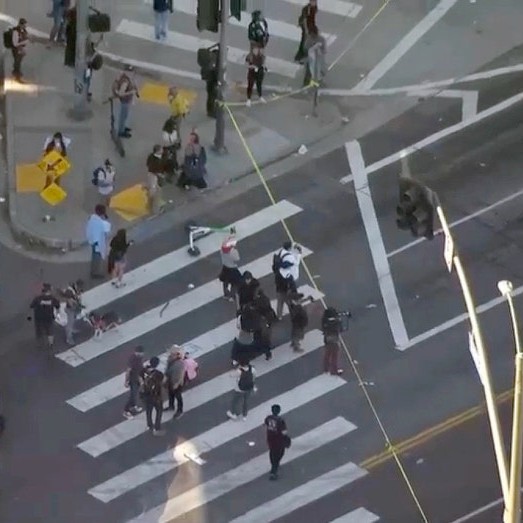
Footage obtained by FOX 11 Los Angeles, referenced in the Fox News report, showed students marching through downtown streets carrying backpacks, holding signs, and waving large Mexican flags. Police said the group blocked at least four lanes of traffic as it moved through the city.
Crowds appeared to thin as the protest neared the federal Immigration and Customs Enforcement, or ICE, field office at East Temple Street and North Alameda Street. That federal building has long been a focal point for local demonstrations over deportation, detention, and border enforcement policies.
From Student Walkout to Street March
Fox News reported that the crowd consisted of hundreds of middle and high school students who left class to participate. Their protest targeted federal immigration enforcement, though officials have not publicly detailed which specific policies or actions the students were responding to that day.
The available reporting does not indicate which schools the students attended, whether the walkouts were coordinated with any formal organizations, or how the march route was chosen. It also does not clarify whether school administrators or parents had prior notice of students’ plans.
Publicly available descriptions suggest a familiar dynamic in Los Angeles and other large cities, where youth-led protests often move quickly from campus grounds onto surrounding streets. Once that shift occurs, traffic disruption, police response, and, at times, confrontations tend to follow.
In this case, the description of students carrying backpacks and school-related items, combined with images of flags and protest signs, highlights the overlap between a school day and a political demonstration. It also raises questions for school districts, parents, and city officials about how to balance students’ civic engagement with safety obligations during the school day.
The Dispersal Order and Legal Standards
Under California law, police can issue a dispersal order when they determine that a gathering has become an unlawful assembly or when there is an immediate threat to public safety. People who remain after a lawful order to disperse can be arrested on misdemeanor charges related to unlawful assembly or failure to disperse.
In this protest, the LAPD stated that a dispersal order was given and warned that those who stayed could face arrest. The department did not release the exact wording of the order, how it was broadcast, or how much time officers allowed for people to leave before moving to enforce it.
The threshold for declaring an unlawful assembly typically requires violence, credible threats of violence, or other serious safety risks. The community advisory mentioned thrown objects, interference with an arrest, and later, vandalism. Without access to the full advisory text, body camera footage, or radio logs, it is not yet possible to independently evaluate how LAPD applied that standard in this case.
One key question in any protest response is whether officers attempted de-escalation before issuing a dispersal order. The Fox News account does not describe any earlier negotiations or crowd management steps, nor does it mention whether any community liaisons, school officials, or youth advocates were on scene.
Another unresolved issue is the number and type of charges ultimately filed related to failure to disperse. While police warned that remaining at the scene could result in arrest, they have not, in the reporting available so far, provided a breakdown of charges beyond the vandalism allegations.
Vandalism Allegations and Possible Felony Charges
According to LAPD statements reported by Fox News, at least four people were detained on suspicion of vandalizing property in the area near the ICE field office. Police said those individuals would be booked on felony vandalism charges.
California’s vandalism statute allows prosecutors to charge vandalism as a felony when the damage meets or exceeds a specified dollar amount, or when certain circumstances, such as prior convictions, are present. Conviction can carry potential prison time, restitution requirements, and a criminal record that can affect education, housing, and employment.
Police have not publicly detailed what was damaged, how much the damage was estimated to cost, or whether the suspected vandalism targeted government property, private businesses, or other sites. They have also not released the ages, identities, or affiliations of the four individuals, beyond stating that it was unclear whether they were students or participants in the march.
That uncertainty matters. If the suspects are minors, their cases would likely move through the juvenile justice system, which operates under different rules, including privacy protections and an emphasis on rehabilitation. If they are adults, they could face the full range of adult felony penalties.
Without a charging document or court docket, it is not yet possible to confirm whether felony vandalism complaints have been filed, whether prosecutors may ultimately reduce the charges, or whether any of the detained individuals will instead face misdemeanor counts.
What is clear from LAPD’s statement, as reported, is that police chose to emphasize potential felony consequences in their public description of the protest. That choice underscores how quickly a student-led demonstration can intersect with serious criminal exposure when property damage is alleged.
ICE Office as a Protest Flashpoint
The reported rise in tensions near ICE’s Los Angeles field office fits a pattern seen in past demonstrations over immigration enforcement. Federal facilities that house immigration courts, detention offices, or enforcement agencies often become symbolic targets in protests about deportations, family separations, or workplace raids.
In this case, Fox News reported that crowds appeared to dwindle as the march approached the ICE office at East Temple Street and North Alameda Street. It is not clear from the available reporting whether the dispersal order was given before the protest reached the federal building, outside it, or after the crowd began to move away.
No federal agency has, in the reporting available so far, publicly described its involvement in the response. There is no indication yet whether federal officers coordinated with LAPD on protest management or whether any federal property was damaged.
National Debate Over Student Protests
The Fox News article on the Los Angeles protest links to separate coverage of Texas Governor Greg Abbott, who has publicly threatened arrests for violent student protesters and funding cuts for schools that allow walkouts. Those statements, reported elsewhere by Fox News, frame student protests as both a public safety concern and a political issue.
Although Abbott’s jurisdiction is Texas, his comments reflect a broader national debate over how far students, and the schools that serve them, can go in supporting or tolerating political activism during the school day. That debate intensifies when protests touch on charged issues like immigration enforcement.
Los Angeles, which has a long history of student walkouts over immigration, war, and education policy, now faces a familiar set of questions. How much responsibility should schools bear for off-campus conduct once students walk out? What safeguards should be in place when minors join protests near busy streets, police lines, and federal facilities?
Parents, educators, and civil liberties advocates often differ on those questions, but they intersect directly with policing decisions like the one LAPD made when it issued a dispersal order and moved to detain suspected vandals.
Unanswered Questions After the March
As of the information contained in the Fox News report, many important details about the downtown Los Angeles protest remain unclear.
Authorities have not publicly provided a full tally of detentions and arrests, a breakdown of charges beyond the reported felony vandalism counts, or any information about injuries to protesters, bystanders, or officers.
Officials have also not released information about whether students faced school discipline, whether any complaints have been filed about police conduct at the protest, or whether the LAPD will review its use of dispersal orders in youth-led demonstrations.
Without those answers, the public record of what happened in downtown Los Angeles is still largely defined by brief police advisories and limited media footage. Future court filings, departmental reports, or additional on-the-record statements could clarify who was arrested, what exactly was damaged, and how police balanced the rights of young demonstrators with their obligations to protect public safety.
For now, one central tension remains unresolved. When a student protest over immigration enforcement moves from school grounds to federal buildings and city streets, where should the line be drawn between constitutionally protected dissent, unlawful assembly, and criminal prosecution?