

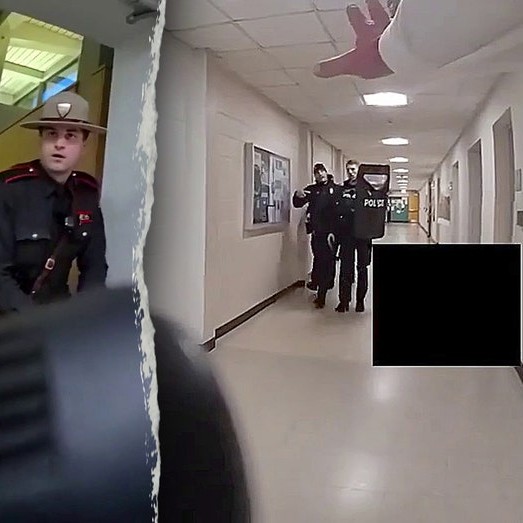
Newly released body camera video from Providence Police captures the moments officers flooded Brown University’s campus on December 13th after reports of a gunman in a crowded lecture hall, yet the suspect they were searching for had already slipped away, raising unresolved questions about security and response.
TLDR
Providence Police released redacted body camera, 911, and radio recordings from the December 13th Brown University shooting that killed two students and injured nine, documenting a rapid campus search for former student Claudio Manuel Neves Valente, later found dead in New Hampshire.
What the Newly Released Footage Shows
On February 10th, 2026, Providence Police released a compilation of body camera recordings, emergency calls, and radio transmissions from the Brown University shooting, responding to public records requests while redacting graphic scenes, victims’ identities, and other details they said were exempt under Rhode Island’s Access to Public Records Act.
The audio begins shortly after 4 p.m., when Brown University Police radioed Providence emergency dispatch to report gunfire inside the Barus and Holley science building. At approximately 4:11 p.m., according to the incident report, officers relayed a description of a person dressed in all black with a ski mask and an unknown direction of travel.
By 4:16 p.m., an officer in command is heard formally notifying dispatch that the campus is facing an active threat. The body camera video captures that moment, as the officer tells colleagues and dispatch, \”Be advised, it’s an active shooter situation.\” Officers then move in formation through corridors, directing additional units to potential entry and exit points.
The footage shows a methodical, room-by-room search of Barus and Holley, including stairwells and laboratories, with officers calling out to students, ordering hands to be visible, and looking for additional victims. Even as the search expands floor by floor, the materials do not show any direct encounter with the gunman, underscoring that the suspect had already left the building before police could contain the scene.
Inside Tanner Auditorium on December 13th
According to the Providence Police incident report summarized in the release, the shooting unfolded inside Tanner Auditorium, also listed as Room 166, during an economics exam review attended by dozens of students. The auditorium is described as a sloped room with staircases along each side and entrances at the top and bottom, features that shaped both the victims’ escape routes and the investigators’ reconstruction of events.
Two students, 18-year-old Mukhammad Aziz Umurzokov and 19-year-old Ella Cook, were killed during the attack. Investigators wrote that Umurzokov was found dead near the upper entrance door, while Cook was discovered between the central aisles on the auditorium floor. Nine other people were transported to Rhode Island Hospital with gunshot wounds, according to the report and subsequent police statements.
As detectives worked to identify a suspect, they pulled still images from campus surveillance cameras and showed them to surviving victims. One victim, who told detectives she had seen the shooter clearly, reacted sharply when shown a photograph of Claudio Manuel Neves Valente, freezing, pushing back from the image, and becoming visibly emotional before confirming that the picture matched the gunman she remembered.
Police wrote that two additional victims, interviewed separately, were also presented with the same still images and independently identified Neves Valente as the shooter. Those identifications, combined with witness accounts and video evidence, were central to the narrative that emerges from the incident report, even though the suspect would never face a courtroom.
Investigators determined that Neves Valente was a former Brown University physics doctoral student who attended from 2000 to 2001 before formally withdrawing in the fall of 2003. He was later located in a storage facility in Salem, New Hampshire, where, according to law enforcement, FBI SWAT personnel found him dead of an apparent self-inflicted gunshot wound as they attempted to take him into custody.
A Search That Failed to Contain the Shooter
The body camera compilation emphasizes how quickly Providence and Brown officers moved to secure the science complex. Yet the same materials highlight an unresolved issue for the campus and the city, namely, how a suspect described publicly as heavily armed and disguised in a ski mask managed to evade the initial perimeter and travel more than an hour away before being located.
The records released so far do not show when Neves Valente is believed to have left campus, how he exited the area, or whether any cameras or license plate readers captured his movements that afternoon. They also do not indicate at what point investigators first developed his identity as a suspect, or how long it took for his image to be circulated across law enforcement agencies beyond Providence.
Earlier reporting by Fox News has quoted a criminal profiler who described Brown University as a \”soft target\” before the attack and has detailed questions about why Providence’s $1 million Real Time Crime Center did not flag the unfolding violence. The center is designed to aggregate live video feeds and data for investigators, but the body camera package released by police does not reference any alerts or assistance from that system.
Those gaps have raised practical questions rather than abstract ones. If the Real Time Crime Center or other surveillance tools were not configured to detect or assist in this incident, residents and campus community members are left to ask what role those systems play in mass casualty events and what changes, if any, will be made before the next emergency.
Security Overhaul and the Question of Transparency
In separate coverage, Fox News has reported that Brown University announced a campuswide security overhaul after the shooting that killed two students and wounded nine others. The university has not released its internal deliberations through the police records, leaving it unclear from these materials alone which specific vulnerabilities administrators believe contributed to the attack.
Providence Police, in explaining the redactions applied to the body camera and audio files, cited a need to protect the privacy and dignity of victims and witnesses, remove graphic material, and comply with exemptions in the Access to Public Records Act. That approach mirrors how many agencies have handled high-profile violent incidents, but it also means that key portions of the response, including some interactions inside Tanner Auditorium, remain out of public view.
The result is a partial record that documents the urgency of the response while leaving persistent blind spots about prevention and pursuit. Families, students, and city residents can see officers rushing toward danger and hear the moment the incident was classified as an active shooter situation, yet they still lack a full accounting of how early warnings were handled and how the suspect ultimately slipped through the dragnet.
Whether subsequent reviews of campus security, city technology, and interagency coordination will answer those questions remains uncertain. For now, the footage and reports released by Providence Police offer a detailed look at the chaos inside Barus and Holley, but only a partial explanation of how a former student was able to turn a familiar lecture hall into a crime scene and then vanish into the wider region.
References
- Fox News: Brown University Shooting Bodycam Footage Shows Urgent Search for Suspect Who Slipped Through Dragnet
- Fox News: Brown University Implements Campuswide Security Overhaul After Mass Shooting Leaves 2 Dead, 9 Wounded
- Fox News: Claudio Manuel Neves Valente Identified as Brown University Shooting Suspect Found Dead