

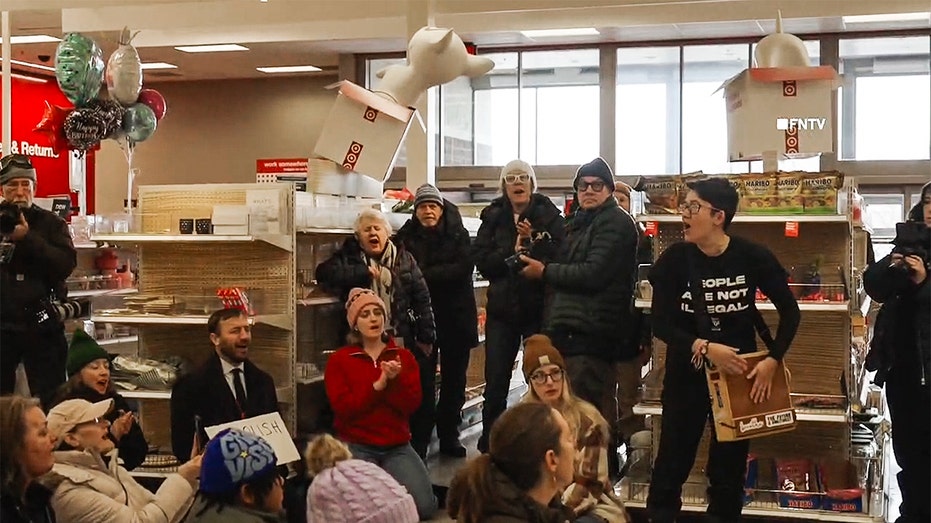
Shoppers stepped around people sitting cross-legged on the floor of a Minnesota Target while a man with an Abolish ICE sign called the store a staging ground for federal agents. Across town, an Immigration and Customs Enforcement officer was captured on video saying he was there to arrest a child sex offender. Both were talking about the same parking lots.
How A Routine Store Became A Protest Site
According to a report from Fox News Digital, a group of anti-ICE protesters entered a Target store in St. Paul, Minnesota, and staged a sit-in. The action took place inside the store and centered on claims that the retailer was allowing Immigration and Customs Enforcement, or ICE, to use its parking lot as an operational base.
Video shared online and described in the same report shows an ICE agent in St. Paul confronting people he said were disrupting an arrest. The officer stated that his team was trying to detain an alleged child sex offender and accused bystanders of honking car horns and impeding the operation.
At the time of the Fox News report, Target had not provided a public statement in response to the protesters. There was also no public documentation in that report of any formal agreement between Target and ICE regarding use of store property.
A Retailer Pulled Into Federal Immigration Enforcement
Large retail parking lots often function as quasi-public spaces. They are privately owned, but open to customers, delivery drivers, and people passing through. Law enforcement officers frequently use such spaces to meet, observe, or conduct arrests that begin elsewhere. Those activities are generally lawful if officers have the authority to act in that jurisdiction.
ICE is a federal agency within the Department of Homeland Security that carries out immigration enforcement and some criminal investigations. Its Enforcement and Removal Operations arm focuses on people who are in the country without authorization, as well as individuals who have immigration violations combined with criminal histories. ICE states that its civil immigration arrests and removals are guided by federal law and internal policy.https://www.ice.gov/about-ice
There are limits on where ICE generally carries out enforcement. Agency guidelines list places such as schools, hospitals, and houses of worship as “sensitive locations,” where enforcement actions are supposed to be avoided or require higher-level approval.https://www.ice.gov/ero/sensitive-locations Retail stores and parking lots are not included in that sensitive-locations list.
Within that framework, a retailer might find its property used for lawful enforcement activity even without a formal partnership. What the Minnesota protesters demanded was not only clarity about what was happening, but an explicit corporate stance against any cooperation.
What Protesters Say Target Is Doing
Inside the St. Paul Target, organizers sat in the aisles and spoke through chants and short speeches. One protester, identified only in the Fox News report, claimed that ICE regularly convened at the store.
“Target parking lots have been a meeting place for ICE agents,” the protester said, adding that “ICE agents are using the toilets at Target, so they are facilitating this invasion.”
The same speaker accused the company of doing nothing to oppose what he described as a broader campaign against immigrant communities. “They are not at all participating in challenging this ethnic cleansing we are seeing in this country,” he said.
Another participant framed the demands in terms of family stability. She called on Target to align itself with local residents and said she wanted the company to “protect our tiny children from losing their parents.” She added, “We do not just want your tiny baby clothes. We want your protection for our families.”
Protesters also called for the abolition of ICE itself and vowed to return, chanting “We will be back, we will be back,” according to the Fox account. The group’s public argument tied everyday consumer spaces to the fear that routine shopping or driving through a parking lot could intersect with an arrest.
The report does not name the organizations involved, and there is no indication that protesters inside the Target were arrested or cited. There is also no indication that the group provided documentation, such as internal emails or lease agreements, to support claims of a formal arrangement between Target and federal agents.
What Federal Agents Say They Were Doing
In the separate incident referenced in the same Fox article, an ICE agent is recorded confronting people who appear to be observing or filming from nearby. He accuses them of interfering with an enforcement operation in St. Paul that he says targets an alleged child sex offender.
“We are here to arrest a child sex offender and you guys are out here honking,” the agent says in the video, according to the Fox report. Someone off camera responds, “No, we are press. We are not honking.”
The officer then points toward a vehicle and says, “That vehicle right there is honking and impeding our investigations while we are trying to arrest a child sex offender. That is who you guys are protecting. Insane.”
Federal law makes it a crime to forcibly assault, resist, oppose, impede, intimidate, or interfere with certain federal officers while they are performing official duties.https://www.law.cornell.edu/uscode/text/18/111 The brief video excerpt described by Fox does not show what preceded the confrontation or whether any charges resulted from the behavior the agent described.
ICE has publicly argued that its workplace and community arrests focus on people with criminal histories. In one enforcement report describing arrests during the Trump administration, the agency stated that a large majority of individuals arrested by Enforcement and Removal Operations had prior criminal convictions or pending criminal charges.https://www.ice.gov/features/ero-2019 Critics often counter that the same operations can sweep up people whose only violations are immigration related, or whose criminal records involve older, lower-level offenses.
Where The Law And Corporate Policy Intersect
Several separate questions sit underneath the images of people on a store floor and officers in a parking lot.
One involves the legal status of federal officers on private commercial property. In general, property owners can ask anyone to leave their land, including law enforcement, unless officers have a warrant, are in hot pursuit, or have some other independent legal ground to be there. The Fox report does not indicate whether Target invited ICE to use its parking lots, tolerated their presence without objection, or ever attempted to limit such use.
Another question is when protest crosses a legal line. Federal law prohibits certain forms of interference with officers, but courts have recognized that recording public officials and peacefully observing police activity in public places are protected First Amendment activities in many circumstances.https://www.aclu.org/know-your-rights/protesters-rights Honking a car horn near an arrest could be treated as expressive conduct, a minor traffic violation, or obstructive behavior, depending on the facts and how much it actually impedes an operation.
A third layer involves corporate responsibility. Major retailers typically maintain written policies about how they respond to law enforcement requests, whether they allow officers to use break rooms, and when they share security footage. Those policies often balance cooperation with legal orders against privacy and public-relations concerns. Target’s internal rules on these points were not public in the materials cited by Fox, and the company did not provide a comment in that report.
For immigrants and mixed-status families, the difference between a neutral policy and an actively welcoming posture toward federal agents can feel significant. Civil liberties groups advise people to treat workplaces, homes, and public spaces differently when it comes to immigration enforcement, and they encourage bystanders to know their rights when encountering ICE operations.https://www.aclu.org/know-your-rights/immigrants-rights
What Remains Unclear
The Fox News Digital story outlines a vivid scene at a St. Paul Target and a terse exchange at an ICE operation. It documents protesters’ allegations that the retailer’s parking lots help facilitate deportations, and it records an agent’s insistence that his team was trying to apprehend a person accused of serious sexual crimes against a child.
What the reporting does not answer is whether Target formally authorized or coordinated any such use of its property, whether the alleged child sex offender was in fact arrested and charged, or whether anyone present in the parking lot faced consequences for what the agent called interference. Without those details, the sit-in, the chanting, and the confrontation in the street remain fragments of a larger contest over where immigration enforcement should occur and what role large private employers should play when it does.
Until Target, ICE, or local authorities provide fuller accounts or records, the precise relationship between one retailer’s lots and federal arrest operations will remain unsettled in the public record, even as protesters promise to return and agents continue their work.