

Thousands of federal agents pouring into Minneapolis are not the only show of force. In a federal courtroom across town, Minnesota is accusing the Trump administration of turning immigration law into leverage for something the state says has nothing to do with border security: its voter rolls and its own policymaking.
According to a lawsuit described in a January 2026 report from Law&Crime, the state wants a federal judge to temporarily shut down a large-scale deployment of Immigration and Customs Enforcement (ICE) and Border Patrol agents known as Operation Metro Surge. The administration presents the surge as an immigration crackdown. Minnesota argues it is an unconstitutional attempt to force the state to abandon its own laws and hand over sensitive data.
Federal Firepower Meets State Pushback
U.S. District Judge Katherine M. Menendez is presiding over the case in Minnesota. At a recent hearing, she questioned both the federal government’s explanation for sending thousands of federal officers into Minneapolis and her own authority to step in, according to the Law&Crime report.
Earlier in the month, Minnesota filed suit seeking a temporary restraining order that would immediately halt Operation Metro Surge while the court considers the broader constitutional claims. The state contends the surge violates the Tenth Amendment, which reserves to the states or the people powers not delegated to the federal government. The Supreme Court has interpreted that amendment to prevent Washington from directly ordering state officials to administer or enforce federal programs, a concept often called the anti-commandeering doctrine, as summarized by Cornell Law School’s Legal Information Institute (LII).
In court, state attorneys described the influx of federal agents as an “unlawful and unchecked invasion” of Minneapolis. Special counsel Lindsey Middlecamp argued that the federal forces were using immigration enforcement as a pretext while inflicting what she called widespread violence on residents. The true aim, she said, was political: to pressure Minnesota to give up its sovereignty.
Violence on the Streets and a Death Under Scrutiny
The hearing unfolded against the backdrop of a fatal encounter involving federal agents. Law&Crime reports that 37-year-old Alex Pretti, a U.S. citizen and licensed gun owner, was shot and killed by federal officers on a Minneapolis street. The article states that he was shot in the back several times after being disarmed.
State attorney Brian Scott Carter told the court that the administration had effectively placed “an army” in Minnesota that was “stir[ring] the pot with conduct that is pervasive and includes illegal violent conduct.” He added that “the lawlessness we’ve seen, your honor, is jaw-dropping.”
Those descriptions are allegations from the state’s legal team, not findings from a completed investigation. The federal government, through its lawyers, has not conceded that agents engaged in unlawful violence. For now, the specifics of Pretti’s death and other incidents mentioned in the hearing remain outside the four corners of this civil case, but they frame the urgency of Minnesota’s request for emergency relief.
The Letter Minnesota Calls ‘a Shakedown’
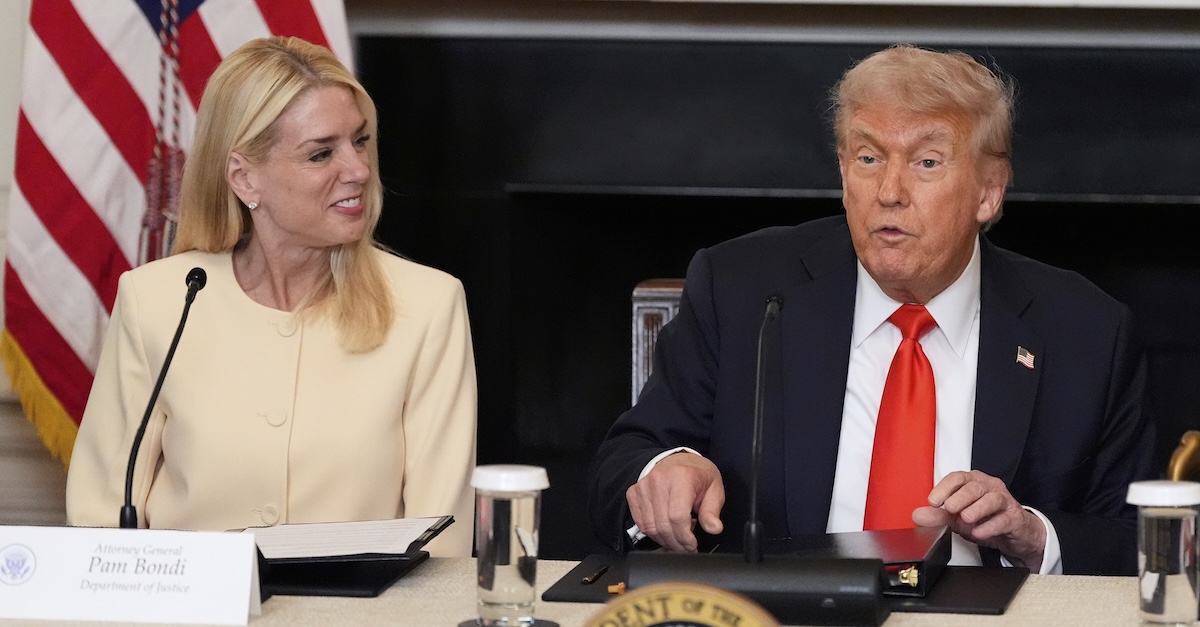
Minnesota’s argument rests heavily on a weekend letter that Attorney General Pam Bondi sent to Governor Tim Walz. According to the lawsuit and Law&Crime’s account, Bondi’s letter listed several conditions the state was expected to meet. Among them: roll back sanctuary city policies, turn over Medicaid and Supplemental Nutrition Assistance Program (SNAP) data, and grant the Department of Justice Civil Rights Division access to the state’s voter rolls.
Carter did not soften his description of that document when he addressed Judge Menendez. “It is a shakedown letter,” he said, as quoted by Law&Crime. “It is a ransom note. That is what you expect from someone who is extorting you.” In Carter’s telling, the message was clear. Federal forces would remain on the ground, and the pressure would continue, unless Minnesota gave in.
Carter emphasized that voter roll access has no direct connection to immigration enforcement. He accused the federal government of trying to “hijack the state’s legislative process” and “bend the state’s will to its own.” He told the court, “That is not allowed under the Constitution.” Those statements capture the core of the state’s Tenth Amendment claim: that the surge is being used to force changes in state law and data practices that Congress has not authorized and that Minnesota does not consent to.
Middlecamp argued that the message embedded in the Bondi letter and the surge itself was blunt. In her words, the administration was effectively telling Minnesota to “change its laws and policies” or “suffer invasion of mass armed forces.” The state also pointed to a social media post from former President Donald Trump earlier in the month in which he wrote that “the day of reckoning & retribution” was coming in Minnesota. To state officials, that language underscored their view that the surge is about political retribution, not ordinary immigration enforcement.
What Washington Says It Is Doing
The Justice Department rejects the idea that Operation Metro Surge is an extortion campaign. During the hearing, DOJ attorney Brantley Mayers called Minnesota’s request “staggering,” according to Law&Crime’s account. He argued that an injunction would effectively remove “officers whom the president has concluded should be there to enforce federal immigration law.”
In the DOJ’s view, federal agents are carrying out responsibilities that Congress has assigned to the executive branch. Immigration enforcement has long been an area in which the federal government possesses broad authority. Mayers’ argument casts the state’s lawsuit as an attempt to hamstring that authority by inviting the judiciary to question operational decisions about where and how to deploy officers.
The department has not publicly embraced the political motives Minnesota attributes to the surge. From Washington’s perspective, the presence of large numbers of ICE and Border Patrol personnel in Minneapolis is a lawful effort to address what the administration characterizes as serious immigration related crime. The dispute before Judge Menendez is whether the conditions attached to that presence, as alleged by Minnesota, cross a constitutional line.
The president of the Minnesota Farmers Union is urging farmers to speak out against the Trump administration’s federal crackdown in his state and press for broader immigration reform.
Ag Policy Editor @ChrisClaytonDTN reports: https://t.co/0DuR2KuHWg pic.twitter.com/QHlscsB0wV
— DTN/Progressive Farmer (@dtnpf) January 26, 2026
The Constitutional Line at Stake
The Tenth Amendment does not spell out a detailed rule. Over time, the Supreme Court has developed it through cases that limit federal power over states. In Printz v. United States, for example, the Court held that the federal government could not require local sheriffs to conduct background checks under the Brady Handgun Violence Prevention Act. The decision is one of several that stand for the principle that Washington cannot directly compel state officials to carry out federal regulatory schemes.
That is the doctrinal backdrop for Minnesota’s case. The state is not simply complaining about the presence of federal officers on its streets. Instead, it argues that the combination of a massive deployment, an explicit set of policy demands touching on sanctuary rules and social service databases, and a request for voter roll access amounts to forbidden coercion. In this view, the administration is using its own federal agents as a bargaining chip to reshape state law and gain entry to data repositories the state would not otherwise open.
Judge Menendez surfaced that tension during the hearing. “You understand the federal government has a lot of power in this area, so I am trying to figure out what principle you are asking me to apply that will sort out legal federal law enforcement from this Tenth Amendment argument,” she told Minnesota’s lawyers, as recounted by Law&Crime. Her question captured the central difficulty: federal immigration enforcement is plainly permitted, yet the Constitution also places limits on how Washington may influence state policy choices.
Menendez also wondered aloud whether the remedy Minnesota is seeking fits the problem it describes. She asked whether the proper response to a “flood of illegality” by federal agents would be to “fight each illegal act” through individual lawsuits or criminal prosecutions, rather than asking her to halt an entire federal operation. In her words, “not all crises have a fix from a district court injunction.”
What Comes Next
At the end of the hearing, Menendez declined to rule from the bench. She told the parties that she would take time to write a decision and that the delay should not be interpreted as indifference. “I do not intend in any way for the depth of my analysis or whatever time I take to write to be seen as a belief that this is unimportant,” she said. “It is because it is extremely important that I am doing everything I can to get it right.”
For now, Operation Metro Surge continues, and the Bondi letter stands as the focal exhibit in Minnesota’s claim that the federal government is trying to “shakedown” a state into surrendering both policy control and voter information. Whether Judge Menendez sees an enforceable constitutional boundary in that set of facts will determine not only what happens in Minneapolis, but also how far future administrations may go when they seek to pressure states through the machinery of federal law enforcement.