

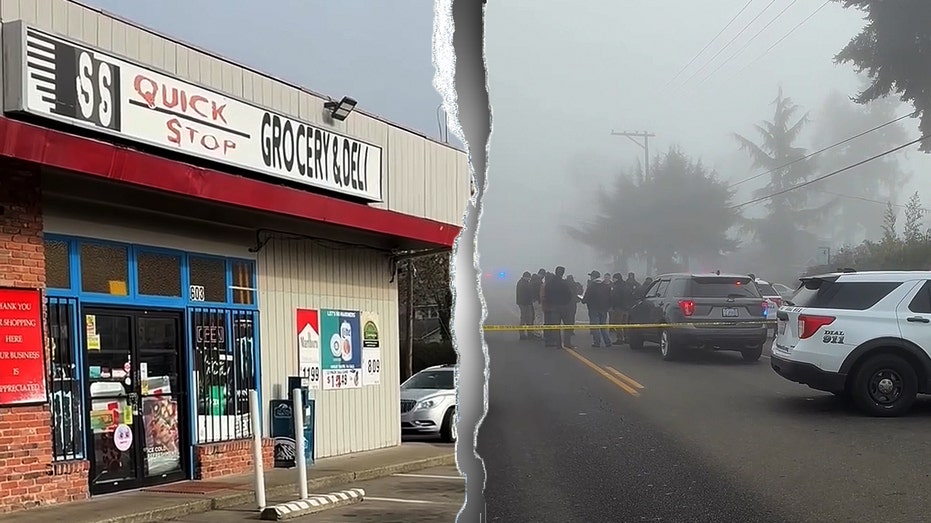
Before sunrise outside a small Parkland convenience store, a man walking his dog was asked what religion he followed. Minutes later, he and the dog were bleeding, and the person he identified as his attacker would be dead after a confrontation with deputies.
What Authorities Say Happened Outside the Store
The Pierce County Sheriff’s Office in Washington state says deputies shot and killed a man after an early-morning stabbing in Parkland, an unincorporated community near Tacoma. According to the agency, the man who was stabbed told deputies his attacker had first asked him about his religion, then lunged at him with a knife and also stabbed his dog.
In a Facebook video update, the sheriff’s office said the incident began around 6:30 a.m. outside the S S Quickstop Grocer in Parkland. The injured man called 911 to report that an unknown individual had stabbed him near the store, the agency wrote in a narrated reel posted to its official page.
When deputies arrived, they found the caller and his dog in serious condition. The man reported that an unfamiliar person approached him and asked him what religion he practiced. The office summarized his account in a statement quoted by multiple outlets.
“The victim answered the man and said something about being a Christian, and the man then attacked and stabbed the victim and his dog,” the Pierce County Sheriff’s Office said, according to reporting by Fox News.
That description comes solely from the injured man’s account as relayed by deputies. As of now, investigators have not released any surveillance footage or independent witness statements that would publicly confirm the exchange about religion.
The 911 Call, the Search, and the Injured Dog
After the stabbing report, deputies and medical responders treated the man at the scene and arranged his transport to a hospital. The sheriff’s office has said only that he was in serious condition. His name, age, and exact injuries have not been publicly released.
The victim’s dog was taken separately to a local animal hospital, where veterinary staff brought the animal into immediate surgery, according to Fox News. Officials have not provided an update on whether the dog survived.
Before leaving for the hospital, the wounded man was able to give deputies a physical description of the suspect. That brief interaction shaped the hours that followed. Based on his description, the sheriff’s office says deputies searched the surrounding area for several hours for a man they believed to be armed with a knife.
The sheriff’s office has not yet made public any recordings of the 911 call itself, nor any detailed account of how that suspect description was broadcast to deputies in the field.
The Confrontation Behind the House
Roughly two hours after the initial 911 call, a Pierce County deputy spotted someone who appeared to match the description given by the victim on the 800 block of 112th Street South in Parkland, according to local station FOX 13 Seattle.
When the deputy tried to contact him, the man ran behind a nearby house. The sheriff’s office told FOX 13 that the man was armed and that he advanced toward deputies during the encounter behind the residence. Deputies then opened fire.
Paramedics transported the suspect to a hospital, where he died of his injuries, FOX 13 reported. Authorities have not released his name, age, or any other identifying details. It is not yet clear how many deputies fired their weapons or how many rounds were discharged.
As of the latest public statements, the sheriff’s office has not said whether any deputies were wearing body cameras or whether dashboard cameras captured the shooting or the moments leading up to it. The agency did not immediately respond to a request for comment from Fox News Digital, the outlet reported.
Is this being treated as a hate crime?
The detail that the victim says he was asked about his religion and identified himself as a Christian before the attack has prompted questions about possible biased motivation. Washington state law allows for criminal charges related to malicious harassment when a person is targeted because of characteristics such as religion.
At this stage, however, authorities have not publicly labeled the stabbing a hate crime or announced any specific bias-related investigation. Neither the sheriff’s office’s Facebook update nor the early television reports used that legal term. They described the question about religion as part of the victim’s account rather than as a formal finding about motive.
There are other unknowns. Investigators have not said whether the suspect and victim had crossed paths before that morning, whether any additional words were exchanged, or whether alcohol, drugs, or untreated mental illness may have played a role. Without the suspect alive to explain his actions, any conclusion about motive will likely rest on witness accounts, physical evidence, and any past statements or social media activity that investigators can uncover.
How the Shooting Will Be Reviewed
Because deputies used deadly force, the case will trigger a separate review of their actions. In Washington, officer-involved shootings are typically investigated by an independent investigative team and then reviewed by county prosecutors, under reforms adopted in recent years.
The Pierce County Sheriff’s Office has not yet released a detailed timeline of the shooting, the number of deputies involved, or whether less-lethal options were considered or attempted before shots were fired. The names of the deputies involved are also not yet public. Those omissions are not unusual in the first days after a fatal shooting, when agencies often cite the need for formal interviews and notification of families.
Key questions for investigators will likely include:
Item 1: What exactly happened in the moments between the deputy spotting the suspect on 112th Street and the shooting behind the house?
Item 2: Whether any video, from body cameras, dash cameras, or security systems, captured the encounter.
Item 3: Whether the suspect made any statements that shed light on his intent or state of mind.
Item 4: Whether the level of force used by deputies complied with state law and department policy.
Until those details are documented in public reports, much of the encounter exists only in brief official summaries.
What We Still Do Not Know
Several weeks after the incident, the public record remains thin. Authorities have not disclosed the condition of the injured man or his dog. It is not clear whether the victim remains hospitalized, whether he has been interviewed again in greater detail, or whether his account of the attack has changed in any way since the initial 911 call.
Investigators also have not said whether they recovered the knife allegedly used in the stabbing and later displayed during the confrontation with deputies. Any forensic testing of that weapon, of the suspect’s clothing, or of blood at the scene has not yet been summarized for the public.
The absence of names for both the suspect and the victim makes it harder for outside observers to piece together a fuller picture of who they were and what may have led to the violence. That anonymity can protect privacy for the injured person and their family, but it also limits independent scrutiny of claims about motive and behavior.
For now, what is on the record is narrow. A man told deputies he was attacked shortly after identifying himself as Christian. Deputies, acting on his description, later confronted a man they say was armed with a knife and advancing toward them. One person lay in a hospital, another on a medical examiner’s table, and a dog in an animal surgical suite. Until investigative files are released, the distance between those three scenes remains filled with unanswered questions.