

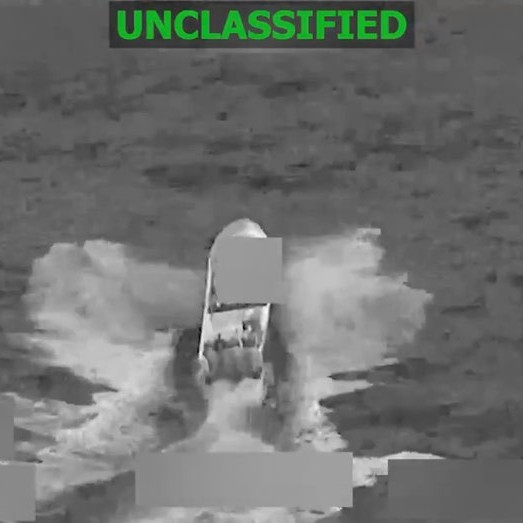
The U.S. military says a lethal strike on a vessel in the Eastern Pacific killed two suspected narco-terrorists, in what officials describe as an operation against a designated terrorist organization. Yet basic facts about the targets, the group involved, and what evidence justified the use of force have not been made public.
According to U.S. Southern Command, known as USSOUTHCOM, intelligence indicated the vessel was operating along established drug trafficking routes and engaged in narco-trafficking activity. The strike, carried out on a Thursday, was ordered by the command’s new leader, Gen. Francis L. Donovan, on the same day he formally assumed command. It was also the second such U.S. strike of the year, with a previous operation killing two additional suspects and leaving one survivor, according to officials.
Strike in the Eastern Pacific
In a brief account released through the media, U.S. forces conducted what officials called a lethal kinetic strike on a vessel allegedly operated by a designated terrorist organization. The terminology signals more than a routine interdiction. It frames the action as part of a counterterrorism mission layered onto long-running counter-narcotics efforts in waters off Central and South America.
Officials have stated that intelligence confirmed the vessel was moving along known narco-trafficking routes in the Eastern Pacific and was engaged in trafficking activity. Two individuals on board were reported killed. Their identities, nationalities, and any organizational affiliations beyond the broad label of a designated terrorist organization have not been disclosed publicly.
No information has been released about the size of the vessel, the presence of additional crew, or whether any physical evidence, such as drugs or weapons, was recovered after the strike. Authorities have also not said whether any partner nation assisted in tracking or targeting the vessel, or whether the operation took place in international waters or within a particular country’s maritime jurisdiction.
The description of those killed as suspected narco-terrorists underscores the mixture of criminal and security labels that has shaped U.S. policy in the region for decades. However, officials have not identified which U.S. or international lists the unnamed group appears on, or what specific conduct led to its designation as a terrorist organization.
Second Lethal Strike in a Growing Pattern
USSOUTHCOM officials acknowledged that the Eastern Pacific operation was the second lethal strike of the year. In an earlier incident, also reported by Fox News, U.S. forces struck a vessel allegedly tied to a narco-terror group, killing two people and leaving one survivor who was later the focus of a search effort.
U.S. STRIKE KILLS TWO SUSPECTED NARCO-TERRORISTS AT SEA
U.S. forces conducted a lethal strike on a vessel in the Eastern Pacific on Thursday, killing two suspected narco-terrorists.
U.S. Southern Command, or USSOUTHCOM, said intelligence confirmed the boat was on known drug… https://t.co/azjKL5Gh5l pic.twitter.com/zjQIS2vcjz
— Hold My Beer News (@holdmybeernews) February 6, 2026
Taken together, the two incidents outline a pattern of using stand-off military force against suspected traffickers at sea rather than the more common approach of interdiction, boarding, and arrest. Public accounts so far do not explain why lethal force was chosen in these cases, what immediate threat the vessels were assessed to pose, or whether non-lethal options were considered.
The United States has long conducted counter-drug missions in cooperation with regional partners, often involving the Navy, Coast Guard, and partner nation forces. Those operations typically emphasize seizures and arrests, followed by prosecutions in U.S. or partner courts. These recent strikes, however, appear to emphasize neutralizing targets identified as narco-terrorists, with no public indication of pending criminal cases or extradition efforts tied to the individuals killed.
New Commander, Continuing Campaign
The decision to authorize the latest strike rested with Gen. Francis L. Donovan, who took over as commander of USSOUTHCOM on the same day the operation occurred, according to the command’s statement summarized in media reports. Donovan was sworn in during a ceremony at the Pentagon, replacing acting commander U.S. Air Force Lt. Gen. Evan L. Pettus.
In a statement released with his appointment, Donovan framed the command’s work in broad regional terms. “Together with our partner nations, we will continue to address shared challenges, uphold democratic values, and ensure a safe and prosperous future for the region,” he said.
Separate Fox News reporting has noted that USSOUTHCOM’s previous permanent commander retired abruptly amid increasing scrutiny of earlier strikes in the Caribbean. Those earlier operations, and the questions they raised about targeting, transparency, and oversight, form the backdrop for Donovan’s first decisions as commander, including the approval of this most recent strike.
Officials have not said whether Donovan personally reviewed detailed intelligence on the Eastern Pacific vessel before giving the order, or whether the decision relied on standing rules of engagement for counter-narcotics and counterterrorism operations in the region.
Legal Authorities and Oversight
USSOUTHCOM oversees U.S. military activities in Central and South America and the Caribbean, including support for counter-narcotics missions. Under U.S. law, the Department of Defense may assist other agencies in detecting and monitoring drug trafficking, and in some circumstances may take more direct action when authorized.
The description of the targets as suspected narco-terrorists suggests that officials view the operation at the intersection of counter-drug enforcement and counterterrorism. That framing can carry significant legal and policy implications, including which rules of engagement apply, what level of evidence is required to approve a lethal strike, and what oversight mechanisms are triggered in Washington.
Public reports so far have not clarified whether the Eastern Pacific operation was conducted under authorities tied primarily to counterterrorism, to counter-narcotics support, or to some combination of both. Nor have officials indicated whether Congress or specific oversight committees received prior notice of the operation, or whether the strike will be the subject of any formal after-action review that could eventually be summarized for the public.
Because the individuals killed have been publicly identified only as suspects, it is not clear whether they were the subject of existing criminal indictments in U.S. courts or ongoing investigations. There has been no public indication that the evidence underpinning the decision to strike will be shared, even in redacted form, outside classified channels.
Information Gaps and Public Accountability
Despite the gravity of employing lethal force at sea, much of what is publicly known about this strike comes from a short set of official statements summarized in news reports. Key details remain unavailable, including:
- The precise location of the vessel at the time of the strike.
- The identities and nationalities of the two people reported killed.
- The name of the designated terrorist organization alleged to control the vessel.
- Whether any survivors were rescued, detained, or interviewed.
- What physical evidence was recovered, if any, and where it is it being held.
Officials have not indicated whether video, imagery, or other supporting material exists that could be released without compromising sources and methods. There is also no public description of how the intelligence that flagged the vessel as a narco-terror target was vetted, or whether any independent review confirmed the assessment before the strike was carried out.
This level of secrecy is not unusual for sensitive military operations. Yet it constrains the public’s ability to assess whether the use of lethal force aligned with stated U.S. commitments to minimize civilian harm, respect partner nation sovereignty, and reserve deadly force for situations involving a significant threat or clear legal authority.
The command has framed the operation as part of a wider campaign against networks that traffic drugs and, in some cases, blend criminal activity with political violence. What remains to be seen is whether more information about this specific strike, and about the broader pattern of lethal maritime operations in the region, will be released, or whether the public account will remain limited to a handful of lines in an official statement.