

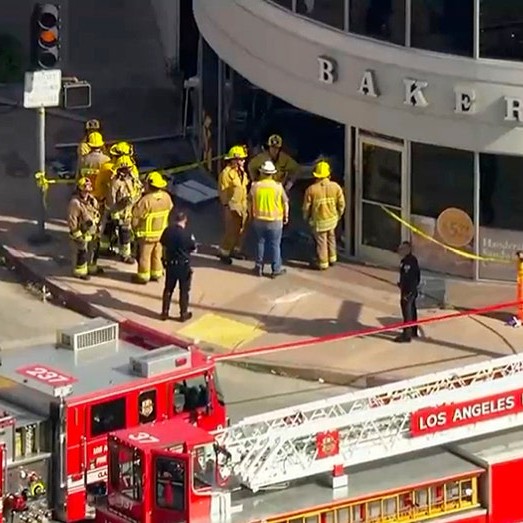
Three people were killed, and six others were hurt when a car drove into a grocery store in Los Angeles’ Westwood neighborhood on February 5th, 2026. Even as officials describe the event as an apparent accidental traffic collision, key questions remain about how an everyday trip along Westwood Boulevard turned into a mass-casualty scene inside a store.
Authorities say a single elderly driver in a silver sedan struck a bicyclist, left the roadway, and crashed into the front of the market around 12:11 p.m. local time. Nine people were involved in total, according to the Los Angeles Fire Department, which is working alongside law enforcement to determine whether this remains classified as a tragic accident or becomes a criminal case.
What Authorities Have Confirmed So Far
According to reporting from Fox News, firefighters and paramedics were dispatched shortly after the initial 911 calls on February 5th, 2026. The Los Angeles Fire Department said the vehicle ended up inside the front of the grocery store on Westwood Boulevard, causing extensive damage and trapping people under the car.
#LIVE Westwood crash leaves 2 dead, 5 injured; cause of the collision is under investigationhttps://t.co/FNEkVFBiAw pic.twitter.com/WGbLeR8Xfp
— ABC7 Eyewitness News (@ABC7) February 5, 2026
At a news briefing, a Los Angeles Fire Department spokesperson said nine people were involved. Three were pronounced dead at the scene. Of the six survivors, two were described as in serious condition, two in moderate condition, and two declined transport to the hospital.
The same spokesperson described how the crash scene quickly shifted from a dynamic rescue effort to a secured investigative site. “This is becoming more of a static incident, and it’s being investigated so far as an accidental traffic collision,” the spokesperson said.
Investigators have not publicly identified the deceased, the injured, or the driver. Authorities typically wait to release names until families are notified, and no public records describing the victims’ identities or ages have been made available in this case.
A Single Driver, 9 Victims
Officials have described the driver as elderly and alone in the vehicle. According to the Los Angeles Fire Department spokesperson, early accounts suggest the driver tried to avoid another road user seconds before the crash.
“It appears the driver, the elderly driver, was trying to swerve out of the way of a bicyclist, and all we know is that that elderly driver in that single vehicle did strike a bicyclist,” the spokesperson said. He continued, “What we do know again is a total of nine patients, three that tragically were deceased, two that are in serious, at least serious condition, two in moderate condition, and two that declined transport.”
This description offers an initial narrative: a split-second attempt to avoid a cyclist, a collision with that cyclist, and momentum that carried the sedan into the store entrance. At this stage, however, it is not publicly known how fast the car was traveling, whether there was any mechanical problem, or whether the driver experienced a medical emergency.
Officials have not alleged that alcohol, drugs, or intentional conduct played any role, and they have not announced any traffic citations or criminal charges. The early statements from the fire department frame the event as accidental, but in major injury and fatal crashes, that preliminary assessment can change as more evidence is collected.
From Rescue To Investigation
The first priority for responders was removing the car and reaching those pinned beneath it. The Los Angeles Fire Department spokesperson later confirmed that some victims were trapped under the vehicle, which came to rest inside the store.
“Firefighters, again, are problem solvers, and they came in and were able to remove that vehicle to gain access to those patients,” he said. “We called for waves of additional firefighter paramedics who rendered immediate medical aid.”
In practice, that kind of response often involves specialized equipment to lift or move the vehicle, triage multiple patients at once, and coordinate with nearby hospitals prepared to receive critical trauma cases. The decision to summon additional ambulances and paramedic units, as described by the spokesperson, reflects the scale of the injuries and the need for rapid transport.
Once all patients are removed and the immediate danger has passed, scenes like this shift into a different phase. Investigators document the crash site, photograph the vehicle and damage patterns, and look for skid marks, debris fields, and surveillance footage. Witnesses, including store employees, nearby drivers, and pedestrians, are typically interviewed to establish a timeline of what they saw and heard before the impact.
Although the Los Angeles Police Department has not publicly outlined its steps in this specific case, serious collisions in the city are generally handled by specialized traffic units. Those investigators analyze whether any traffic laws were violated, whether driver behavior reached the level of negligence, and what contributing factors, if any, might have turned a near miss into a fatal event.
Will This Remain an Accident
The fire department spokesperson’s language, calling this an “accidental traffic collision,” reflects how the incident was initially understood on the day of the crash. That classification, however, is not final. Under California law, a fatal traffic collision can be treated as a crime if investigators and prosecutors conclude that the driver acted with gross negligence or with disregard for safety.
Potential charges in such cases can include vehicular manslaughter, depending on the findings about speed, attention, impairment, and compliance with traffic signals. Civil liability can also arise in parallel, as injured people or families of those killed decide whether to pursue claims against the driver or others.
As of now, there is no public indication that prosecutors have filed charges or that the driver has been arrested. Officials have also not disclosed whether they have seized the vehicle for mechanical inspection or obtained blood tests, medical records, or phone records, steps that are commonly used to rule out impairment, medical crises, or distraction.
The central unresolved questions are procedural rather than speculative. Investigators must determine: Did the driver reasonably react to an unexpected hazard, or did preventable errors occur? Was the collision solely the result of a momentary lapse, or does the evidence suggest a pattern of risky driving, mechanical failure, or health problems that should have been addressed earlier? Public filings and charging decisions, if any, will eventually offer a partial answer.
Storefront Crashes and Older Drivers
Although each incident is unique, this crash fits into a broader category that concerns traffic safety experts: vehicles striking buildings, sidewalks, and storefronts from adjacent streets or parking areas. Such crashes are relatively rare compared with routine fender benders, but when they occur, they put unprotected people in immediate danger, often with fatal consequences.
In some widely reported cases around the United States in recent years, investigators have attributed similar incidents to pedal confusion, where drivers mistakenly press the accelerator instead of the brake, or misjudge parking maneuvers near entrances. Advocates for stronger protections have called for reinforced barriers in front of busy storefronts, especially in dense pedestrian areas.
This case also intersects with long-running debates about how regulators and families should evaluate older drivers’ fitness behind the wheel. Early statements have emphasized that the Westwood driver was elderly, but officials have not indicated whether any age-related medical issues played a role. California, like many states, requires in-person license renewal assessments for some older drivers, yet still relies heavily on self-reporting and family intervention when abilities decline.
Without findings from the official investigation, it is not possible to say whether age, reflexes, or medical conditions contributed in Westwood. The only documented facts so far are that an elderly driver, attempting to avoid a bicyclist, lost the path of travel and left three people dead inside and around a neighborhood store.
Community Impact and Next Steps
Grocery stores serve as routine gathering points in neighborhoods like Westwood, where students, workers, and families pass through daily. A mid-day crash that turns that familiar setting into a fatal scene reverberates beyond the immediate victims, affecting employees who witnessed the impact, customers who narrowly escaped injury, and residents who view that corner as part of their daily lives.
Authorities have not yet publicly detailed the store’s condition, how long it may remain closed, or what support is being offered to staff and witnesses. In serious incidents, businesses sometimes engage trauma counselors, and city agencies may coordinate with victim services organizations, but no such steps have been formally announced in this case.
For now, the public record consists of the fire department’s statements, basic injury counts, and photographs of a silver sedan inside a shattered storefront. The names of the three people who died, their reasons for being at that location, and the full medical outcomes for the injured have not yet been shared.
As investigators reconstruct the seconds before the car jumped the curb, they will decide whether this Westwood collision will remain categorized as a noncriminal traffic tragedy or become a test of how the legal system assigns responsibility when a driver, a cyclist, and a crowded store intersect in the worst possible way.