

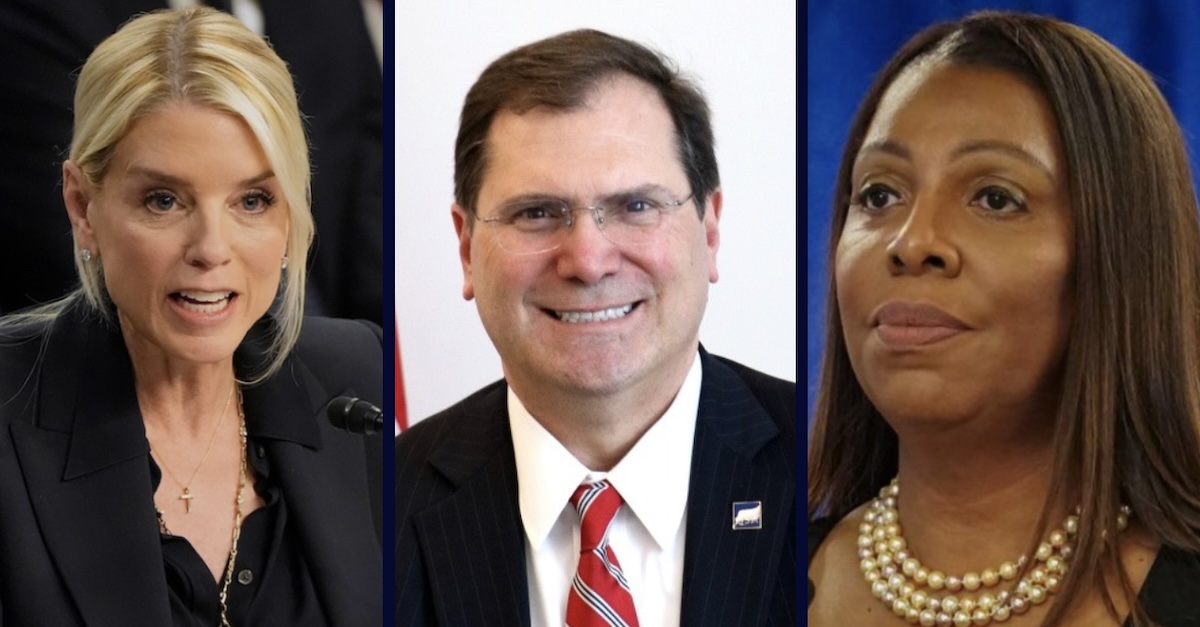
On the same day federal prosecutors asked a judge to rescue a faltering grand jury investigation into New York Attorney General Letitia James, their own filing misidentified the official they relied on to justify that probe.
According to reporting by Law & Crime, the U.S. Department of Justice urged U.S. District Judge Lorna Schofield, sitting in the Northern District of New York, to pause her ruling that invalidated subpoenas issued to James’s office. Schofield had already concluded that Acting U.S. Attorney John Sarcone was serving unlawfully, quashed his grand jury subpoenas, and disqualified him from further involvement in the case.
Appointment Problems Collide With a High-Profile Probe
The fight over Sarcone’s status grows out of a broader series of rulings that have questioned how Attorney General Pam Bondi installed interim and acting U.S. attorneys, according to Law & Crime. Judges in multiple districts have concluded that several Bondi-era officials were unlawfully appointed, which has in turn threatened some of the Trump administration’s priorities in federal court.
Law & Crime reports that in the Eastern District of Virginia, cases targeting Letitia James and former FBI Director James Comey were tossed entirely after courts determined that Acting U.S. Attorney Lindsey Halligan lacked lawful authority to hold the post and supervise those prosecutions. Halligan has since stepped aside while new leadership is installed.
In the Northern District of New York, the focus is on Sarcone. Judge Schofield found that he was “acting in name only” and that the federal grand jury subpoenas he caused to be issued to James’s office were invalid. She quashed the subpoenas and removed him from the matter.
Those subpoenas, Law & Crime previously reported, were part of a Department of Justice criminal investigation into how James’s office handled civil fraud lawsuits against Donald Trump, his family business, and the National Rifle Association. The state cases, which are separate from the federal probe, accuse Trump and others of persistent business fraud and seek extensive financial penalties and structural remedies for the Trump Organization, as detailed in filings from the New York Attorney General’s office.
The Legal Ground Under Acting U.S. Attorneys
Federal law does allow for temporary leadership in U.S. attorney offices. Under 28 U.S.C. 546, the Attorney General may appoint an interim U.S. attorney when a vacancy occurs, but that authority is time-limited and subject to additional steps if the vacancy persists. The Department of Justice also designates a First Assistant United States Attorney in each district, who normally serves as the second in command and may assume certain functions when the top job is vacant.
Judges examining Bondi’s appointment practices have focused on the gap between those statutory frameworks and the reality on the ground. In several districts, courts have concluded that Bondi or her delegates allowed interim or acting officials to stay in charge beyond the time limits or without the necessary legal appointments. That is the backdrop against which Schofield evaluated Sarcone’s authority.
Her ruling treated Sarcone’s “acting” title as more than a label. If he was not lawfully in that role, then, in her view, he lacked the power to issue grand jury subpoenas at all. That conclusion not only undercut the subpoenas to James’s office. It also raised the possibility that other decisions made under Sarcone’s supervision could face similar challenges.
Enter ‘Raymond’ Ellison
When the Justice Department returned to Schofield’s court seeking a stay of her ruling, it tried to reassure the judge that Sarcone’s work could be salvaged even if his title was defective. The government argued that he was at least properly serving as First Assistant United States Attorney and as a special attorney, and that these roles gave him the necessary authority to supervise the grand jury investigation.
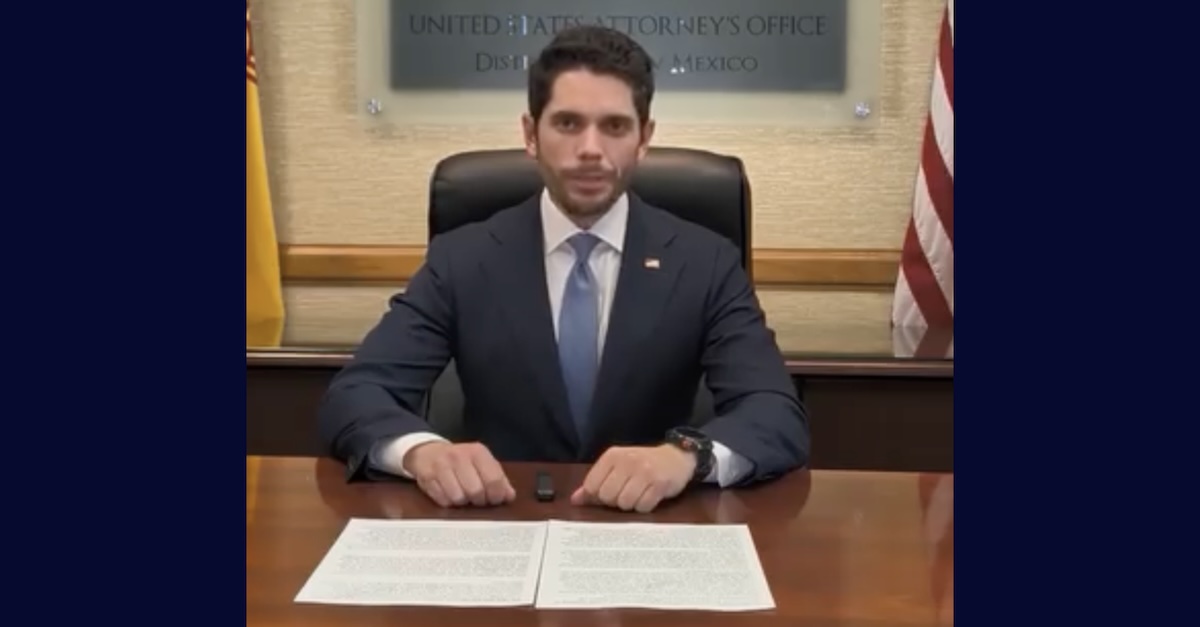
To support that argument, Justice Department lawyers cited a recent opinion involving another Bondi era official, Ryan Ellison, in a separate district. In that case, U.S. District Judge David Nuffer concluded that Ellison had improperly continued to claim the role of acting U.S. attorney after his resignation. The opinion, according to Law & Crime, stated that Ellison “was not a valid acting U.S. attorney” and that he “cannot perform the functions of U.S. Attorney and that any claim that he is acting or interim is improper.”
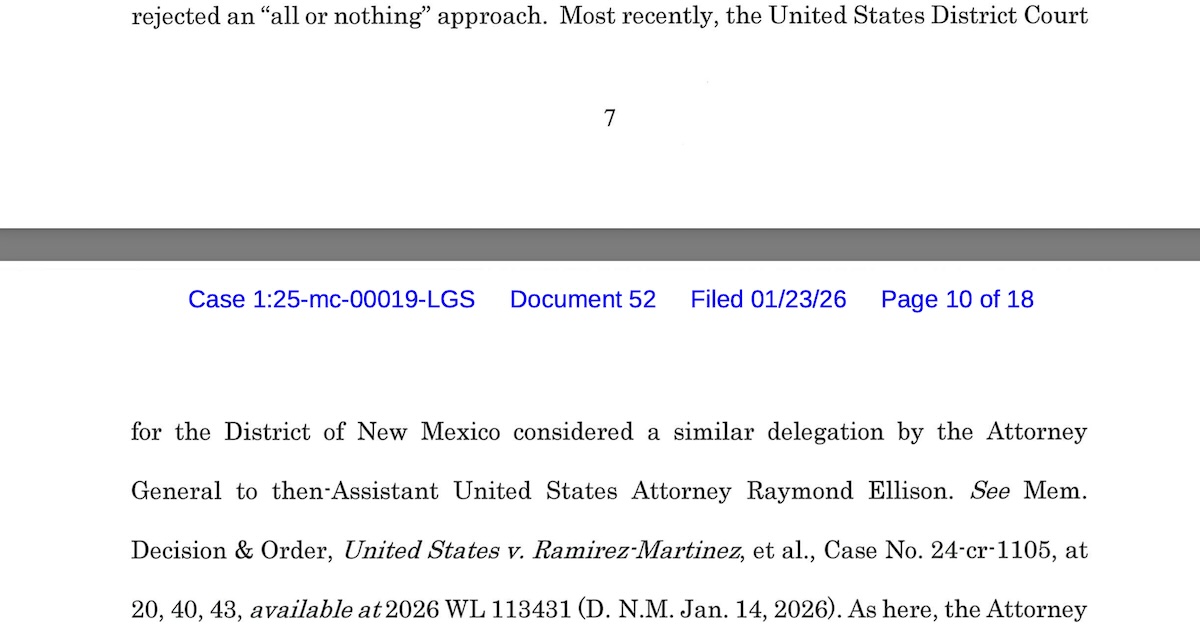
Yet in the very filing that invoked Ellison’s case as an analogy, the Justice Department repeatedly referred to him as “Raymond” Ellison, not Ryan, according to the Law & Crime review of the brief. The substance of the citation rested on Judge Nuffer’s opinion, but the name error highlighted the tension between the department’s insistence on legal precision and the apparent sloppiness of its own paperwork.
Ellison himself publicly accepted part of Nuffer’s ruling, Law & Crime reported. He acknowledged that his designation as acting U.S. attorney was invalid, but noted that he had been properly designated as First Assistant United States Attorney, pointing to an earlier case involving Bill Essayli as an example of how that status could sustain his authority.
The Delegation Theory the DOJ Is Leaning On
Despite Nuffer’s rejection of Ellison’s claim to be an acting U.S. attorney, the Justice Department pointed to another aspect of his role that it argued should apply by analogy to Sarcone. In its filing, the government noted that “The Attorney General designated Ellison as First Assistant United States Attorney, and the delegation was used to allow Ellison to perform the functions of a First Assistant United States Attorney, including supervising and conducting proceedings in the district.”
A similar delegation, the department argued, meant that Sarcone could lawfully oversee the investigation into James’s office even if his “acting” title was flawed. According to Law & Crime, the filing contended that Sarcone was “at minimum validly serving as first assistant and special attorney” and that Judge Schofield should not have invalidated his subpoenas based solely on “a defect in title.”
At the same time, Justice Department lawyers appeared to recognize that the legal landscape is unsettled. The brief acknowledged that, “Despite the ruling, there is a serious legal question about the validity of the delegation that warrants a stay pending appeal.” In other words, the government is asking for time for a higher court to decide whether its structure for filling top prosecutor roles in Bondi’s Justice Department passes legal muster.
A Request for a Pause, Not Immediate Power
In seeking a stay of Schofield’s order, the Justice Department is not currently asking to compel James’s office to comply with the disputed subpoenas. According to the Law & Crime report, the department told the court that it would not seek to enforce the two subpoenas if the stay is granted.
That position reflects a narrow focus on preserving the government’s appellate options rather than on immediate investigative steps. By putting enforcement on hold, federal prosecutors appear to be trying to minimize additional conflict with New York’s attorney general while still keeping alive the possibility that a higher court will revive the subpoenas later.
What remains unclear from the public record is how extensive the impact of these appointment rulings might be on other matters supervised by Bondi’s temporary appointees. Law & Crime notes that the list of affected officials includes temporary prosecutors in New Jersey, Nevada, California, the Northern District of New York, and the Eastern District of Virginia.
Unsettled Questions for Courts and Prosecutors
The dispute in Schofield’s courtroom brings together several threads. There is a politically sensitive criminal investigation scrutinizing a state attorney general who has already brought major civil actions against a former president and the National Rifle Association. There are structural questions about how far the Attorney General may go in stretching interim appointments and delegations of authority when Senate-confirmed positions are vacant.
Layered on top of all that are the federal government’s own missteps. The choice to rely on Ryan Ellison’s case while misnaming him as “Raymond” in the briefing may not affect the legal outcome, but it underscores how closely judges are now examining every detail of Bondi-era appointment decisions.
For now, the subpoenas to Letitia James’s office remain quashed, and John Sarcone is off the case. The Justice Department is betting that an appellate court will accept its argument that a First Assistant and special attorney can keep a grand jury investigation alive even when a judge has stripped away the “acting” title. Until that happens, the most concrete fact is that a federal probe into a powerful state official is on hold, while the basic question of who was allowed to run it is still being litigated.