

Federal officials say a Mexican national injured his head when he ran from an ICE arrest and struck a concrete wall in Minnesota. The man, Alberto Castaneda-Mondragon, insists there was no wall at all, alleging instead that immigration officers beat him so severely he could not remember his own daughter.
TLDR
Federal officials say Alberto Castaneda-Mondragon injured his head when he fell against a concrete wall while fleeing an ICE arrest in Minnesota. He tells a very different story, alleging repeated beatings, severe brain injuries, and racist abuse in custody.
Conflicting Accounts of a January Arrest
The Department of Homeland Security, or DHS, and 31-year-old Mexican citizen Alberto Castaneda-Mondragon now offer incompatible explanations for what happened during a January 8th, 2026, operation in Minnesota. According to DHS, he was already handcuffed when he tried to escape, fell, and hit his head. According to Castaneda-Mondragon, officers began beating him from the moment of arrest and continued inside federal custody.
The case highlights a familiar collision in immigration enforcement: an official narrative that portrays resistance and flight, and a detainee account that alleges excessive force and racist abuse. It also underscores a recurring gap in public understanding, because the government has released statements but not, so far, investigative findings or detailed records explaining how it assessed what occurred.
Fox News, citing DHS statements and an interview Castaneda-Mondragon gave to the Associated Press, first laid out the competing versions of events. Both accounts agree that he ended the day in a hospital emergency room. They diverge sharply on how and why he got there, and on the extent and cause of his injuries.
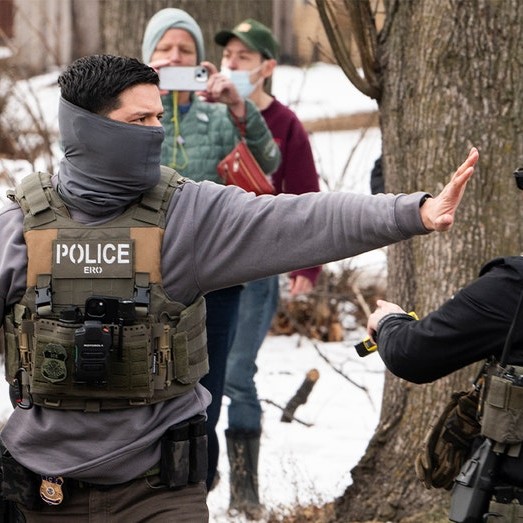
ICE agents in Minnesota are shown during an enforcement operation, a reminder of the day-to-day encounters that can quickly escalate and later become the subject of conflicting claims.
A Mexican immigrant was left with severe head injuries after ICE agents beat him during a Jan. 8 arrest in St. Paul, Minnesota, the Associated Press reports. Alberto Castañeda Mondragón, 31, was pulled from a car, handcuffed, and struck in the head with a metal baton, then beaten… https://t.co/MEK45nWh8v pic.twitter.com/Dynim2wl2s
— Drop Site (@DropSiteNews) February 9, 2026
What DHS Says Happened
In a public statement summarized by Fox News, DHS said U.S. Immigration and Customs Enforcement, or ICE, officers placed Castaneda-Mondragon in handcuffs during an operation in Minnesota on January 8th. DHS said that while still restrained, he tried to flee toward a main highway. On the social media platform X, the department stated that, during this escape attempt, he fell and struck his head on a concrete wall.
According to DHS, once officers regained custody, they requested an ambulance so medical personnel could examine him. The department said Castaneda-Mondragon declined care at that point and told responders he was uninjured. DHS said officers nevertheless alerted staff at the detention facility about the incident and that he was later taken to Hennepin County Medical Center in Minneapolis to be evaluated for a head injury.
DHS has emphasized the danger it associates with people who resist federal officers. In the same public messaging campaign, the department said, “Resisting officers and evading arrest is dangerous for our officers, illegal aliens, and the public,” and described such conduct as a felony and federal crime. The department also criticized what it called “sanctuary politicians,” asserting that local opposition to ICE contributes to risky confrontations.
What Castaneda-Mondragon Alleges
Castaneda-Mondragon, interviewed in Spanish by the Associated Press and quoted by Fox News, describes the day very differently. He says he was in a vehicle with a friend near a shopping center in St. Paul when ICE agents pulled them over. According to his account, officers threw him to the ground, handcuffed him, and began to punch him and hit his head with what he described as a steel baton.
“They started beating me right away when they arrested me,” he told the Associated Press, according to the Fox News account. He says officers dragged him into a sport utility vehicle and continued to assault him while transporting him to a detention facility. Once there, he alleges, the beatings resumed instead of ending.
Castaneda-Mondragon told reporters he remembers being in the emergency room and claimed doctors later informed him that he had eight skull fractures and five life-threatening brain hemorrhages. Fox News did not cite hospital records, and public reporting so far has not independently confirmed the exact nature or number of his injuries. His description, if accurate, would suggest a level of force far more severe than DHS has acknowledged.
The starkest factual disagreement centers on DHS’s description of a fall against a concrete wall. “There was never a wall,” Castaneda said in Spanish, according to the Associated Press account relayed by Fox News. He described pleading with officers to stop. “They laughed at me and hit me again,” he said, adding that he perceived their behavior as driven by racism toward immigrants: “They were very racist people.” Those statements, like DHS’s, are allegations, not findings by a court or independent investigator.
Procedures, Medical Care, and What Remains Unknown
Both accounts confirm that Castaneda-Mondragon was eventually evaluated at Hennepin County Medical Center after his time in ICE custody. DHS says officers first called an ambulance at the scene of the arrest, where he allegedly declined treatment and claimed to be uninjured. He says he recalls the emergency room and has described memory loss so severe that he initially did not remember he had a daughter.
The tension between those details raises basic factual questions. If he did sustain multiple skull fractures and brain hemorrhages, medical records could clarify when doctors believe the injuries occurred, what kind of trauma likely caused them, and whether they are consistent with a single fall, repeated blows, or some combination. Those records are protected by privacy laws, and neither DHS nor the hospital has made them public.
The case also touches on how complaints about force by immigration officers are typically handled. DHS has several oversight components, including the Office for Civil Rights and Civil Liberties and the Office of Inspector General, that can review allegations of abuse. ICE internal affairs units can also examine officers’ conduct. Public reporting on this incident, however, has not yet described any specific internal or external investigation focused on Castaneda-Mondragon’s claims.
Legally, the stakes run in more than one direction. DHS has framed the conduct it describes as felony-level resistance to federal officers, although it has not publicly detailed any specific charges tied to the alleged escape attempt. At the same time, if an investigation were to substantiate Castaneda-Mondragon’s allegations of beatings in custody, it could implicate federal civil rights protections that prohibit officials from using unreasonable force or inflicting punishment on people who have not been convicted of a crime.
For now, the public record consists largely of dueling narratives, filtered through agency statements and media interviews. DHS points to a handcuffed flight, a fall, and an ambulance call. Castaneda-Mondragon points to batons, racist taunts, and injuries he says no wall could explain. Whether internal reviews, medical documentation, or potential court proceedings will reconcile those accounts, or leave the central disputes unresolved, remains an open question.