

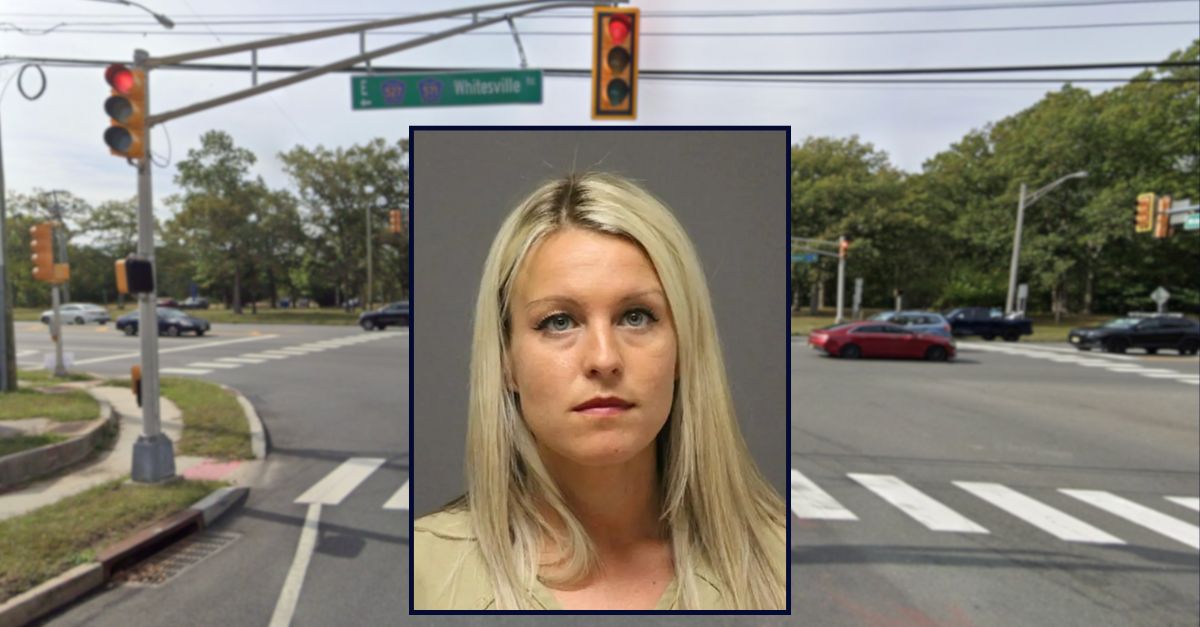
The state asked for years in prison after a five-car collision killed two drivers on a New Jersey highway. Instead, the woman at the center of the case walked out of court with probation and a suspended license.
The Crash On Route 571
According to an account from the Ocean County Prosecutor’s Office, the chain of events began on a March morning in 2022 on Route 571 in Manchester Township, about 30 miles from Trenton. Investigators said that around 7:15 a.m., a 2018 Honda Civic driven by 34-year-old Danielle M. Bowker was traveling west when it crossed into oncoming traffic and struck a New Jersey Department of Transportation Ford F-550 pickup traveling east.[1]
Neither Bowker, nor the driver or passenger in the state truck, died in the initial head-on collision. But the impact sent the heavier Ford out of control. Prosecutors said the pickup then hit a 2012 Toyota Camry driven by 48-year-old Michael Sadis, pushing his car off the road into an embankment, before continuing forward into a 2015 Toyota Corolla driven by 58-year-old Paul Lamberti.[1]
Sadis was pronounced dead at the scene. Lamberti was airlifted to Jersey Shore University Medical Center in Neptune, where he later died of his injuries.[1] Those two deaths would define the criminal case that followed.
From Marijuana Allegation To Manslaughter Conviction
In the months after the crash, investigators focused on whether Bowker had been impaired. In June 2022, she was charged with two counts each of vehicular homicide, strict liability vehicular homicide, assault by auto, and driving while intoxicated, according to the prosecutor’s office summary of the case.[1]
Prosecutors said blood drawn from Bowker after the crash showed the presence of THC, the primary psychoactive compound in cannabis. Based on those lab results, the state retained a psychopharmacologist who reviewed the testing and offered an opinion that Bowker had been too impaired to drive safely.
“Upon reviewing the laboratory results of Bowker’s blood draw, the state’s psychopharmacologist rendered an opinion that at the time of the crash, Bowker’s faculties were impaired due to the effects of marijuana intoxication, and that she could not safely operate a motor vehicle,” Ocean County Prosecutor Bradley D. Billhimer said when announcing the charges.[1]
The defense did not dispute that Bowker used cannabis. At trial in October 2025, she admitted smoking marijuana the night before the crash. The question for jurors was whether she was still impaired the next morning when she got behind the wheel.
A defense expert told the jury that the psychoactive effects of marijuana typically wear off within several hours and that any consumption the prior night would have been unlikely to affect Bowker by the time she woke up and drove. That testimony tracked with existing scientific literature that distinguishes between the relatively short window of impairment and the much longer period during which THC or its metabolites can remain detectable in blood or urine.[2]
Jurors ultimately rejected the marijuana related charges. According to local reporting cited by Law & Crime, the jury foreperson indicated in court that they found Bowker reckless, but not intoxicated, concluding that her criminal liability rested on failure to maintain her lane rather than drug use.[1]
The panel convicted Bowker of two counts of third-degree vehicular manslaughter tied to reckless driving. It did not convict her on strict liability vehicular homicide, a New Jersey offense that applies when a person causes a death while driving under the influence, regardless of intent.[3]
Why Prosecutors Wanted Prison And The Judge Did Not
After the guilty verdicts, Ocean County prosecutors asked the court to impose significant prison time. In a sentencing submission described in the same public account, the state requested three years behind bars for each victim and argued that the sentences should run consecutively rather than concurrently. That approach would have kept Bowker in state prison for six years.[1]
New Jersey law treats most third-degree crimes as carrying a potential term of three to five years in state prison. At the same time, the state generally presumes that people convicted of third-degree offenses, who have no prior record and whose crimes did not involve violence in the traditional sense, may be eligible for non-custodial sentences such as probation.[3]
Bowker appeared to fall into that gray area. She had been found reckless. Two people died as a result. But jurors had specifically rejected the allegation that she was intoxicated on marijuana when she crossed into oncoming traffic. That left the sentencing judge, Superior Court Judge Dina M. Vicari, to weigh the seriousness of the harm against the legal findings the jury had actually made.
In January 2026, Judge Vicari sentenced Bowker to five years of probation and suspended her driving privileges for two years. The judge declined to send her to prison at all, opting instead for community-based supervision.[1]
For the families of Sadis and Lamberti, that outcome meant that the person held criminally responsible for the collision that killed their loved ones would not serve time behind bars. In a statement after the earlier verdict, Prosecutor Billhimer had framed the jury’s decision as a form of accountability that could offer some relief, saying the office hoped the result would provide “some measure of justice and closure” for the victims’ relatives.[1]
He also stressed deterrence, warning that drivers who act recklessly and cause deaths should expect legal consequences. The sentence that followed, however, was far more lenient than what his office said it wanted.
The Limits Of Proving Marijuana Impairment
A central tension in the case was not whether THC was in Bowker’s blood. It was whether prosecutors could prove that its presence actually affected her driving on the morning of the crash.
Unlike alcohol, where breath and blood tests can reliably correlate a driver’s blood alcohol concentration with impairment, there is no widely accepted numeric threshold for marijuana impairment. THC and its metabolites can linger in a person’s body long after the subjective effects of cannabis have faded. Public health agencies, including the U.S. Centers for Disease Control and Prevention, have noted that this makes it harder to connect a blood test result to real-time driving ability.[2]
New Jersey’s impaired driving laws prohibit operating a vehicle while under the influence of alcohol or drugs, including cannabis, and carry criminal penalties when a death results. But those statutes still require proof that the driver was actually impaired, not just that a drug was detectable in their system.[4]
In Bowker’s case, the jury heard conflicting expert opinions on that question and sided with the defense. The result underscores a practical reality that police, prosecutors, and defense attorneys across the country have been grappling with as more states legalize cannabis for medical or recreational use. Toxicology results alone may not be enough to persuade jurors that a driver was under the influence at a specific moment in time.
For families who lose relatives in crashes where cannabis is suspected, that distinction can feel technical. For defendants whose liberty is at stake, it is the core of due process. Here, the legal standard for conviction on marijuana related charges was not met, even though the underlying driving behavior was still found criminally reckless.
What Remains Unanswered
Two men are dead. The woman whose car first crossed the center line has been convicted of third-degree offenses, but she will serve her sentence in the community, not in prison. Prosecutors maintain that her conduct merited incarceration. A judge concluded otherwise.
The public record in this case does not fully explain why Bowker’s vehicle left its lane on Route 571 that morning or precisely how Judge Vicari weighed her background, the jury’s rejection of impairment, and the loss of life in deciding on probation. It does, however, highlight a recurring fault line in traffic fatality cases that involve cannabis. When science, law, and grief collide in the courtroom, the outcome can hinge less on what everyone agrees happened and more on what the state can prove about a driver’s state of mind at the exact moment of impact.