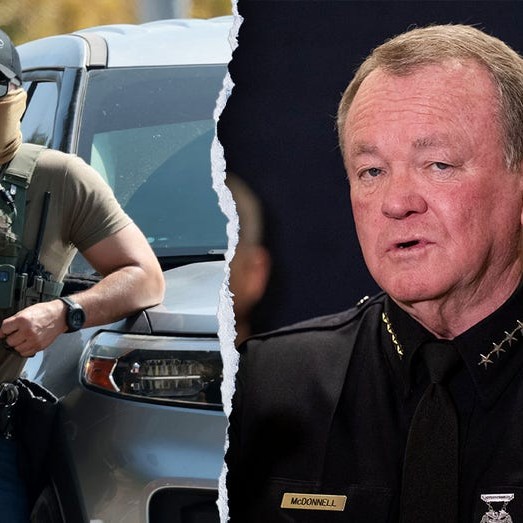
Los Angeles officers may soon find themselves watching federal colleagues break a new California law, and their chief says they will not step in.
At the center of the dispute is a statewide ban on masks for law enforcement, signed by Gov. Gavin Newsom, and a public statement from Los Angeles Police Department Chief Jim McDonnell that his officers will not cite federal immigration agents who keep their faces covered during operations. The move highlights a growing conflict between state-level transparency rules, federal immigration enforcement, and local police safety concerns.
The New California Mask Law
According to Fox News Digital, Newsom signed a bill in September 2025 that makes it a misdemeanor for local, state, or federal law enforcement officers to wear masks or other disguises while performing official duties in California.
The law creates two key exceptions. Officers working undercover and those engaged in tactical operations that require protective gear can still cover their faces. Outside those situations, the statute is written to apply broadly to any law enforcement presence on duty in the state.
When Newsom signed the bill, Fox News reports that he challenged its critics with a pointed question: What are you afraid of?
The governor and supporters have framed the law as a transparency measure, intended to make it easier for residents to identify who is exercising state power in their neighborhoods.
California has already tested the limits of state power around federal immigration enforcement. Its 2017 sanctuary law, often referred to as the California Values Act, that limited how local agencies could cooperate with federal immigration authorities. That statute prompted a federal preemption lawsuit from the Trump Justice Department in 2018, which argued that California was obstructing federal immigration enforcement under the Supremacy Clause of the U.S. Constitution. Courts ultimately left most of the sanctuary framework in place.
The new mask law pushes into different territory. Instead of limiting cooperation, it seeks to dictate how any officer, including federal agents, may present themselves while working in the state.
LAPD’s Tactical Argument Against Enforcement
Chief McDonnell told Fox Los Angeles’ morning program Good Day LA
that the LAPD will not enforce the mask statute against federal immigration agents during field operations.
He described the issue as one of practical safety. In his interview, McDonnell said, From a practical standpoint, our role when we get to a scene is to de-escalate the situation, not to ramp it up. Trying to enforce a misdemeanor violation on another law enforcement agency, that is not going to end well. And that is not going to be good.
McDonnell followed with a broader concern about crowd dynamics at immigration raids. From a public safety standpoint, for anybody in that environment. Potentially, you have a crowd that could be agitated and trying to get their point across,
he said. He added that stepping in to cite Immigration and Customs Enforcement, or ICE, agents for wearing a mask, it is not a safe way to do business.
The chief is not disputing that the statute exists or that it appears to cover federal officers on California soil. Instead, he is asserting a form of on-the-ground discretion about when the LAPD will act. In practice, that would leave local residents watching masked federal raids even though a state law on the books describes that very conduct as a misdemeanor.
McDonnell has not, in the Fox reporting, laid out how his department will handle complaints after the fact, such as if a resident files a report that ICE agents violated the mask ban once a scene has calmed. The public record so far focuses on his decision not to intervene at the moment of an operation.
A Federal Lawsuit and Supremacy Concerns
Fox News Digital reports that the Trump administration has already gone to court to stop California from enforcing the mask restriction against federal personnel. A spokesperson for Newsom’s office told the outlet, The federal government has sued to stop the state from enforcing this law. We are defending the law in court, which would go in effect on July 1.
That description fits a familiar pattern. During Trump’s first term, the Justice Department sued California over several immigration related statutes, arguing that they were preempted by federal law and interfered with national immigration priorities.
The legal question now is more specific. Can a state make it a crime for a federal officer to wear a mask while carrying out federal responsibilities, outside of a narrow set of exceptions? Federal lawyers in prior clashes have pointed to a line of Supreme Court decisions that limit states from directly regulating how federal functions are carried out. California defenders typically respond that states retain power over general health and safety rules that apply to everyone, including federal personnel, while they are within state borders.
Until a court rules on the new challenge, the exact boundaries remain unsettled. Newsom’s office has signaled it intends to defend the statute as written. The Fox report does not indicate whether any federal court has issued an injunction that would temporarily block the law.
Why ICE Agents Say They Wear Masks
The mask ban followed a series of immigration raids in and around Los Angeles, where federal agents were seen wearing face coverings. Fox News reports that Department of Homeland Security Assistant Secretary Tricia McLaughlin has said federal agents are already required to identify themselves and wear clothing that clearly displays they are with ICE or Homeland Security during operations.
In the same Fox account, authorities said ICE agents have used masks to shield themselves and their families from doxxing and threats. That concern is not hypothetical. During the Trump administration, immigration enforcement personnel became targets of organized online efforts to collect and publish their personal details. In 2018, The Washington Post reported that activists had compiled and posted what they described as a list of 1,595 ICE employees
with links to their social media profiles and other personal information.
Federal agencies have also faced criticism for the way agents present themselves. During the 2020 protests in Portland and other cities, observers and civil rights groups objected to officers in military-style gear who wore generic patches and covered faces. Critics argued that this made it difficult for residents to know which agency was operating in their streets and to hold specific officers accountable for any misconduct. In response, the Department of Homeland Security said that officers were required to display identifying insignia and that certain protective equipment was necessary for safety in volatile situations.
The Los Angeles raids that preceded California’s mask law combined both sets of concerns. Agents wore face coverings, while DHS officials maintained that they remained clearly marked as federal officers through their clothing.
Community Fears and Local Officials’ Response
Los Angeles Mayor Karen Bass has previously criticized the use of masked agents in immigration enforcement. Fox News Digital reports that in a separate interview with ABC News, Bass described how the operations felt to residents on the ground.
When the raids started, fear spread,
she said. The masked men in unmarked cars, no license plate, no real uniforms, jumping out of cars with rifles and snatching people off the street, leading a lot of people to think maybe kidnappings were taking place.
Her account illustrates the gap between what federal agencies say about identification standards and what people on the street perceive when heavily armed, masked officers move quickly and without clear local coordination. For families in neighborhoods with large immigrant populations, the distinction between a kidnapping and an arrest can come down to visible badges, markings on vehicles, and whether officers can be readily identified after the fact.
The new California law attempts to address that perception by removing masks from most encounters, not just from ICE but from all law enforcement personnel in public-facing roles. McDonnell’s stance effectively creates an exception in practice for federal immigration operations in Los Angeles, even while the legal text of the statute does not.
Unclear Rules, Real World Consequences
Right now, three overlapping claims are in play. California insists that nearly all law enforcement officers inside its borders should appear with uncovered faces. Federal immigration agencies say certain face coverings are necessary to protect their personnel from targeted threats. LAPD argues that intervening in the middle of an immigration raid to write a state misdemeanor ticket for a masked ICE agent would put officers and bystanders at risk.
Residents watching a raid unfold may not know which of those positions is in force at any given moment. The Fox News report provides no detail on whether the LAPD will document mask violations after operations end, or whether the department sees any role for itself in collecting evidence if community members want to challenge masked raids under state law.
Courts will eventually define some of these boundaries. The lawsuit described by Newsom’s spokesperson will test how far California can go in prescribing visible identification standards for federal officers on its soil. In the meantime, the policy decisions are being made in television interviews and at the scene of arrests.
For people in Los Angeles neighborhoods where immigration raids occur, the open question is simple and practical. When masked federal agents arrive, and local officers decline to enforce a state transparency rule, whose standards actually govern what those residents are allowed to see.