

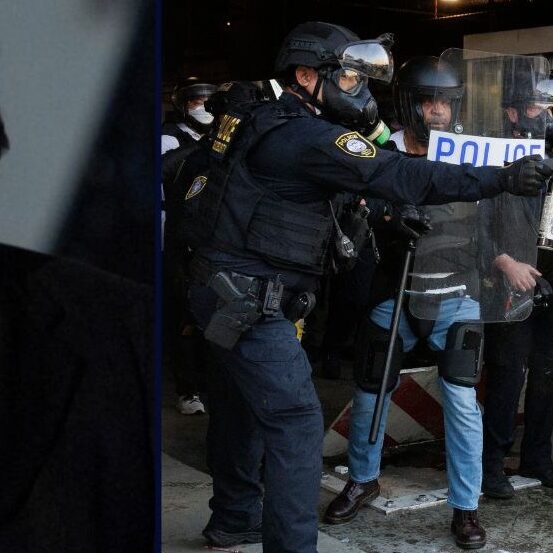
A federal judge in California has blocked part of the state’s new ban on masked law enforcement but allowed a requirement that Immigration and Customs Enforcement agents display their names and badge numbers, leaving open how far states can go in regulating federal officers.
TLDR
A federal judge in Los Angeles declined to halt California’s law requiring visible names or badge numbers for all law enforcement, including ICE, while finding the state’s mask ban unlawfully discriminates among agencies. The order is stayed until February 19th as the DOJ decides its next move.
A federal judge blocked California from enforcing its ban on federal immigration agents wearing masks, ruling the law likely violates the Constitution. A separate ID requirement for officers will remain in effect.
Full story 👇https://t.co/D5fKCQ6LQw pic.twitter.com/qMdSL0qdFW
— Los Angeles Magazine (@LAmag) February 11, 2026
The ruling, issued by U.S. District Judge Christina A. Snyder on a motion for a preliminary injunction, stems from a U.S. Department of Justice lawsuit targeting two California statutes often referred to as the No Secret Police Act and the No Vigilantes Act. Together, those laws sought to bar masked officers and to mandate visible identification for local, state, and federal law enforcement operating in California.
The Trump administration argued that California had overstepped by attempting to control how federal officers carry out their duties. State officials, in turn, framed the measures as basic transparency requirements developed after years of complaints about unmarked federal teams and immigration operations that, critics said, left communities unable to identify who was using force in their neighborhoods.
The dispute has become an early test of how far states may go in imposing accountability rules on federal agents at a time when immigration enforcement tactics remain politically and legally contested.
How the Mask Ban Ended Up on Hold
In the challenged package, the No Secret Police Act targeted facial coverings worn by law enforcement during enforcement activities, while the No Vigilantes Act required officers to display either a name or badge number along with their agency. Both laws were passed by the California Legislature and signed by Governor Gavin Newsom amid public anger over aggressive ICE operations and deployments of federal personnel at protests.
According to Law & Crime, the Justice Department focused heavily on the mask provision. Although the statute’s text referred broadly to “law enforcement” in California, Snyder concluded that, in practice, it treated categories of officers differently and therefore ran into intergovernmental immunity concerns.
The opinion notes that the law did not burden all law enforcement the same way. Federal and some local officers were restricted from using facial coverings in circumstances where certain state officers faced fewer constraints. At the core of Snyder’s analysis was the conclusion that the state had written the measure in a way that favored its own personnel when compared with their federal counterparts.
In effect, the court found that California can regulate the conduct of federal officers through generally applicable rules, but cannot structure those rules to advantage state officers over similarly situated federal and local agencies. Snyder suggested that the problem lay in the design of the statute, not necessarily in the idea of restricting masks itself.
Rather than foreclosing a mask rule altogether, the court’s order points toward a potential fix: California could extend any mask prohibition to all law enforcement officers within its borders, including its own agencies such as the California Highway Patrol. After the ruling, state lawmakers publicly indicated they intended to revise the legislation to do just that, as reported by KQED.
Why the Identification Rule Survived
The Justice Department did not ask the court to block the separate requirement that officers display visible identification. That section of the law applies across federal, state, and local agencies, and Snyder described it as the kind of neutral, generally applicable regulation states may impose on those operating within their territory.
In the 30-page order, Snyder analogized the ID rule to traffic laws that govern how federal employees drive on state roads. Those rules affect how federal officers do their jobs, but they do not amount to an impermissible attempt to direct core federal functions.
The judge wrote that the challenged provisions restrict certain ways of performing law enforcement duties by “prohibiting a facial covering and requiring the display of visible identification” in nonexempt situations, yet remain enforceable so long as they operate evenly and respect established immunities. Because the identification requirement applies to all law enforcement in California, it avoided the discrimination problem that undermined the mask ban.
Snyder went further in explaining the purpose she saw behind the statutes. The opinion states that “the Court finds that these Acts serve the public interest by promoting transparency which is essential for accountability and public trust.” On the specific question of officers concealing who they are, Snyder added that there is “no cognizable justification for law enforcement officers to conceal their identities during their performance of routine, non-exempted law enforcement functions and interactions with the general public.”
That framing links the law directly to accountability debates that intensified during immigration raids and protest responses in recent years, where residents and advocates reported officers without name tags or clear agency markings. In Snyder’s view, requiring basic identification in routine encounters does not interfere with federal objectives.
The Limits of Federal Objections
Beyond the mask discrimination issue, the Justice Department advanced a broader claim: that California’s regulations on masking and identification would compromise officer safety and obstruct federal law enforcement operations. Snyder was unpersuaded.
The order notes that the United States had not demonstrated that current masking or anonymity practices are essential to carrying out federal law. According to the opinion, the record did not support the idea that the state’s rules would meaningfully enable criminal targeting of officers or cripple immigration enforcement.
As Snyder summarized, the United States “has not shown that its current practices with respect to masking and identification are essential to federal law enforcement operations.” The order continued that “a rule that prohibits law enforcement officers from wearing masks or requires them to have visible identification does not facilitate or enable criminals to harm law enforcement officers.”
Those findings matter at the preliminary injunction stage, where the court must weigh whether the party seeking to block a law has shown a likelihood of success on the merits, irreparable harm, and a tilt in the public interest and equities. On the current record, Snyder concluded that the Justice Department had not cleared that bar with respect to the identification rule or the overall structure of California’s transparency framework.
The partial win on the mask provision, in other words, came from the statute’s uneven coverage, not from a broad endorsement of the federal government’s arguments about its own needs.
What Happens Next for ICE and California
For now, the ruling has been stayed until February 19th. That built-in delay gives the Justice Department time to decide whether to seek further relief from the Ninth Circuit Court of Appeals and allows California lawmakers to begin work on revising the mask statute.
If the stay expires without additional court intervention, ICE agents and other federal officers operating openly in California, aside from defined exemptions such as undercover work, will be legally required to display visible identification linking them to an agency and either a name or badge number. State and local officers will face the same requirement.
The mask rule, by contrast, remains in legal limbo. Unless the Legislature enacts a revised version that treats all law enforcement alike, enforcement against federal officers would remain blocked under Snyder’s order. Lawmakers have already signaled they intend to broaden the ban so that state agencies are also covered, which could restore the provision on a uniform basis.
The case highlights a continuing tension in the crime and immigration context. States are exploring ways to impose transparency and accountability conditions on officers within their borders, while federal officials argue that some of those conditions intrude on national priorities or safety practices. Snyder’s opinion sketches one possible boundary: even-handed rules that mirror long-accepted regulations, such as traffic laws, can apply to federal officers, but statutes that advantage state agencies over federal ones are unlikely to stand.
Whether the Justice Department chooses to appeal, and how quickly California can rework its mask ban, will determine how long this particular arrangement lasts. The answers will shape not only how ICE operates in the state, but also how other jurisdictions draft their own accountability laws in the months ahead.
References
- Law & Crime: No Cognizable Justification: Judge Signs Off on California Law Requiring ICE to Display Names and Badge Numbers While on Duty
- CourtListener: United States v. State of California: Order on Motion for Preliminary Injunction
- KQED: After US Judge Blocks California ICE Mask Ban, Scott Wiener Says He Will Make It Enforceable