An alleged armed confrontation over a pair of John Deere tractors has left an eastern Idaho landowner facing two felony aggravated assault charges, and raised familiar questions about where property disputes end, and potential gun crimes begin.
TLDR
Prosecutors in Fremont County, Idaho, have charged 45-year-old landowner Cade Carter with two felony counts of aggravated assault after a late-January encounter in which he allegedly pointed a 12-gauge shotgun at two repossession agents attempting to take his John Deere tractors from his Teton-area property. No shots were fired, and Carter was later released on bond pending a preliminary hearing.
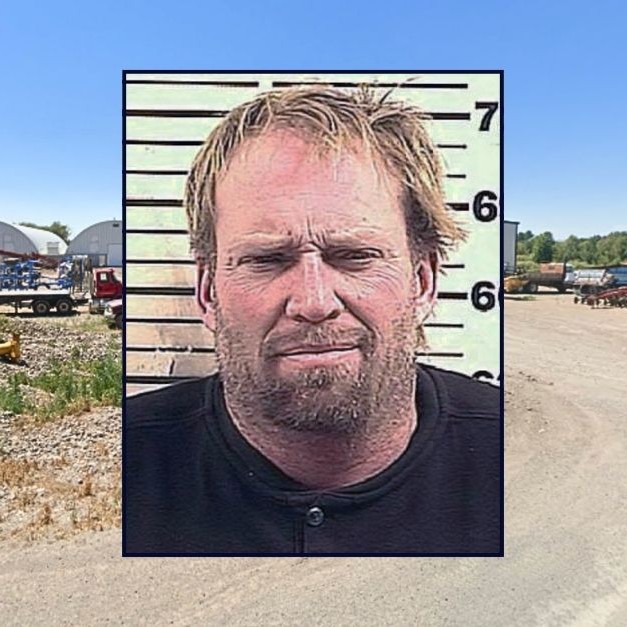
Inset: Booking photo of Cade Carter provided by the Fremont County Sheriff’s Office, with a background image of the rural property where the reported repossession attempt occurred.
Alleged Threats Over Farm Equipment
According to a probable cause affidavit described by Law And Crime, two repossession agents arrived at Carter’s property near Teton on the night of January 25th to carry out what they later told deputies was a lawful repossession of John Deere tractors tied to a debt. One agent reportedly climbed into a tractor cab and began to prepare to drive it off the property.
The affidavit states that Carter, 45, emerged from a building on his land holding a 12-gauge shotgun. The agents told investigators that he stepped in front of the moving equipment, blocking its path, and pointed the firearm at both men. One agent later recounted that Carter warned, “I will blow your [expletive] head off,” and declared, “You are not taking my tractors.”
In the filing, an agent identified as the one on the ground is quoted as explaining that they informed Carter they were there to repossess tractors tied to a John Deere account. The document alleges that “Carter stood in front of the tractor and pointed the shotgun at [the agent] who was seated inside,” refusing to allow the men to leave with the equipment.
The Fremont County Sheriff’s Office has said the agents reported feeling that their lives were in danger throughout the confrontation. Both later told deputies they believed Carter might fire the weapon and that they feared for their safety if they continued the repossession attempt.
How a Repossession Turned into Felony Charges
What happened next, according to the affidavit, shifted the encounter from an argument over debt to a case file on the prosecutor’s desk. While the agent in the tractor cab remained in the driver’s seat, the other agent allegedly moved in on Carter in an effort to control the gun. The document states that the agent grabbed the shotgun barrel and wrestled with Carter until he was able to knock him to the ground and disarm him.
With the firearm removed from Carter’s hands, the agents chose to leave the tractors behind. They drove away from the property and contacted law enforcement, rather than attempting to complete the repossession. They later told deputies they had considered the encounter too volatile to continue once a gun had been introduced.
Deputies from the Fremont County Sheriff’s Office responded to the property that evening. Carter was taken into custody and booked on two counts of aggravated assault. Idaho law treats pointing a firearm at another person in a threatening manner, even without firing, as potential grounds for an aggravated assault charge when prosecutors believe they can show intent to place someone in fear of serious bodily harm.
Online court records reviewed by Law And Crime indicate that Carter was released from custody on a $50,000 surety bond. He is scheduled for a preliminary hearing on February 25th in Fremont County. At that hearing, a magistrate judge will decide whether there is enough evidence for the felony charges to move forward toward a possible trial.
As of the latest available filings, there is no indication in the public record that the tractors were ultimately repossessed or that any additional charges related to the incident, such as unlawful discharge of a firearm, have been filed. No injuries were reported.
What the Case Reveals About Debt and Force
The affidavit and law enforcement statements describe an encounter that is increasingly familiar in rural debt disputes. Repossession agents, who are hired to recover vehicles or equipment after missed payments, are allowed to remove property under contract but are generally required to avoid what courts term a breach of the peace. When a firearm is introduced, the question often shifts from whether the repossession is lawful to whether a crime has been committed against the people attempting it.
According to the account relayed by the Fremont County Sheriff’s Office, the agents in this case believed they had the right to take the tractors and that they followed standard procedures by contacting law enforcement once the situation escalated. Carter’s perspective on the underlying debt, the repossession process, or what led him to retrieve a shotgun rather than rely on civil remedies is not detailed in the public documents.
Cases like this also highlight how quickly property disputes can become criminal matters in states where gun ownership is common. A landowner who believes a repossession is improper can challenge it in civil court, but when a weapon is allegedly pointed at a person, the focus for investigators shifts to whether that action created a reasonable fear of imminent harm. As one line in the affidavit puts it, the agents felt their lives were “threatened” and they “feared” what would happen next if they stayed.
Several elements remain unresolved and will likely be examined more closely if the case proceeds. Those include whether any cameras recorded the confrontation, whether there were prior disputes or warnings between Carter and the lender, and how precisely each person involved describes the moments before the shotgun was disarmed. Carter has not been convicted of any crime in connection with the incident and, like any defendant, is presumed innocent unless prosecutors prove the charges beyond a reasonable doubt.
For now, the case sits at a procedural turning point. Prosecutors have filed two felony counts, Carter is free on bond, and the tractors remain a focal point of both the alleged threats and the underlying financial dispute. What began as a standard repossession on a winter night in rural Idaho will now hinge on testimony, affidavits, and courtroom rulings rather than force at the edge of a field.