

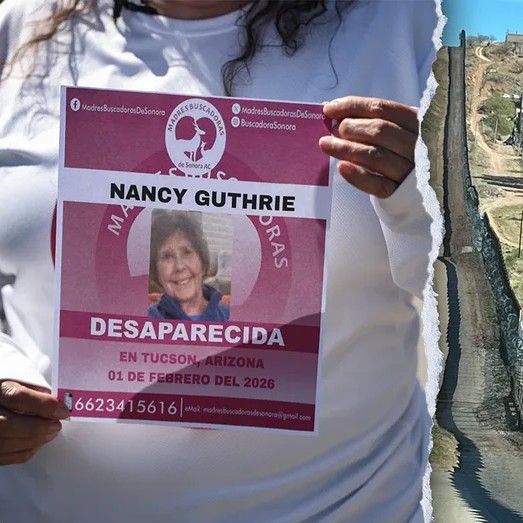
In the disappearance of 84-year-old Nancy Guthrie from the Catalina Foothills near Tucson, officials on both sides of the border agree on one point: there is no evidence she was taken into Mexico. Yet an expert says cross-border protocols should have activated early, while authorities in Sonora publicly insist they have never received a formal request for help.
TLDR
Investigators say they have no indication that missing Arizona resident Nancy Guthrie was taken across the border, and experts describe such an abduction as logistically difficult. Mexican officials, however, report no formal U.S. request for assistance, raising questions about binational coordination.
Missing Near an International Border
Guthrie, an 84-year-old resident of the unincorporated Catalina Foothills community outside Tucson, was reported missing after she was last seen at her home, according to Fox News reporting. Local authorities have treated the case as an alleged kidnapping, though they have not announced any suspects or filed criminal charges.
Investigators in Pima County have publicly emphasized that, so far, there is no sign that Guthrie was moved out of the country. Pima County Sheriff Chris Nanos said investigators have not developed evidence that would tie her disappearance to a cross-border plot.
“We know where Mexico is in relationship to this, and it is a possibility. But no, we have nothing to indicate that,” Nanos previously told Fox News Digital, underscoring that the idea of a cross-border abduction remains theoretical in this case.
Despite that public stance, the proximity of Guthrie’s home to the southern border has shaped how both experts and the public view the investigation. Catalina Foothills sits within driving distance of the Nogales crossing, one of Arizona’s major ports of entry to Mexico.
What Security at the Nogales Border Looks Like
Retired New York Police Department Lieutenant Darrin Porcher, who examined the Nogales area for Fox News, described a physical and technological environment that would complicate any attempt to move a captive across the border undetected.
He pointed to a tall border wall near Nogales, Arizona, lined with barbed wire and stretching for miles beyond the city in both directions. According to Porcher, that barrier is supported by a dense network of cameras and U.S. Border Patrol agents positioned in vehicles at regular intervals.
“When we look at how the border wall is aligned, it seems very difficult to get across from the United States into Mexico because this is not a porous environment,” Porcher said in an interview at the Nogales crossing. His assessment aligns with federal descriptions of the area as heavily monitored, though illicit crossings do still occur elsewhere along the border.
Those logistical realities are central to why multiple officials and commentators have described the odds of a cross-border kidnapping in Guthrie’s case as relatively low. According to Fox News, experts have said that standard federal protocols automatically come into play when a kidnapping near the international boundary is suspected, even when there is no direct evidence of a border crossing.
Porcher, however, argued that investigators should have actively explored the Mexico angle from the outset, precisely because of the region’s geography. “I believe this is something that law enforcement should have attached to immediately within the first 72 hours, because it seems as if they were coming into a brick wall and not gaining any solutions as it relates to a kidnapping occurring,” he said.
Sonora Officials Say They Were Not Formally Asked
Authorities in the Mexican state of Sonora have publicly challenged the suggestion that cross-border protocols have fully engaged in Guthrie’s case. The office of Sonora Attorney General Gustavo Romulo Salas Chavez issued a statement on the social platform X, in Spanish, responding to U.S. media coverage linking Guthrie’s disappearance to possible activity in Mexico.
The statement, as translated and reported by Fox News, said the office “has not received a formal request for collaboration in the case of a missing person in Arizona,” referring to Guthrie. It continued: “To date, this institution has not received any formal request for collaboration, assistance, or exchange of information from U.S. authorities or Mexican federal agencies in relation to said case.”
The wording raises a narrow but important point. Sonora officials did not claim that no communication had occurred at all, only that there had been no formal request for collaboration, assistance, or information exchange through recognized channels. In high-profile cross-border cases, such requests typically move through established lines between U.S. law enforcement agencies, the U.S. Embassy in Mexico City, and state or federal counterparts in Mexico.
From the public record, it is not clear whether informal contacts occurred, whether federal agencies considered but declined to lodge a formal request, or whether such a request is still under review. U.S. agencies have not publicly detailed their outreach, leaving a visible gap between expert claims that protocols automatically apply and Sonora’s assertion that no formal ask has been received.
An Investigation Marked by Disputed Theories
The debate over cross-border coordination is unfolding alongside disagreements about what might have happened inside Guthrie’s home. In a separate Fox News report, an unnamed law enforcement source dismissed a burglary-gone-wrong explanation as highly unlikely given the known facts, calling it “ridiculously rare.” That comment highlights how contested even the basic working theories remain.
Investigators have publicly acknowledged at least one piece of forensic evidence that has not yet led to a breakthrough. According to Fox News reporting on a briefing by the Pima County sheriff, DNA recovered from a glove found near Guthrie’s residence and from inside the home did not match any profiles in the FBI database.
That result leaves investigators in a difficult position. The presence of foreign DNA suggests someone else may have been at or near the home, yet the lack of a database match provides no immediate link to a known offender. Without a suspect, a recovered vehicle, or electronic data pointing toward a southbound route, the cross-border abduction question remains theoretical, even as experts insist it should be examined.
Porcher has framed the early hours of such investigations as critical, particularly in cases where crossing an international boundary would dramatically complicate recovery efforts. His criticism that cross-border questions were not foregrounded in the first 72 hours underscores a broader tension between finite investigative resources and the need to rapidly rule out complex scenarios.
How Cross-Border Requests Typically Work
In cross-border crime investigations involving Mexico, U.S. agencies generally have several tools at their disposal. The FBI maintains legal attache offices that can liaise with Mexican federal authorities. Local sheriffs’ offices or police departments can route requests through federal partners or, when state-level border task forces exist, through them. For missing person cases that may involve kidnapping, those channels can be used to share basic identifying information, photographs, and investigative leads.
Formal collaboration often requires more than a phone call. Mutual legal assistance requests or letters rogatory can be used to obtain records, conduct searches, or take statements in another country. These processes are deliberate and can take time, which is why early, preliminary outreach is typically important when the possibility of a cross-border element cannot be ruled out.
The Sonora attorney general’s statement indicates that, as of the date of that communication, no such formal request naming Guthrie’s case had reached that office. That does not resolve what, if anything, U.S. agencies may have done informally or through other Mexican institutions, but it does draw a bright line around what Sonora is prepared to acknowledge on the record.
For families and communities watching from the outside, this distinction between formal and informal engagement is rarely visible. What they see instead are statements that protocols have been triggered, side by side with statements from neighboring jurisdictions that say no official request ever arrived.
Unresolved Coordination and the Road Ahead
Weeks into the search, the public narrative around Guthrie’s disappearance features three themes that run simultaneously. First, local and county investigators say they have developed no evidence that she was taken across the southern border. Second, an expert who reviewed conditions at the Nogales crossing describes a physically challenging, heavily monitored environment for any would-be abductor. Third, Sonora’s top prosecutor reports receiving no formal U.S. request for assistance, despite commentary suggesting that cross-border protocols should already be in motion.
Each of those elements is documented, but they do not yet fit into a coherent procedural picture. If investigators are confident enough in the absence of cross-border indicators that they have not elevated the case through formal channels, that reflects one set of priorities. If, on the other hand, they believe an international element cannot be excluded, then the lack of a formal request in Sonora becomes a central accountability question.
Until authorities release more details about the steps taken, the timing of any outreach, and the reasons for their choices, the public will have limited insight into how the international piece of this investigation has been handled. Guthrie remains missing, the DNA evidence has not produced a suspect, and the border, watched and fortified, still features in public debate only as an unrealized possibility.
Whether this case eventually involves a cross-border crime or remains entirely domestic, it has already exposed how quickly questions of international coordination arise when an elderly resident goes missing within reach of an international boundary. The investigation’s next milestones, including any future public briefings or cross-border requests, will determine whether the current gap between expert expectations and official statements narrows or persists.