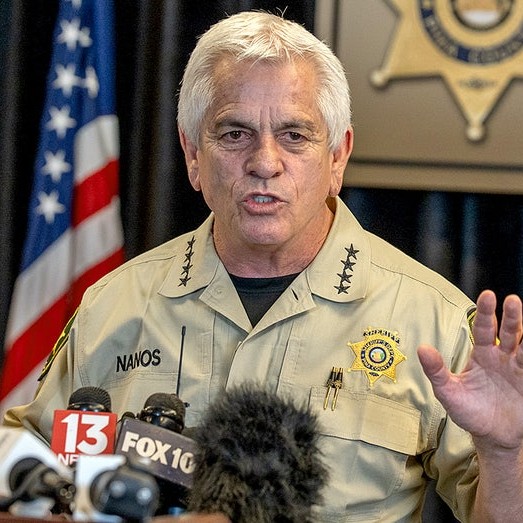
As the search for missing Tucson resident Nancy Guthrie stretches toward the two-week mark, Pima County Sheriff Chris Nanos is confronting renewed scrutiny over his leadership. Civil lawsuits from his own deputies, past referrals to the Arizona Attorney General, and a prior federal forfeiture probe now hang over a high-profile investigation that offers few public answers so far.
TLDR
Recent reporting describes Pima County Sheriff Chris Nanos facing renewed scrutiny during the search for missing resident Nancy Guthrie, with ongoing lawsuits by subordinates, a prior Arizona Attorney General review, and a federal asset forfeiture investigation all cited as context for assessing his department’s decisions.
Missing Person Case Revives Earlier Concerns
According to Fox News, Guthrie vanished from an upscale neighborhood of Tucson, prompting an intensive local and federal search that now includes door-to-door canvassing, analysis of Walmart sales records, and requests for neighbor surveillance footage from narrow time frames before she disappeared. Former FBI officials quoted in that coverage have suggested that canvass work and digital evidence could prove decisive, as agents pursue what one described as an insider tip.
Alongside those efforts, the FBI has doubled the reward for information, and a specialized FBI video unit that previously assisted in the Bryan Kohberger homicide case has been seen working at the Guthrie home, according to Fox News. Separate media reporting has described anonymous letters sent to news outlets demanding payment in Bitcoin in exchange for the kidnapper’s alleged identity, although law enforcement officials have not publicly confirmed the credibility of those messages.
Against that backdrop, some critics have accused Nanos of initially limiting the FBI’s role and routing key forensic evidence to a private laboratory in Florida instead of the FBI crime lab in Quantico, Virginia. In an interview with Fox News, Nanos rejected those claims, saying that his investigators had been working with the Florida lab from the outset and that both the Guthrie family DNA and other samples were already there.
“Why split your evidence to two different labs that could create a conflict,” Nanos said, arguing that using a single facility would avoid delays and confusion. “We trust the FBI’s crime lab. We’ve used them before. But in this case, we started with that lab. It is just that simple.”
He also denied delaying federal involvement, telling Fox News that he contacted the FBI on February 2nd, the first business day after local investigators opened the case. The central question for many residents, however, is whether that explanation is sufficient given past disputes over how Nanos and his command staff have exercised their authority.
Internal Critics Cite Political Retaliation
The most recent and detailed allegations against Nanos come from within his own ranks. According to Fox News, Lieutenant Heather Lappin and Sergeant Aaron Cross have filed lawsuits accusing the sheriff and the Pima County Sheriff’s Department of retaliating against them for protected political speech in the run-up to the 2024 sheriff’s race, which Nanos won by 481 votes.
Cross, a leader of the Pima County Deputies Organization, publicly campaigned against Nanos, including by holding a sign on a street corner that read “Deputies Don’t Want Nanos,” the Fox News report states. He was soon placed on administrative leave, and Nanos asserted that Cross had campaigned in department clothing in violation of policy. Cross has denied that accusation, and his case remains pending in federal court.
Lappin’s lawsuit alleges that after she declared her candidacy to challenge Nanos, department leaders, with the sheriff’s involvement, launched what her complaint calls a retaliatory campaign designed to damage her reputation and undermine her run for office. She claims that she was disciplined over her role teaching at a general instructor school despite having covered the same course several times before, then abruptly transferred from the training unit to the county jail in what she characterizes as a demotion.
The complaint also says that after Lappin posted an image of Cross’s protest sign on her campaign website, she was placed on leave and referred repeatedly to internal affairs. According to Fox News’ summary of the filing, Lappin had been the subject of only one internal affairs referral during approximately 18 years with the department before declaring her candidacy, compared with five referrals afterward.
In addition, Lappin alleges that Nanos personally signed off on disciplinary actions that would ordinarily be handled at a lower level, and that a press release issued shortly before the election stated that Cross was on leave for political campaigning and collaborating with Lappin. The lawsuit says the same release accused Lappin of colluding with a journalist to facilitate payment to an inmate for a news story while she was assigned to the detention center, a claim she denies. Nanos has not filed a detailed public response to those allegations, and Fox News reported that he did not return its request for comment on the lawsuits.
Sexual Assault Case Prompted Attorney General Review
The current litigation is not the first time outside investigators have been asked to examine how Nanos and his command staff handle allegations inside the department. In 2022, a female deputy alleged that supervisor Ricardo Garcia sexually assaulted her at a holiday party, sparking a criminal case and internal scrutiny, according to Fox News.
A jury later acquitted Garcia of sexual assault but convicted him on two counts of attempted sexual assault and two counts of sexual abuse. He was sentenced to one year in jail and three years of probation. The Pima County Deputies Organization argued in 2023 that Nanos had failed to adequately probe how department leadership handled the initial investigation, prompting a request for the Arizona Attorney General’s Office to conduct an independent review.
According to Fox News’ account of that review, the Attorney General’s Office again found no criminal wrongdoing by Nanos or other senior officials, but concluded that the department may have violated several of its own policies. After the findings were released, the Pima County Board of Supervisors voted to require Nanos to explain publicly the status of the internal investigation, underscoring ongoing concern about transparency inside the agency.
Federal Forfeiture Probe Shadowed Early Tenure
Years before the Guthrie case, federal investigators had already placed Pima County’s leadership under a microscope. In 2015, Nanos was appointed sheriff after longtime Sheriff Clarence Dupnik retired, and he soon began campaigning to keep the elected position. The following year, the FBI opened an investigation into the department’s use of civil asset forfeiture funds, which allow law enforcement agencies to retain and spend certain seized money and property.
In October 2016, Chief Deputy Chris Radtke was indicted on federal charges alleging that he had misused hundreds of thousands of dollars from those funds, including approximately $20,000 spent to build a commercial kitchen for a cafe operated by his niece. Radtke ultimately entered a plea agreement and admitted to three misdemeanor counts of theft of government property. He received probation and did not serve time in prison, according to contemporaneous local reporting and a U.S. Department of Justice announcement.
Nanos was never charged in the forfeiture case. During the investigation, however, he gave what local station KGUN described as a fiery interview, sharply criticizing the FBI’s handling of the matter. “If the FBI is having problems doing investigations, please, call us because we have real policemen here,” he said at the time. Voters later removed him from office, but he returned in the 2020 election.
Election Dispute Brought State Scrutiny
Questions about Nanos’ political conduct have also led to another referral to state prosecutors. Shortly after his narrow 2024 victory, the Pima County Board of Supervisors unanimously requested an independent investigation into whether the sheriff had engaged in criminal wrongdoing during the election, according to Fox News. The matter was sent to the Arizona Attorney General’s Office, which reviewed the case and declined to bring charges.
While the Attorney General’s Office did not find evidence to support criminal allegations, the repeated need for outside review has fueled criticism from some deputies and community members that the sheriff’s office struggles to police its own leadership. Supporters have countered that multiple investigations clearing Nanos of criminal liability show that his toughest critics have not been able to substantiate their claims.
Cooperation With Federal Investigators Under the Microscope
That record now frames public reaction to every decision the sheriff makes in the Guthrie investigation, from how quickly he sought federal assistance to which laboratory handles key forensic evidence. Nanos has emphasized that his office and the FBI are working well together and that he has no reason not to partner with federal agents on a complex missing person case.
For Guthrie’s family and for residents of Pima County, the immediate priority remains finding answers in a disappearance that has already stretched local resources and attracted national attention. Longer term, the overlapping history of lawsuits, criminal cases, and external reviews raises a quieter but persistent question: whether the sheriff’s office can rebuild internal trust and public confidence while it manages one of the most closely watched investigations in its recent history.