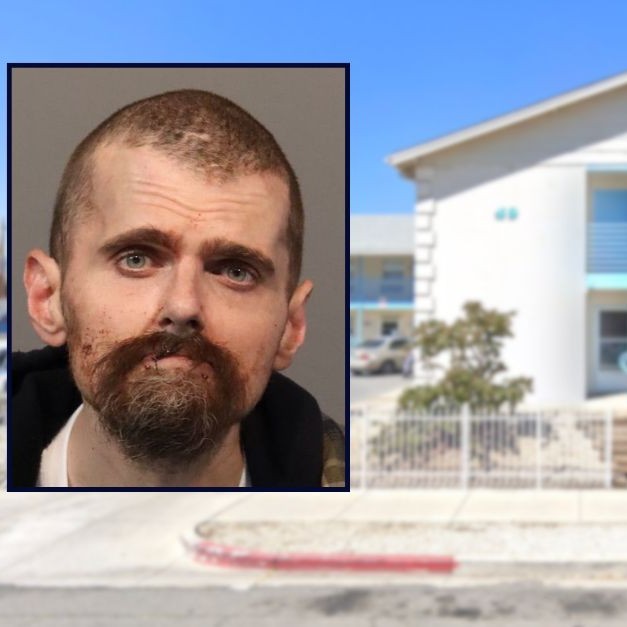
TLDR
Washoe County prosecutors say 44-year-old Jack Willhoit called 911 from a Reno motel, claimed his wife overdosed, then admitted to assaulting her. He has now pleaded guilty to first-degree murder and received life in prison without the possibility of parole.
According to a press release from the Washoe County District Attorney’s Office, 44-year-old Jack Willhoit pleaded guilty to one count of first-degree murder in the killing of his wife, 49-year-old Evelyn Willhoit. A Washoe County judge sentenced him to life in prison without the possibility of parole, the harshest penalty available short of a death sentence under Nevada law.
The killing occurred on May 21st, 2024, inside a room at the Parkway Lodge, a small motel on Park Street in Reno. Police say they were dispatched around 9:30 p.m. after a 911 caller reported that a woman was hurt. Responding officers found Evelyn on the floor with extensive injuries. She was pronounced dead at the scene despite attempted medical aid.
From Overdose Claim to Murder Conviction
In the minutes after the attack, it was Willhoit himself who called 911. Prosecutors say he initially reported that his wife was overdosing on narcotics and might already be dead. That early version of events, recorded in dispatch logs, framed the incident as a possible medical emergency rather than a violent assault.
Investigators quickly found evidence that contradicted that account. Prosecutors say Evelyn had multiple cuts and bruises across her face, as well as a large wound on the left side of her neck surrounded by several smaller cuts. Reno officers also noted what appeared to be burn marks on her chest and left arm. Those findings were later detailed in a probable cause affidavit obtained by Reno station KOLO.
In the DA’s public statement, officials wrote that detectives documented injuries to Willhoit’s own hands. “Detectives in the case noticed that the defendant had swelling on his knuckles, as well as small cuts and scratches on his hands and forearms,” the release said. An autopsy, according to that same statement, concluded that Evelyn died from multiple blunt and sharp force injuries due to physical assault.
The combination of extensive trauma to the victim and visible injuries on the defendant led authorities to treat the case as a homicide, not an overdose. The overdose narrative, prominent in the initial 911 call, does not appear to be supported by the later medical findings described by prosecutors.
Implements in the Motel Room
Investigators have said that several objects inside the motel room appeared to have been used during the assault. According to the DA’s press release and local reporting, officers found blood on household appliances, a handheld torch, a knife, a screwdriver, and Evelyn’s own walking cane.
Those items, scattered within the small motel room, form a key part of the evidentiary picture. Forensic testing can link blood patterns on objects to particular blows, document the direction of force, and help reconstruct the movements of the victim and the assailant. While the full forensic reports have not been released publicly, the DA’s summary indicates that multiple instruments were involved, consistent with the autopsy finding of both blunt and sharp force injuries.
Law enforcement accounts also describe blood staining and spatter throughout the room, including on the walls and the lid of a trash can. That description suggests an extended, close-range assault rather than a single, sudden injury. In court, those details would weigh heavily in sentencing, particularly in a case resolved by plea rather than trial.
Shifting Statements and Claimed Self-Defense
Even as physical evidence accumulated, investigators say Willhoit’s own statements evolved. During an initial interview, he reportedly recounted filling a prescription at Walgreens, buying a bottle of rum at a nearby liquor store, and returning to the motel. According to charging documents summarized by Reno station KTVN, he told police that his wife took most of the pills and drank most of the alcohol, while he had only two shots.
At one point, he claimed that Evelyn began, in his words, “acting crazy and hitting him” on the head with the liquor bottle. That version of events implies some form of self-defense or mutual struggle, a narrative sometimes raised in domestic homicide cases. Investigators, however, had to compare those statements against the physical evidence, the victim’s injuries, and the scene inside the room.
Prosecutors say that for a time, Willhoit insisted that he loved his wife and had not touched her that evening. Over the course of interviews, though, he eventually admitted to punching her. The DA’s office has not publicly detailed the full sequence of his admissions, or how closely they matched the injuries the medical examiner found, but the end result was a guilty plea to first-degree murder rather than a contested trial centered on self-defense claims.
Mental Health, Substance Use, and the Record
According to investigators’ summaries, Willhoit told police that both he and Evelyn had been diagnosed with bipolar disorder and schizoaffective disorder and that they relied on prescription medication. He also described the couple consuming rum and prescription pills before the violence.
The available public documents do not indicate that mental health issues led to a legal finding of incompetence or insanity in this case. There is no indication in the DA’s public statement that defense attorneys pursued an insanity defense, nor is there any mention of a court-ordered psychiatric evaluation affecting the plea. Instead, the case resolved with a straightforward guilty plea to first-degree murder.
In Nevada, a plea to first-degree murder exposes a defendant to a range of potential sentences, including life with or without the possibility of parole. Judges weigh aggravating and mitigating factors, such as the brutality of the crime, any prior criminal history, acceptance of responsibility, and the impact on surviving family members. The decision to impose life without parole signals that the court viewed the offense as falling at the most serious end of that spectrum.
Domestic Violence Behind Closed Doors
Cases like the Willhoit murder often surface only after a fatal incident, leaving little public documentation of what the relationship looked like before. The DA’s press release does not describe prior police calls involving the couple, nor does it indicate whether social service agencies had prior contact with them.
Domestic homicides frequently involve a mixture of underlying mental health concerns, substance use, and long-standing interpersonal conflict. While Willhoit told officers that his wife struck him, the autopsy findings and bloodied objects inside the motel room point to a one-sided, prolonged assault. With only two people in the room and one of them dead, the court had to rely on physical evidence and the defendant’s shifting statements rather than a surviving victim’s account.
In sentencing a defendant to life without parole, Nevada judges effectively decide that the individual will never safely return to the community. For the surviving relatives of Evelyn Willhoit, the conviction and sentence offer procedural closure, but the court record cannot fully reconstruct what happened minute by minute in that motel room or why an argument, however it began, escalated into lethal violence.
What Remains After the Plea
With the guilty plea entered and sentence pronounced, the criminal case against Jack Willhoit is, for now, resolved at the trial court level. He retains the right to pursue appeals or post-conviction petitions, but those would focus on legal issues rather than re-litigating every detail of the evidence.
The public filings and prosecutors’ statements establish certain facts: a 911 call framed as an overdose, a crime scene marked by extensive blood, a victim with severe blunt and sharp force injuries, and a defendant who moved from denial to admission before pleading guilty. What they cannot fully clarify is the precise moment when a night involving alcohol and prescription pills turned into a fatal beating, or whether any earlier intervention could have prevented the outcome.